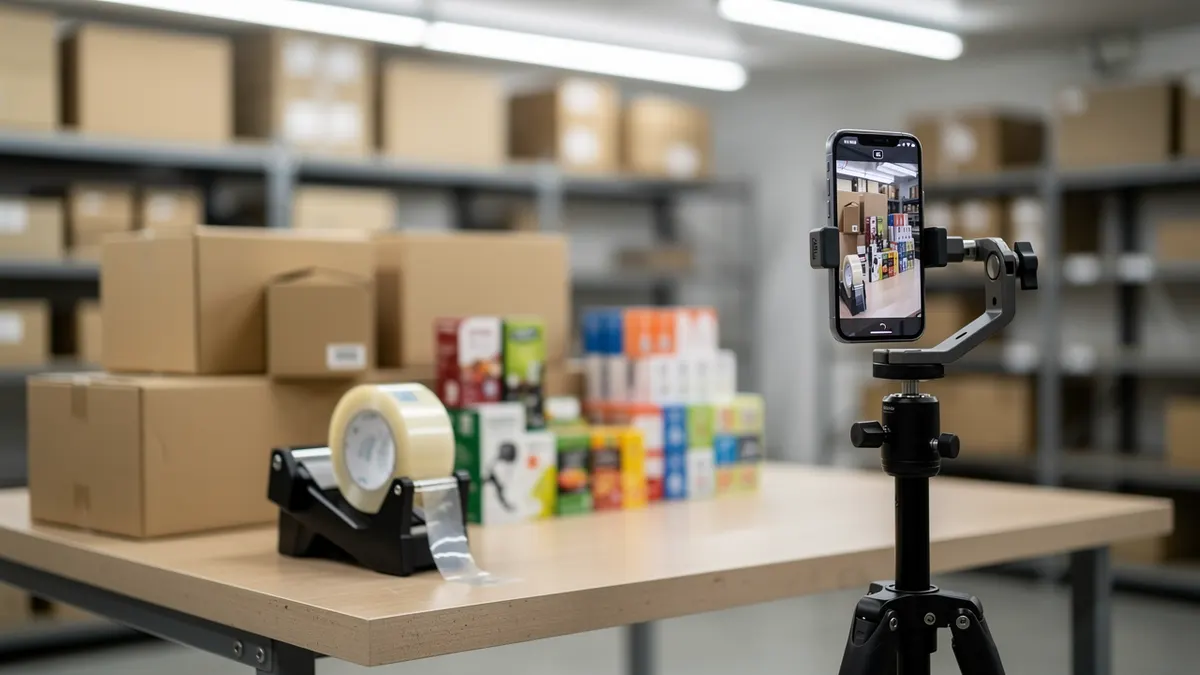
A port, online retail warehouses, regional producers and a capital an hour away: an underrated base for a creator who works.
The client base
Six client categories.
Warehouses and online retail hubs.
Transport and logistics companies.
Food producers and processors.
Port and industrial companies.
Town-centre retail.
And training bodies.
What logistics orders
Six frequent formats.
A recruitment video.
Workplace safety content.
A warehouse tour.
A capability presentation.
Internal training.
And communication toward an industrial client.
What to settle before entering a site
Seven points.
The traffic plan for the machines.
The protective equipment required.
The areas closed to access.
The designated escort.
Written consent from the people filmed.
The confidential processes not to show.
And approval before release.
Regional food
Six regular clients.
Producers and cooperatives.
Processors and cheese makers.
Breweries and cider houses.
Regional distributors.
Grocers and markets.
And restaurants sourcing locally.
What a warehouse shoot needs on the day
Seven practical points.
A meeting point agreed the day before.
A high-visibility vest for every person filming.
A route walked once before rolling.
A quiet corner for the interviews.
A power source identified in advance.
Short takes, so the aisle frees up.
And gear that never sits on the floor.
The capital factor
Six practical consequences.
Budgets reachable within an hour's drive.
Lower production costs here.
Stronger competition on the big contracts.
Travel to be invoiced separately.
An interest in specialising.
And clients who come here to film for the setting.
What to film to get hired
Six examples that close deals.
A clear, readable warehouse tour.
An employee interview with clean sound.
A demonstration of a technical gesture.
A faithful food product sheet.
Short content for social media.
And an honest recruitment video.
How to build a price here
Six lines to show.
Preparation and location scouting.
The half-day or day of shooting.
The waiting time for site access.
The number of revisions included.
The rights line, with duration and territory.
And the travel rate beyond a set zone.
What a riverside site plans differently
Six conditions that shape the day.
Access to the site has to be declared in advance.
Working hours follow the loading schedule.
Wind makes the sound difficult.
A safety vest is compulsory.
Certain areas stay off limits.
And the images are checked before release.
What a river and heritage city orders
| The buyer | Their typical order | Their constraint |
|---|---|---|
| A business in the old centre | The window and the product | Busy pedestrian streets |
| An industrial company | The supervised visit | Site accreditation |
| A regional producer | The gesture and the origin | The production season |
What the old centre imposes on a shoot
Little room to step back and a lot of foot traffic. A wider lens and an early-morning slot deliver in thirty minutes what a midday session does not in two hours.
What to prepare with a producer
The vocabulary of the designation and what is protected. A mention of terroir or method is reproduced exactly as supplied, and confirmed by the producer before publication.
What the platform brings
On UGC MATCH, joining is free and there is no subscription: you declare your languages, you are visible by category and country, and the order keeps a record of the brief and the delivery. The brand pays at ordering, the funds are not released straight away, and payment goes out on approval. The platform retains 10% of the price on the creator side, who therefore keeps 90%, and charges the brand a 6% service fee, with a minimum of 1.50 EUR.
One last marker: here, what gets you called back is not your image, it is having got in nobody's way during the shoot.
Sources
- Urssaf, official auto-entrepreneur portal
- Service Public, how to become a micro-entrepreneur
- Service Public, crossing the micro-entrepreneur turnover thresholds
Checked on 26 August 2026. Thresholds and rates change: where this guide and the official source disagree, the official source is right.