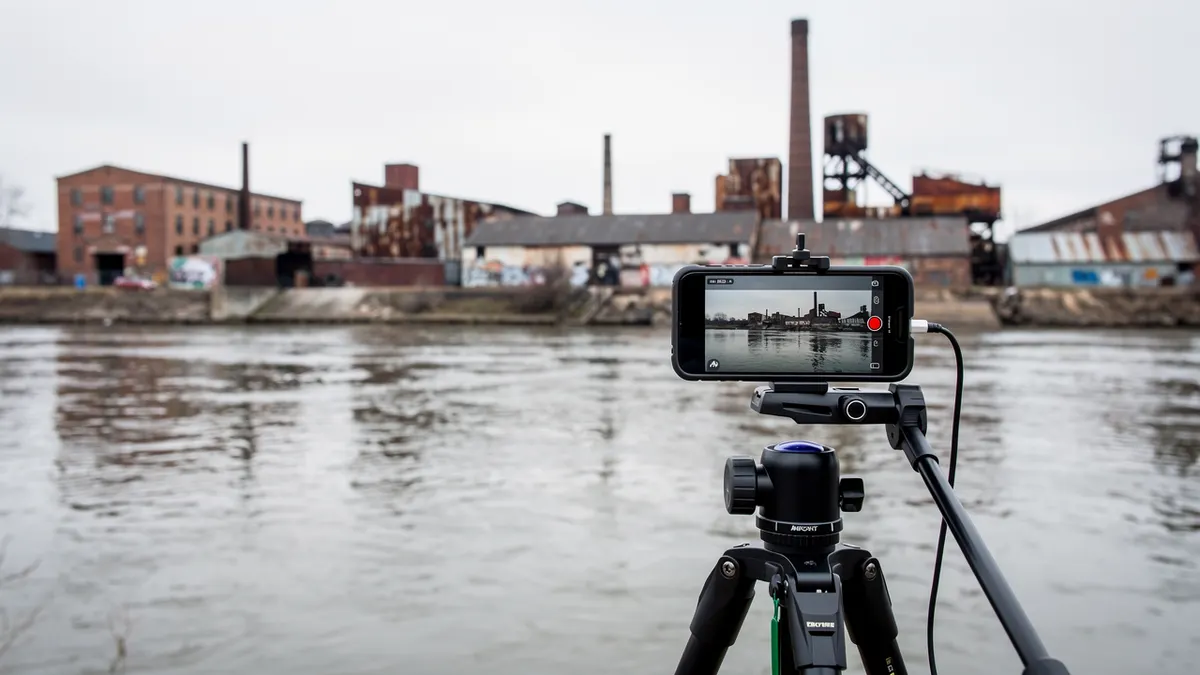
Halfway between two big cities, with industry, a river economy and a market small enough that simply being present is the whole advantage.
The local industrial fabric
Six sectors present.
Wood and paper processing.
Metalwork and machining.
Food processing.
River and road logistics.
Business services.
And health and education.
What those employers order
Six frequent formats.
A recruitment video.
A trade presentation.
Workplace safety content.
A factory tour.
A video for a trade fair.
And an employee testimonial.
The river and regional tourism
Six possible clients.
Accommodation and inns.
Restaurants with a view.
Museums and heritage sites.
Summer festivals.
Water activities.
And tourist offices.
When to approach them
Six calendar markers.
February and March, for the following summer.
April, for spring campaigns.
June, for festivals.
September, for autumn colours.
November, for the holidays.
And January, for new offers.
An hour from two markets
Six arguments to state.
A short trip to two big cities.
Lower production costs.
Weekday availability.
The ability to shoot early.
Two examples filmed outside your town.
And a clear travel rate.
How to reassure a first-time buyer
Seven moves that close.
Show an example from a comparable business.
Write down what will be delivered, format by format.
Announce a date, then deliver before it.
Offer a first version for approval.
Explain the rights in two sentences.
Give a firm price, not a range.
And answer within the day.
Recurrence rather than volume
In a market this size you will not find fifty new clients a year. You can, however, turn twelve clients into informal subscribers: one order a quarter, a stable rate, a predictable contact. That is what makes income regular here, not permanent hunting.
How to build that recurrence
Six habits.
Offer a quarterly rhythm from the second order.
Keep a stable rate for regular clients.
Follow up before each season.
Deliver a short version as a bonus.
Keep an up-to-date contact list.
And ask for a review after each order.
What is ordered between two metropolises
| The buyer | Their typical order | What they compare |
|---|---|---|
| A local business | Venue videos | Availability |
| A regional company | Product videos | The rate |
| A big-city brand | A batch delivered remotely | The deadline |
What an intermediate position allows
Two markets reachable within the day and no urban studio overheads. That combination is a concrete pricing argument, provided the travel time is stated in the profile.
What is built alongside the local work
A remote order book. The local part and the remote part do not share the same seasonal dips, and that balance is what makes income regular across the year.
What the platform brings
On UGC MATCH, joining is free and there is no subscription: you are visible by category, language and country, and the order keeps a record of the brief and the delivery. The brand pays at ordering, the funds are not released straight away, and payment goes out on approval. The platform retains 10% of the price on the creator side, who therefore keeps 90%, and charges the brand a 6% service fee, with a minimum of 1.50 EUR.
One last marker: here, your competitor is not another creator, it is the idea that video is a luxury. Answer that and the market opens.