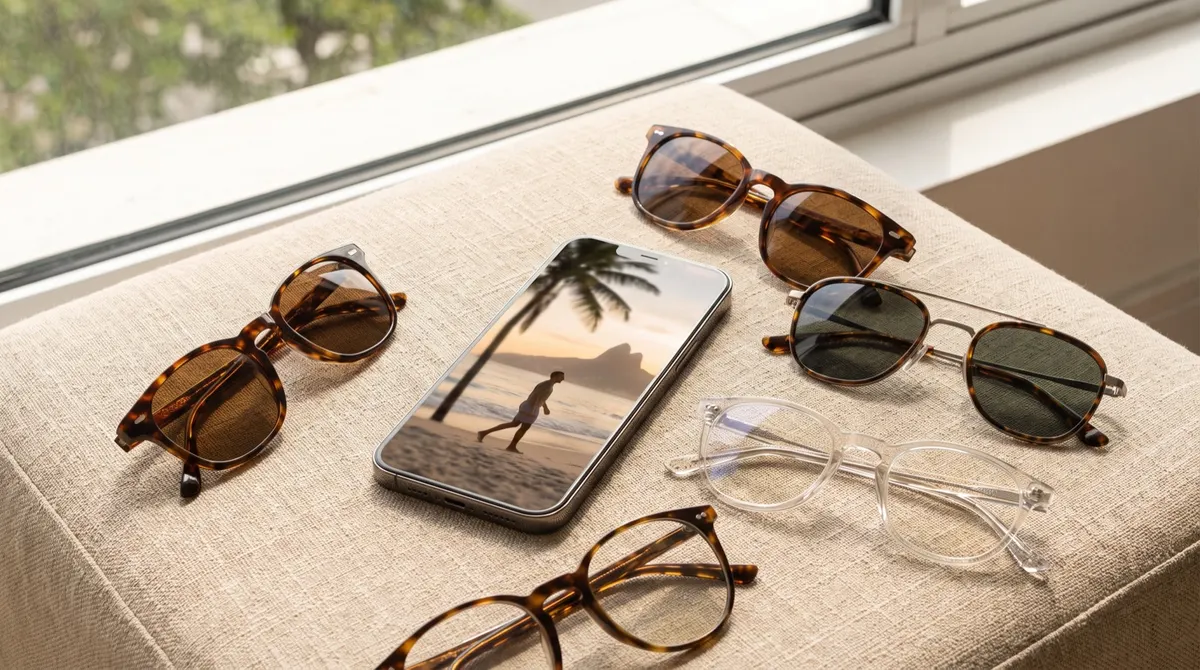
How eyewear brands in Brazil use UGC, the try-on and styling formats, and how creators deliver.
Why eyewear suits UGC so well in Brazil
Seven reasons specific to this category and this market.
The product is worn on the face, so no studio photo replaces a filmed try-on.
The country's light is strong, which makes sunglasses useful all year rather than seasonal.
The choice is made with others, by showing the frame to those around you, and the video circulates.
Faces are very diverse, and a single ambassador represents nothing.
Online buying is growing, but the fear of getting the size wrong remains the main barrier.
The average price justifies explanatory content, unlike an impulse purchase.
And an optical frame is chosen for years, which makes the buyer patient and attentive to detail.
The formats that convert for eyewear
Seven formats, from the most useful to the most decorative.
Trying on three frames on the same face, filmed with no cut between them.
Comparing two sizes of the same frame, a format nobody produces and which answers the real question.
Styling by occasion: work, beach, driving, evening.
A whole day in the same pair, which proves comfort better than any statement.
A sturdiness demonstration: folding, a light drop, cleaning, storing.
Moving from prescription to sun, or the reverse, for ranges that allow it.
And the unboxing, useful only if the case and accessories are part of the argument.
Showing fit and reflections properly
Seven shooting moves that separate a useful video from a pretty one.
Filming facing a window, but slightly offset, to avoid the white rectangle in the lenses.
Adding a three-quarter shot and a profile shot, dealt with above.
Showing the frame resting on a hand, to give the real scale.
Filming the moment the frame is put on, which reveals the bridge support.
Smiling once, because the cheeks push the frame up and change everything.
Showing the gesture of pushing the frame back up if it exists, rather than hiding it.
And ending on a static ten-second shot, motionless, where the viewer can really look.
Filming lenses without seeing yourself in them
Six solutions to the most common problem in eyewear shooting.
Standing at forty-five degrees to the light source, never facing it.
Switching off screens behind the camera, the prime cause of square reflections.
Wearing dark plain clothing, which reflects far less than a light pattern.
Lowering the chin slightly, which moves the reflection below the eye line.
Filming outdoors in the shade, the best free light for this category.
And checking every take on screen before continuing, because a reflection is never fixed in the edit.
Where the content runs and how the licence works
Seven uses, with what they imply on the rights side.
The brand's product page, often the first use requested.
Paid advertising, invoiced separately and limited in time.
The pages of retail opticians, which have to be explicitly included if they are intended.
Marketplaces, whose terms of use have to be compatible with your licence.
Shop windows and in-store screens, a use often forgotten in contracts.
The seasonal catalogue, which extends the exploitation period beyond the campaign.
And reposting by the brand on its own networks, to be distinguished from paid advertising.
What you cannot claim about glasses
Six precautions, to be validated with a lawyer and with the competent authority before the shoot.
Any claim of protection against radiation falls under its own regulation and is checked.
An effect on eye strain or sleep is a claim to have validated before saying it out loud.
An optical frame implies a prescribed correction, which is not the creator's business.
Mentions of a standard or certification are quoted as they are, never rephrased.
Medical vocabulary is to be avoided entirely, even by way of comparison.
And a promise about the product's lifespan commits the brand, not the creator saying it.
What an eyewear video must show
| Shot | What it solves | Technical detail |
|---|---|---|
| The face straight on | The width against the features | No lens distortion |
| The profile | The length of the arms | Side lighting |
| The frame close-up | Material and hinge | A hand for scale |
What is almost always missing
The match with the face shape. Simply saying what face shape you have and why this frame suits answers the question that blocks the most purchases.
What is never promised
A correction, visual comfort, protection against light or an effect on fatigue. Those belong to an eyecare professional, and a protection standard is confirmed with the manufacturer.
Building a lasting eyewear content channel
Seven steps for turning an assignment into a series.
Building a library of different faces, the real asset of an eyewear brand.
Refilming the same frame on three face shapes, which multiplies use with no new product.
Fixing a constant setting and framing, so the videos can be compared with each other.
Planning the return or buyout of the product, a systematic question in this category.
Documenting the exact reference on screen, because models look very much alike.
Renewing by season, keeping the videos that explain rather than those that decorate.
And keeping the unedited rushes, often reused by the brand a year later.
One last marker: in Brazil, an eyewear video honestly showing a badly fitting frame sells better than one where everything falls perfectly. The buyer is not looking for proof that the frame is beautiful, they are looking for proof that it will sit on their own face, and that proof always comes from the profile.