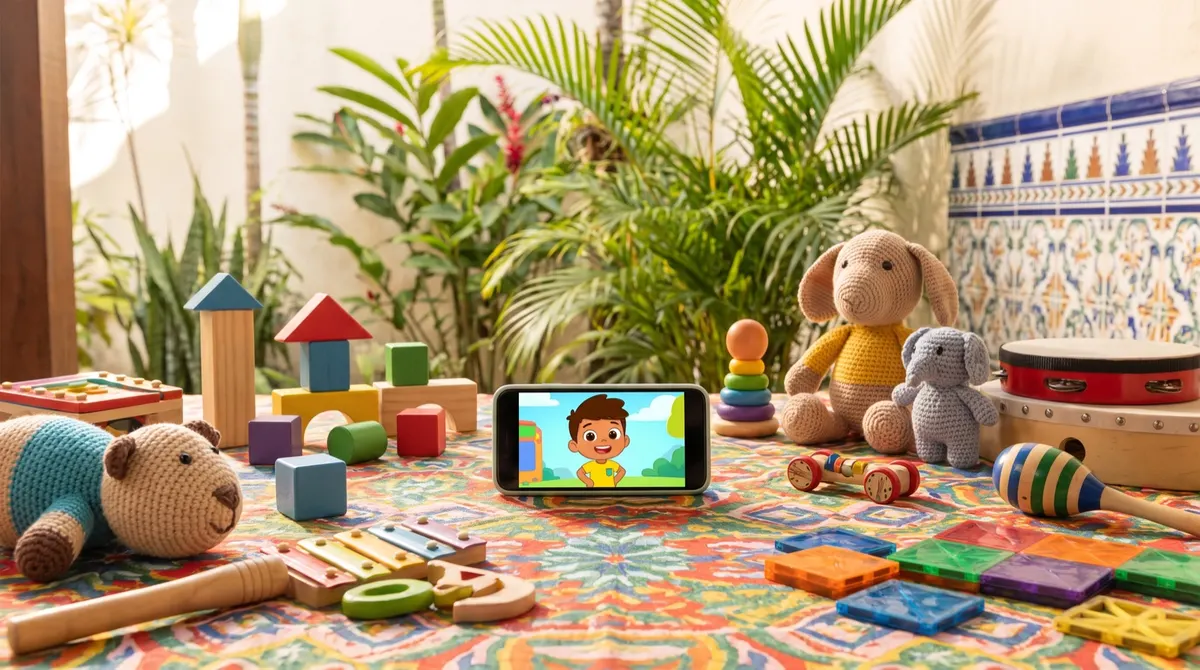
How toy and children's brands in Brazil use UGC, parents' trust and the formats that work.
Why UGC suits toy brands in Brazil
Seven reasons rooted in this market.
A toy is bought online but assessed through use, which only video shows.
Family budgets are watched, which makes proof of prolonged use decisive.
Siblings are common, and parents want to know whether the toy passes from one child to another.
Festivities and birthdays create predictable buying peaks.
Flats are often small, hence the importance of showing the space actually taken up.
Parents exchange a lot in private groups, where these videos circulate naturally.
And assembly, sturdiness and storage are concrete questions no photo addresses.
Parents' trust is the whole category
Seven elements that build that trust, or destroy it.
The age stated by the brand, quoted as it is, never adapted to the child being filmed.
The safety warnings, shown on screen rather than summarised.
Batteries, their type and whether they are in the box, a systematic question.
The real assembly time, timed, with no cut artificially shortening it.
The noise the toy makes, information parents actively look for.
Sturdiness after several days, including the pieces already lost.
And honesty about what displeased, the only thing that makes the rest believable.
A responsible framework: children are filmed by their own parents
Seven shooting rules, non-negotiable in this category.
The child is filmed by their parent, never by a third party, and the parent stays present.
The parent's consent is written, and the second parent is informed where custody is shared.
No identifying element appears: school uniform, name on a bag, street sign, recognisable facade.
The full first name and exact age are not given.
The child can be filmed from behind, in profile or only their hands, which is enough in most formats.
The child can stop the shoot at any moment, and that has to be respected without discussion.
And the parent keeps the right to withdraw the video, which has to appear in the licence contract.
What advertising aimed at children does not allow
Six points to validate with a lawyer and with the competent authority before the shoot.
The framework for advertising aimed at children is strict in Brazil and is checked case by case.
A video does not address the child directly to ask them to buy or to have someone buy.
Urgency and scarcity vocabulary is to be avoided entirely in this category.
Educational or developmental claims have to be supplied by the brand and validated.
Safety and compliance mentions are quoted word for word, never rephrased.
And content aimed at parents is clearly distinguished, in tone as in editing, from content that would speak to children.
The formats that really convert
Seven formats, from the most useful to the most decorative.
The next-day return, dealt with above, and the most effective of all.
The timed assembly, from box to ready toy, with no cut.
The storage demonstration, which answers the space objection.
The sturdiness test after a week, with the real marks.
Sharing between two children of different ages, much watched by families.
The comparison with a toy already owned, which places the product without disparaging.
And the gift format, filmed for festive periods, where the question is price against duration of use.
Where it runs and how the licence works
Six uses, with their effect on the contract.
The product page, the first use requested in this category.
Paid advertising, to be framed with particular attention to targeting, which is checked with the competent authority.
The pages of retailers and supermarkets, to be included explicitly if they are intended.
Marketplaces, where video strongly reduces returns.
Customer service, which often uses the assembly video as a manual.
And the licence period, which has to be time-limited, particularly when a child is visible.
What is filmed, and how
| Subject | The right way | What is ruled out |
|---|---|---|
| The toy in action | Hands, object, movement | The child's face in close-up |
| Assembly or set-up | The real time to get going | A recognisable interior |
| Storing it | The size once put away | Any identifying detail |
What protects the filmed child
Written consent from both parents, framing with no face or recognisable place, and no first name, exact age or neighbourhood clue. When in doubt, film only the hands.
What is never said without a document
A recommended age, a safety standard, a material composition or an educational claim. Each is read on the packaging and confirmed with the manufacturer and the competent authority.
Building a collaboration that lasts
Six steps for turning one shipment into a regular relationship.
Offering a seven-day follow-up from the first assignment, which few creators do.
Systematically filming the assembly, even when it is not requested.
Keeping a neutral, constant setting, reusable from one brand to another.
Documenting age by bracket rather than by exact figure, protecting the child while still informing.
Delivering a faceless version in addition to the main one, much appreciated by cautious brands.
And refusing briefs that ask the child to recite a script, which shows immediately and damages parents' trust.
One last marker: in Brazil a toy brand does not buy a pretty video, it buys the proof that a child kept playing after the novelty. That proof cannot be produced on demand, it is filmed by keeping the phone within reach the next day, when nobody expects it.