Fashion buys more UGC than any other category, and wastes more of it too. The cause fits in one sentence: plenty of brands order pretty videos when what triggers the purchase is information.
In Argentina a second cause is added, and it is purely a matter of the calendar.
The calendar that shifts everything
A brand running its content planning from Europe or North America is six months out if it applies its schedule unchanged.
There, the summer collection is promoted while the northern hemisphere is putting coats away: the campaign is prepared in October and November. The winter one is worked on in April and May, exactly when European brands launch their swimwear.
On top of that shift come commercial peaks that either do not exist elsewhere or fall on other dates. The Hot Sale in May concentrates a significant part of the year for many online shops. Mother's Day is celebrated in October, not in May. Christmas lands in high summer, which completely changes the wardrobe shown in end-of-year videos.
The practical rule: pieces are commissioned four to six weeks before each peak. A brief sent three weeks before the Hot Sale arrives too late to produce, revise and test.
What actually converts in clothing
The try-on in motion. The garment worn, on a real body, walking. By far the best performing format, and the one that needs the least production.
Honesty about sizing. One sentence giving the person's height and the size they are wearing, with a word on the fit, cuts returns and raises conversion at the same time. It is rare for a single line to do both.
Three ways to wear the same piece. It shows that a price spreads across several uses, which no quality argument achieves as quickly.
The fabric in close-up. How it falls, the stitching, whether it is see-through against the light. This is exactly what a product photo cannot show, so this is where video wins.
Expectation against reality. The look on the product page next to the look on the body. It feels risky and converts very well, because it answers the fear that blocks the purchase.
The bodies you show
This is the decision that weighs most on the result, and the one most brands avoid.
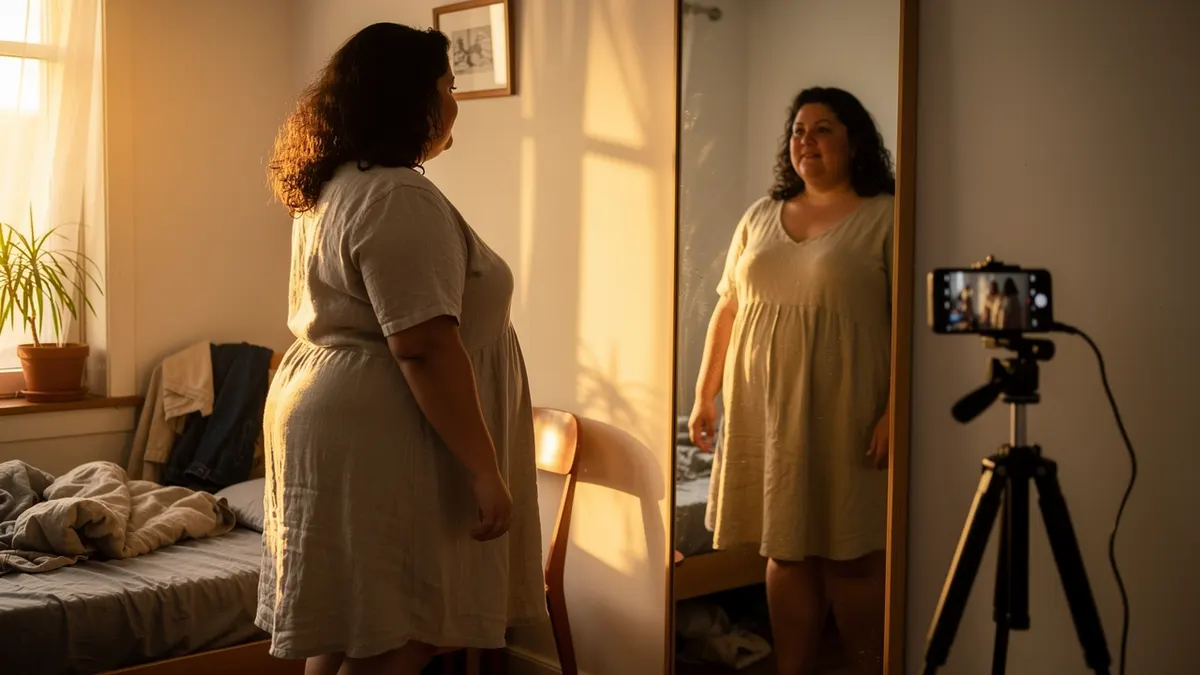
If the range runs from S to XXL, you need creators of at least three different sizes. A customer who never sees a body close to theirs concludes the garment is not for them, and no promise about the cut undoes that impression.
Look too for people who resemble your customers in age and setting, not only young silhouettes in very bright flats. An ordinary interior often sells better than a perfect set.
The brief that produces usable material
Give the person's measurements and the size they received, the setting the piece is worn in, three possible openings, and the list of details to show without discussion: the fastening, the lining, the real length, what happens when the arms go up.
And always ask for movement. A motionless garment says nothing. Walking, sitting down, climbing stairs, it says everything the customer wants to know.
What each take must show
| Take | What it proves | Length |
|---|---|---|
| Walking front then back | The cut and the length | 12 s |
| Sitting then standing | How the fabric behaves | 8 s |
| Close shot on the seam | The finishing | 6 s |
What is prepared before the fitting
Garment ironed, label tucked in, mirror cleaned, background cleared, light locked for the whole series.
What gets a delivery refused
A filter that changes the colour, a stated size that does not match, a frame that cuts the shoes.
How many pieces to order
For advertising, six different creators with three openings each is a minimum. In fashion the variety of bodies and styles moves the result more than image quality, and it is the line item not to save on.