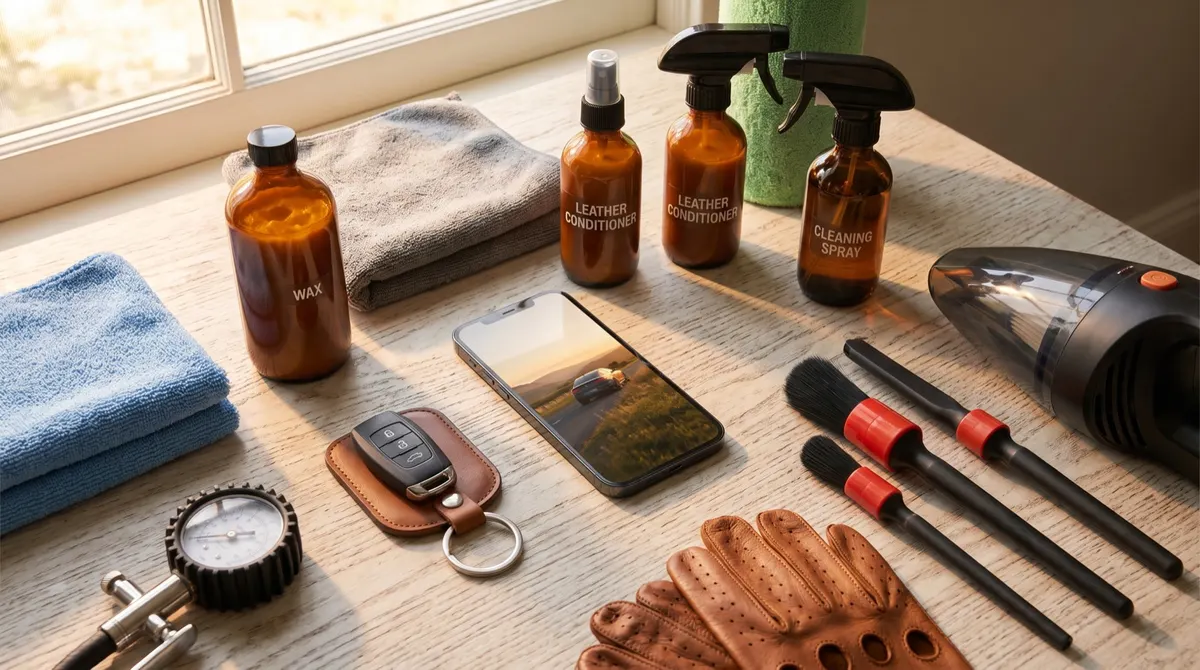
This format shines for car accessories and maintenance: fitting demonstrations, satisfying before and after, real use. Here are the videos that convert and how to find the creators.
Why this format works so well here
Because the purchase rests on two questions the product page does not answer: will it fit my car, and can I fit it myself. A video answers both in thirty seconds, with hands, a recognisable model and a real fitting time. It is also a category where the before and after is immediate and visually satisfying, which makes it naturally suited to the short format.
Which formats convert best
Seven formats, from the most effective to the most situational.
The fitting in real time, timed.
The before and after of a cleaning product, same framing.
The durability test after several days, dealt with above.
The comparison between the accessory and the improvised solution.
The unboxing with a compatibility check.
Use while driving, filmed on a fixed camera and stationary for any handling.
And the answer to a specific objection, often the mounting or the compatibility.
How to film well in and around a car
The light
A car interior is a trap: reflecting windows, harsh contrasts, a useless dome light. Film early in the morning or in overcast weather, with a door open, and avoid full sun which burns out light surfaces.
The angles
Three angles cover almost everything: over the shoulder for handling, at dashboard height for the result, and outside with the door open to place the scene. Do not move the camera during a fitting.
The sound
It is the category's weak point. A cabin echoes, an engine hums, a street goes by. Record the voice stationary, engine off, and keep mechanical sounds as separate shots.
How to brief a creator for this kind of product
Seven mentions to write down.
The model and year of vehicle required, or the absence of any requirement.
The exact compatibility to check before shooting.
The expected fitting time, timed.
The tools needed, shown on the table.
The safety rules, non-negotiable.
The second shoot, a week later.
And the permitted claims, approved by the brand.
What must never be shown
Six situations that make a video unusable.
Handling carried out while driving.
A phone held in the hand at the wheel.
A readable number plate.
A fitting that would breach the applicable rules.
An installation without the protections specified by the manufacturer.
And an unverified promise of universal compatibility.
What a video costs in this category
Seven budget markers, to adjust for the vehicle.
A simple fitting demonstration, short format.
A cleaning before and after, on a fixed shot.
A video with a second shoot included, a week later.
A shoot on a specific vehicle requested by the brand.
A batch of three products filmed the same day, cheaper per unit.
A vertical and horizontal version of the same shoot.
And advertising rights, always invoiced separately.
The minimum kit for filming a car
Six items, nothing more.
A recent phone, braced against a door.
A small tripod, essential for two-handed fitting.
A clip-on microphone, the voice alone justifies buying one.
A cloth, for fingerprints on black surfaces.
A small lamp, only for the interior.
And a light towel, to set parts down without scratching them.
The briefing mistakes that come back most often
Six omissions seen campaign after campaign.
Not specifying which vehicle model is accepted.
Forgetting to say whether the engine must be off.
Letting the creator choose the product claims.
Asking for a result without showing the gesture.
Not planning a cutaway on the product alone.
And delivering the product without the fitting instructions.
What separates two creators
Five signs to look at before choosing.
How clean the vehicle is in their past videos.
How stable the image is during handling.
How clear the voice is indoors.
Whether announced deadlines are met.
And the willingness to reshoot without argument.
How to reuse a video beyond advertising
Six uses that extend the value of one shoot.
The site's product page, as a short loop.
Marketplaces that accept video.
After-sales support, in answer to fitting questions.
Resellers and partner workshops.
The sales catalogue sent to distributors.
And internal training for sales teams.
What usage rights to provide for
Six elements to write into the quote.
Paid advertising, invoiced separately.
Use in online sales listings.
A duration of at least twelve months.
The right to recrop and re-edit.
Use on marketplace product pages.
And the fate of the rushes, useful for recutting a demonstration.
How to check compatibility before the shoot
Six checks to have the creator make, in photos, before starting.
The model, year and trim of the vehicle.
A photo of the fitting spot, uncropped.
A measurement of the available space, with a ruler beside it.
Whether the original mounting points are there.
The condition of the surface, clean and dry.
And the brand's written confirmation before filming.
Where to find creators in this category
Six methods, from the most reliable to the slowest.
Looking among owners of the model concerned.
Going through brand clubs and communities.
Seeing who already publishes maintenance videos.
Contacting workshops and tuners.
Filtering a marketplace by category.
And calling back those whose results you already know.
What is filmed on a vehicle
| Shot | What it proves | The constraint |
|---|---|---|
| The exterior in motion | The real presence | A location closed to traffic |
| The interior at a standstill | Space and finish | Engine off |
| A gesture of use | The ergonomics | A hand, a detail, no cut |
What you never film yourself
Any shot from the driving position in motion. It is done with a dedicated operator on a closed site, never by the person at the wheel, whatever the length of the shot.
What is verified before stating a value
A consumption, a range, a power output, a standard feature or a safety rating. Each is read on the official documentation and confirmed with the manufacturer.
What a good first campaign looks like
Six decisions for a first attempt.
Three different products, not three videos of the same one.
Two creators with different vehicles.
A fitting filmed in real time for each product.
A second shoot planned and paid for in advance.
A test release on a small audience.
And a measurement of the product return rate, decisive in this category.
One last marker: here, the video that sells is not the one showing the new product, it is the one showing it still in place a week later.