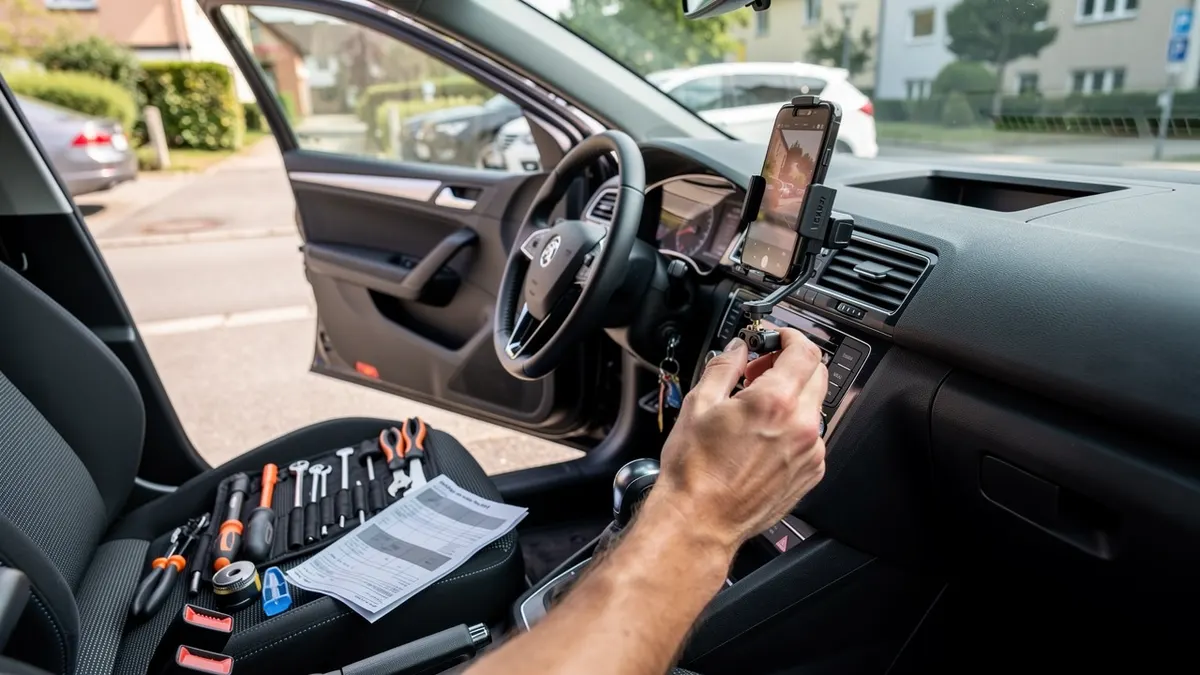
The category where type-approval documents decide the sale, and why one technical error ruins the campaign.
What is missing is everyday life
Three videos the audience looks for and nobody produces.
The boot really loaded: the week's shopping, the pushchair, the dog, four people's luggage.
Parking in a narrow city space, with the manoeuvres and the camera views.
And winter: starting, de-icing, range dropping, cold seats.
One production rule: film over a full week, not over an afternoon. What convinces in this category is repetition, not the beautiful image.
What accessories and parts require
Four points, without which the video is useless.
The exact compatibility: model, year, engine, trim level. A list, on screen, not a vague sentence.
The real fitting: the tools needed, the time, and what requires a professional.
The effect on the vehicle's warranty, stated clearly.
And behaviour over time: noise, play, corrosion after a winter.
Two absolute prohibitions: promising a quantified performance gain with no documented measurement, and showing a fitting that does not follow the manufacturer's instructions.
The German relationship with duration
That is the cultural trait commanding everything else.
The purchase is thought over ten years, not three. The question is not whether it is beautiful, it is whether it lasts and whether it can be repaired.
Three arguments that carry.
The availability of spare parts, and their price.
Servicing: intervals, average cost, what can be done yourself.
And resale value, with what preserves or destroys it.
Who to film
Three profiles, and none of them is a car influencer.
The person using the vehicle every day for the same thing: commuting, worksite, family.
The mechanic, for the technical part, in their own words.
And the second-hand buyer, talking about the model after a hundred thousand kilometres. It is the rarest and most watched testimony.
The calendar
Two seasons command the year.
The tyre change, twice a year, which triggers massive searching.
And the spring, when servicing, cleaning and accessories start again.
One simple rule: seasonal content must be online three weeks before the peak, and stay available the following year, because those searches come back identically.
What is filmed on a vehicle
| Shot | What it proves | Constraint |
|---|---|---|
| The exterior in motion | The lines and the stability | Two people, safety first |
| The cabin at a standstill | Materials and space | Difficult light |
| The loaded boot | The real volume | A reference object |
What is prepared before filming
A clean vehicle, a masked plate, a private or authorised location, and a driver who is not the person filming. No shot justifies taking a risk.
What is never claimed without a document
A consumption figure, a range, a power output, an emission value or a delivery time. Those come from the official specification, to be confirmed with the manufacturer.
What to ask of the creator
Four points before signing.
That they modify nothing on the vehicle without written agreement.
That they film plates blurred or out of frame, and show no personal document.
That they respect the road rules in every shot: a filmed manoeuvre breaking a rule makes the video unusable, however interesting it is.
And that they keep the rushes of the fitting, which serve as proof in case of dispute.
One last obligation: the advertising disclosure is still owed as soon as there is consideration, and technical claims, comparisons and mandatory statements are checked with a lawyer before publication.