In this market the promise counts for less than the sensation. What the audience wants to know is what the product does on ordinary skin, at an ordinary moment.
What the video has to show
Four sequences, in this order of usefulness.
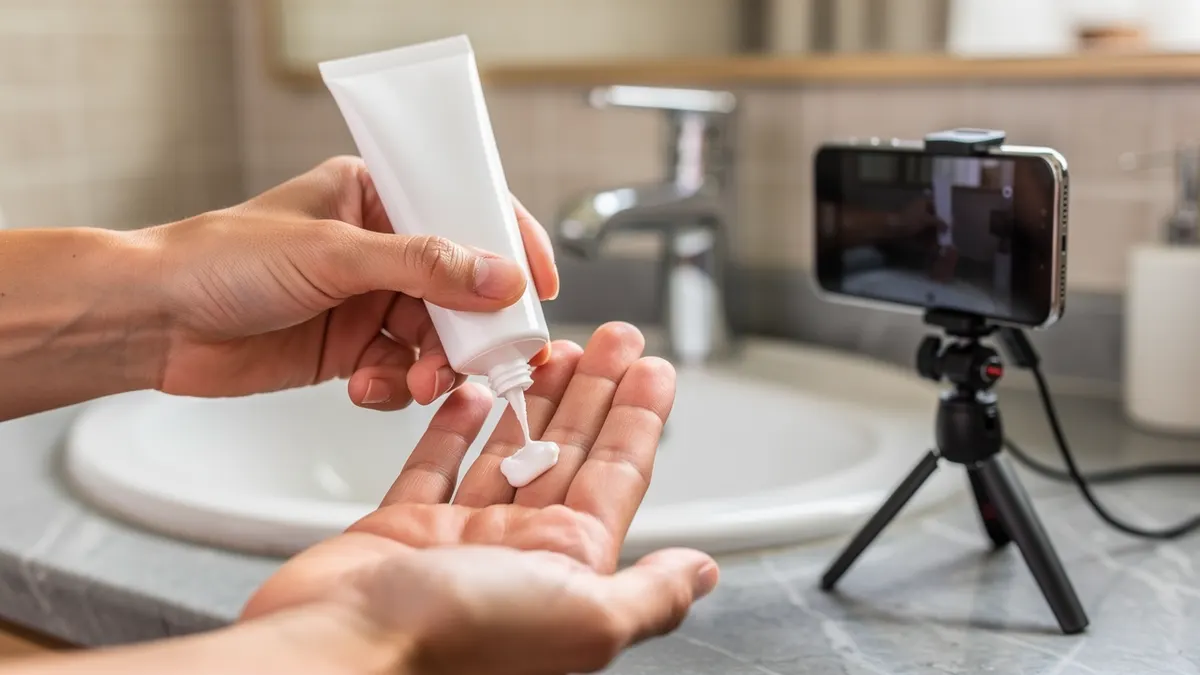
The texture in extreme close-up, without music: how it spreads, whether it is sticky, whether it shines, how long it takes to sink in. That is the question no photograph settles.
The real quantity, shown on the finger and on the skin, with how long the container lasts at that rate.
The full routine in the real order, with what the product replaces: a bathroom is already full.
And the objection said out loud: the price, the feel, the previous disappointment.
What may not be claimed
This is the part where improvising costs most.
What may be said about a cosmetic product in terms of effect, composition, tolerance, comparison or environmental claim is regulated and depends on the product and the market. The permitted wording comes from the brand's approved documentation, word for word, and the creator never rewords it.
Those points are checked with the competent authority and with a lawyer before the shoot. And the same rule applies to the picture: a shot filmed as proof promises as much as a sentence.
Why before and after works less well than people think
Three reasons, and they add up in this market.
The audience here is particularly practised at spotting what changed apart from the product: the light, the angle, the hour, the make-up. As soon as one of those moves, the comparison proves nothing.
The sequence is also the most closely watched from a regulatory point of view, because it suggests a result without saying it.
And it ages badly: it cannot be rerun two years later without somebody asking whether the result held.
Texture, on the other hand, poses none of those three problems and convinces more.
What to buy for a test
A minimum set, from a single shoot.
The texture on its own, the full routine, the objection handled, and four different openings to revive the advertising with no new session.
Add the source file with no burnt-in text and no music: that is what allows new versions to be made later without paying for another shoot.
What the light decides
| Source | Skin rendering | When to use it |
|---|---|---|
| Side window | Visible texture, soft shadows | Applying a skincare product |
| Front ring light | Smoothed skin, catchlight in the eye | Make-up, before and after |
| Ceiling light alone | Marked under-eye shadows | To avoid |
What is filmed in close-up
The texture as it leaves the bottle, the spread on the back of the hand, the absorption after thirty seconds.
What is not said on camera
A therapeutic effect, a duration of results or a comparison with a treatment, to be confirmed with a lawyer.
The detail that closes the sale
Availability, said in the video.
In this market a significant share of skincare purchases still goes through pharmacies and parapharmacies, and the viewer wants to know where to find the product before travelling. One sentence naming the distribution channel, with no price, prevents half the abandonments.
So also film a legible shelf shot, two seconds. It is the least spectacular sequence in the category and one of the most useful.