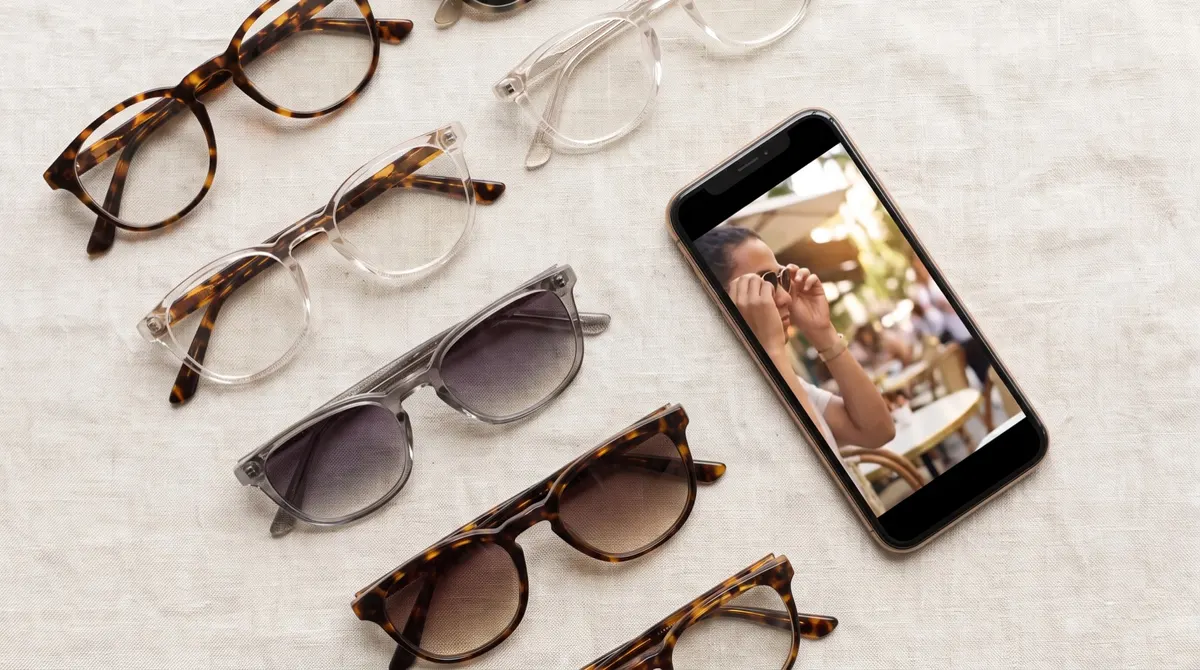
Eyewear sells on the try-on, the fit to the face and real light. The shots that convert, the brief, the rights and the casting.
Why this format works for eyewear
Because the purchase rests on a question the product page does not answer: will this shape suit a face like mine. No studio photo answers it, a video on a real face answers in three seconds.
The shots that sell a frame
Seven shots, to ask for in this order.
The face straight on, with no reflection.
The profile, for the temple length.
The three-quarter view, in daylight.
The putting-on gesture, in one take.
The close-up on the hinge or a detail.
The with and without, in the same frame.
And the outdoor shot, for sunglasses.
The formats that convert best
Seven formats, from the most common to the most specific.
The try-on across three frames.
The honest verdict after a week of wear.
The comparison with the previous pair.
The answer to a face-shape question.
The unboxing with a check on the case.
The cleaning routine.
And the one frame, three outfits format.
How to avoid reflections
Six simple settings.
Turn the face fifteen degrees away from the light.
Lower the chin slightly.
Move the ring light away or switch it off.
Film in front of a window rather than under a ceiling light.
Check the screen before every take.
And redo the take if a reflection appears.
What to send the creator
Seven items, with the parcel.
Two or three frames, in different sizes.
The case and the cloth.
The technical sheet with the dimensions.
The care instructions.
The list of points to show.
The official vocabulary for the shapes.
And the return address, if there is a return.
What to ask before shipping
Six useful pieces of information.
The approximate face width.
The usual prescription, if these are optical frames.
The style usually worn.
The planned filming location.
The light available.
And their real availability to film.
What to write in the brief
Seven blocks.
The frames and the collection concerned.
The main message, in one sentence.
The mandatory shots.
What must not be claimed.
The required vocabulary for shapes.
The format and the length.
And the usage rights, with their duration.
The claims to frame carefully
Six subjects to handle with care.
Protection from sunlight.
Filtering of screen light.
The resistance of the lenses.
Visual comfort.
Claims relating to correction.
And any numerical comparison with a competitor.
These subjects fall under precise rules that vary by country: the wording is checked with the brand and, in case of doubt, with the competent authority.
Why the diversity of faces matters here
Because a frame does not exist independently of the face wearing it. The same shape behaves differently depending on face width, nose height or the distance between the eyes. Three different faces teach a brand more than three angles of the same face.
How to cast varied face shapes
Seven reflexes.
Write down the range of widths you are looking for.
Order the same frame from three creators.
Do not confine one shape to a single face type.
Filter by language and country.
Accept different ages in the same batch.
Provide frames in distinct sizes.
And pay the same rate for the same work.
The case of optical frames
Six extra precautions.
Film neutral lenses, with no prescription.
Avoid any promise about vision.
Show the fit rather than the performance.
Do not suggest a diagnosis.
Refer to an eye care professional for correction.
And stay factual about the materials.
The case of sunglasses
Six specifics.
Film outdoors, in real light.
Show how they behave against the light.
Avoid full midday sun.
Show the case and how they are stored.
Film the gesture of pushing them onto the forehead.
And show the real tint, with no filter.
What lowers returns
Six things to show explicitly.
The total width of the frame.
The length of the temples.
The perceived weight.
The shape on a comparable face.
The real tint of the lenses.
And whether there are nose pads.
Filming mistakes specific to this category
Seven reflexes to correct.
Filming under a ceiling light.
Using a ring light head on.
Framing too tight to see the profile.
Filming against a glaring white background.
Adding a filter that changes the tint.
Forgetting to show the face without glasses just before.
And cutting between the gesture and the result.
The usage rights to write into the quote
Seven points.
The licence duration.
The territories.
Advertising use.
Use on the product page.
Use in store, screens included.
The right to crop and to subtitle.
And the price of a renewal.
An eyewear brand's calendar
Six periods that shape the year.
Spring, before the sunglasses season.
Summer, in full use.
The September return.
The end-of-year holidays.
The winter sales.
And collection launches.
What to plan for an outdoor shoot
Six preparations.
Choose an hour outside the midday sun.
Scout a wall or foliage as a background.
Bring a cloth for fingerprints.
Take the case to protect between takes.
Check the wind, which ruffles hair and spoils sound.
And have an indoor fallback.
How to measure
Six indicators, in this order.
Three-second retention.
The click rate to the product page.
The add-to-basket rate.
The acquisition cost.
The product return rate.
And the creative's lifespan.
The questions to ask the creator before ordering
Seven questions, in one message.
Where do you film, indoors or outdoors.
What light do you have available.
Do you usually wear glasses.
Can you film a sharp profile.
What is your approximate face width.
What turnaround do you announce.
And in which language do you speak to camera.
What to check before approving
Seven checks, before paying.
No reflection hides the eyes.
The profile is visible and sharp.
The lens tint is faithful.
The frame is shown close up.
No forbidden claim is spoken.
The requested formats are delivered.
And the length respects the brief.
What to ask for beyond the file
Six useful items.
A vertical version and a square version.
A version with no burned-in text.
The profile shot on its own.
A still frame extracted, for the product page.
The list of frames filmed.
And the written reminder of the rights granted.
Where to find the right creators
Six selection criteria.
A face filmed with no reflection in the examples.
A setting with natural light.
An ability to film outdoors.
A descriptive, unexaggerated tone.
Your market's language.
And examples in a fashion or accessory category.
What an eyewear video must show
| Shot | What it solves | The technical detail |
|---|---|---|
| The face straight on | The width against the features | No lens distortion |
| The profile | The length of the arms | Side lighting |
| The frame close-up | Material and hinge | A hand for scale |
What is almost always missing
The match with the face shape. Simply saying what face shape you have and why this frame suits answers the question that blocks the most online purchases.
What is never promised
A correction, visual comfort, protection against light or an effect on fatigue. Those belong to an eyecare professional, and a standard is confirmed with the manufacturer.
What the platform brings
On UGC MATCH, joining is free and there is no subscription: you filter by category, language and country, and the order keeps a record of the brief and the delivery. The brand pays at ordering, the funds are not released straight away, and payment goes out on approval. The platform retains 10% of the price on the creator side, who therefore keeps 90%, and charges the brand a 6% service fee, with a minimum of 1.50 EUR.
One last marker: in this category the most useful video is not the most stylish one, it is the one where you clearly see the eyes behind the lenses.