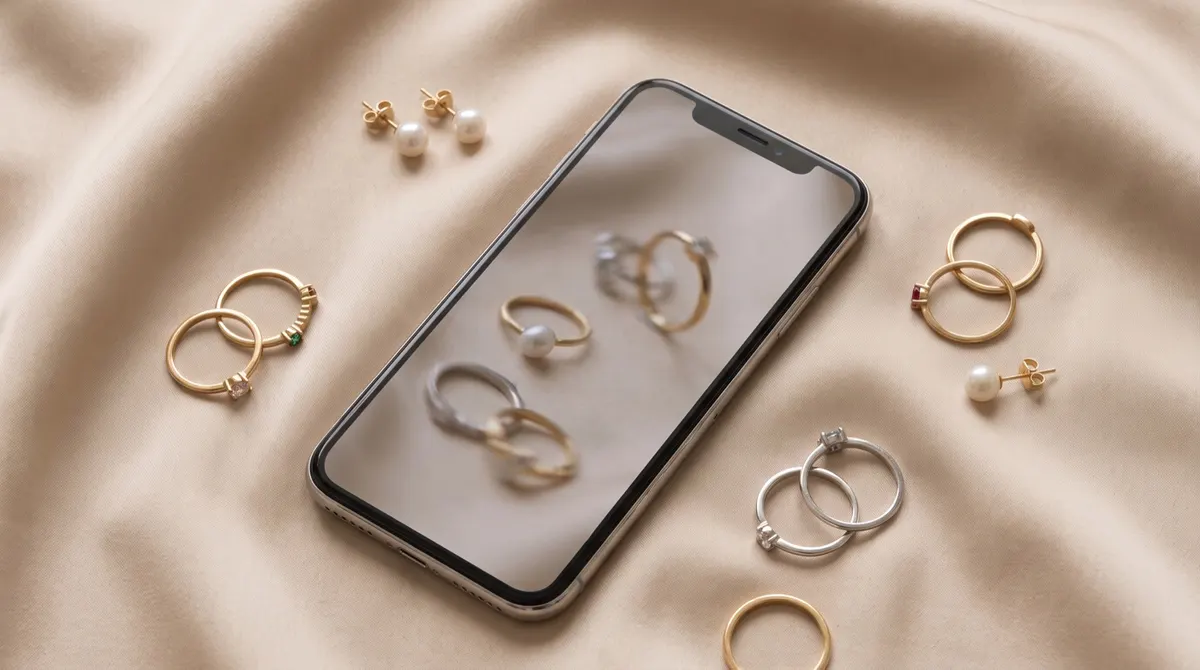
Jewellery sells worn, catching real light. Here are the videos that convert, how to film small shiny objects, the brief and the sourcing.
Why this format works so well for jewellery
Because the purchase stalls on three unknowns a studio photo does not resolve: the real size on an ordinary wrist, the sparkle under domestic light, and how it looks with everything else being worn. A video shot in somebody's home answers all three in seconds, and does it without retouching.
What video shows that a photo does not
Six elements, all invisible in a still.
The sparkle in motion, which only exists on film.
The size on a real body, not on a model's hand.
How the chain or the clasp behaves.
The sound, discreet but present, of a bracelet.
The colour of the metal under window light.
And the way the piece sits once worn.
Which formats convert best
Seven formats, from the most effective to the most situational.
Worn, in an ordinary situation.
Layered with other pieces.
The unboxing, with the case and where it is kept.
The close-up on material and finish.
The gift, filmed from the giver's point of view.
The verdict after months of daily wear.
And the comparison between two sizes or two lengths.
Why jewellery is hard to film
Seven technical obstacles, all avoidable.
Autofocus, dealt with above.
Reflections, which turn a stone into a white patch.
Depth of field, very shallow up close.
Hand shake, amplified in macro.
Dust and fingerprints, invisible to the naked eye.
The contrast between light metal and light skin.
And the small size, which makes scale unreadable without a reference.
The light, without reflections
Six settings that change everything.
Film near a window, never in direct sun.
Put up a white cloth to soften the source.
Avoid ceiling lights, which create bright spots.
Turn the piece slowly, to find the angle with no reflection.
Switch off screens behind the camera.
And check how the metal renders before shooting, not after.
Hands, and what cannot be hidden
Six points to specify in the brief, without judgement.
Short, clean nails, whatever the style.
Moisturised skin, macro shows everything.
No other piece visible unless explicitly asked for.
A neutral sleeve, casting no colour.
A simple background, never a cluttered worktop.
And a slow movement, repeated several times.
How to brief a jewellery creator
Seven mentions to write down.
The exact materials, named as on the product page.
The scale references required, dealt with below.
The style direction, without imposing an outfit.
The obligation to show the clasp working.
The mandatory shots, macro and worn.
A reminder not to grade the metal's colour.
And the return logistics, if the piece has to come back.
The scale references to require
Six ways to make size readable.
The piece worn, wide shot then close shot.
The whole hand in frame, at least once.
An everyday object beside it, for comparison.
The measurement said out loud, if it is known.
The piece laid flat on a neutral surface.
And layered with an item the audience already knows.
Logistics, sending and returning
Seven points to settle before shipping.
The declared value, and the matching insurance.
The shipping method, with tracking.
The return deadline, in writing.
The condition on arrival, photographed by the creator.
Liability in case of loss, defined in advance.
A ban on lending the piece to anybody else.
And the expected cleaning before return, where applicable.
What usage rights to provide for
Six elements to write into the quote.
Paid advertising, invoiced separately.
Use on product pages, much in demand here.
A duration of at least twelve months.
The right to recrop for catalogue formats.
Use of stills pulled from the video.
And the fate of the macro rushes, reusable for a long time.
How to find the right creators
Six criteria, more useful than audience size.
Visible macro work in the portfolio.
A steady image in close-up.
Hands suited to the job, with no aesthetic judgement.
Natural light used well.
Coherence between the profile's look and the brand.
And acceptance of a slow, repeated shoot.
What to check before approving a delivery
Five quick checks, before paying.
The piece is sharp in at least three shots.
The metal colour matches the item received.
One wide shot gives the scale.
The clasp appears in working order.
And no other brand is legible in frame.
What a jewellery video costs
Seven markers, to adjust for the piece.
A short worn format, with no macro.
A format with macro shots, longer to film.
A full unboxing with the case.
A batch of three pieces filmed the same day.
A second vertical version from the same shoot.
Category exclusivity, invoiced separately.
And advertising rights, never included by default.
The most frequent shooting mistakes
Seven errors that force a retake.
Leaving the focus on the hand, dealt with above.
Filming on a black background, which swallows the metal.
Moving the hand during a macro shot.
Forgetting to clean the stone before shooting.
Showing the piece only flat, never worn.
Adding music that blocks reuse in advertising.
And delivering with no wide shot, so no scale reference.
What a jewellery video must show
| Shot | What it solves | The technical detail |
|---|---|---|
| The piece worn | The real size on the body | A hand or neck at camera height |
| The close-up under light | The shine and the finish | A light that moves slightly |
| The clasp in use | How easy it is to put on | A continuous shot, no cut |
What goes wrong most often
Uncontrolled reflection. A polished piece throws back the window, the lamp and sometimes the camera. A white cloth placed to one side diffuses the light and removes the hotspots.
What is never said without a document
A metal, a purity, a stone, a treatment or a warranty. Each is read on the maker's certificate, and a wrongly stated material exposes the brand as much as the creator.
What to measure
Six indicators, none of them views.
The product return rate, often tied to size.
The add-to-basket rate from the product page.
The number of questions about dimensions or material.
The cost per video actually run.
The video's lifespan in paid advertising.
And the share of sales coming from videos with a scale reference.
One last marker: in this category, the video that sells is not the one where the piece shines most, it is the one after which nobody needs to ask the size.