This is the category where a single badly chosen sentence gets a campaign pulled, and where the fear of that sentence produces videos that sell nothing.
What cannot be said
That is the starting point, and it cannot be guessed.
Claims relating to health, weight loss, the prevention or treatment of a disorder, as well as references to health professionals, fall under precise rules that depend on the product and its classification. They are checked before the brief is written, against the applicable rules and, in case of doubt, with a specialist in the sector.
One practical rule fits in a sentence: nothing that is not written on the approved packaging should be said in the video.
What can be shown
Far more than brands think.
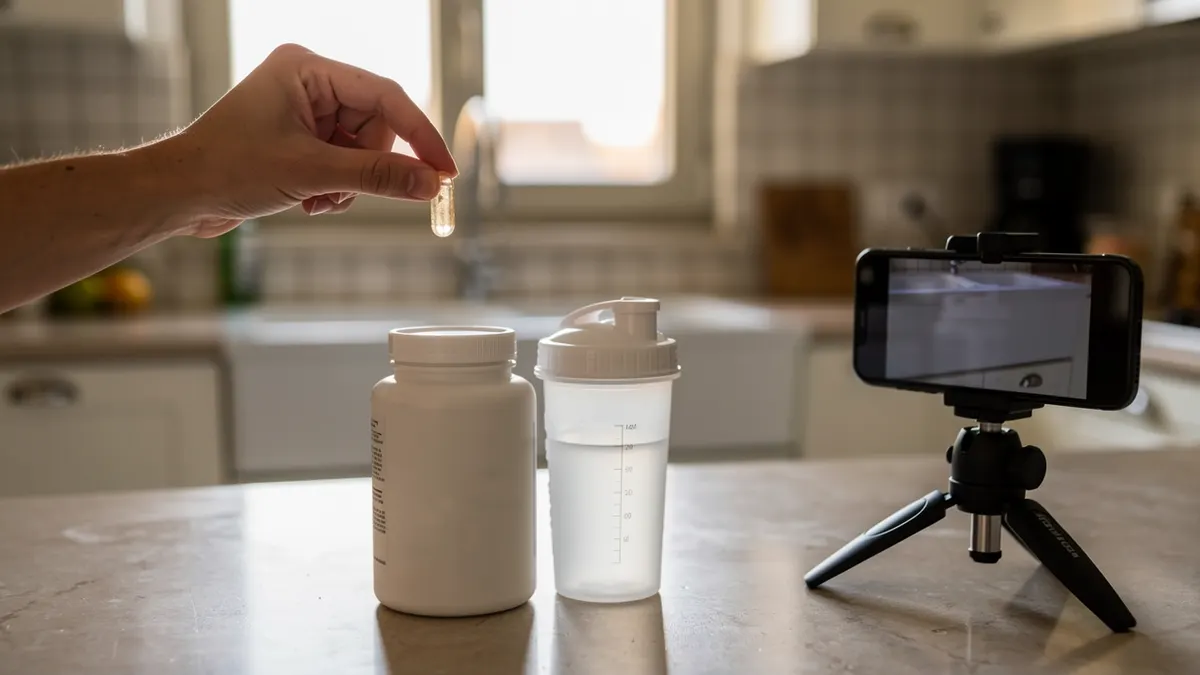
The morning gesture, the measuring of the dose as indicated, the mixing, the resulting texture, the colour, the smell, the format of the container, the room it takes up in a kitchen or a bag.
Showing is not asserting, and that is where the category's room for manoeuvre lies.
What replaces before and after
That is the request that always comes back, and it is also the one that puts campaigns at risk.
Replace it with continuity: the same person, the same shelf, the same glass, filmed at three different moments. You are telling a habit, not a result.
The habit is what you are really selling, since your revenue depends on the second purchase, not the first.
How to write the brief
Two columns, one page.
On the left, the facts the video must contain, copied from the packaging. On the right, what the creator must neither say nor suggest, including out loud when improvising.
Add a constraint few brands set: no invented sentence about the effect, even a positive one, even a vague one. Vagueness is what turns against you fastest.
What to buy for a test
Four videos, two creators, two angles.
One usage angle, one format angle, each in a short version and a long version. That is enough to find out whether the category responds, without committing a budget that a single rejected video would render useless.
The sign that the video will work
Watch the first ten seconds without sound and ask yourself whether you understand which product it is and what you do with it.
If the answer is no, no promise will save what follows. If it is yes, you have a video that can run as an advert without depending on a risky sentence.
What can be said, and in what form
| On screen | Possible wording | Forbidden wording |
|---|---|---|
| The product and its label | What it states | An effect on a disease |
| A daily intake | The gesture, the moment | A recommended dosage |
| A sensation | Personal and dated | A generalised result |
What separates this product from a medicine
The regulatory framework. A supplement is not meant to treat, and any wording suggesting a therapeutic effect shifts into a markedly stricter regime.
What is verified before every sentence
A composition, a dose, an authorised claim and a target population. Those four are read on the label and confirmed with the manufacturer and a health professional.
Plan for rejection
A video can be rejected by an ad platform without a detailed explanation.
So systematically ask for an alternative version of the hook and a version with no burned-in text, delivered at the same time. It costs little at the moment of the shoot and avoids stopping a campaign for a week.