This format is native to the platform. Here is the difference between running from the creator's account and from yours, the formats, hook testing and sourcing.
Why this format is native here
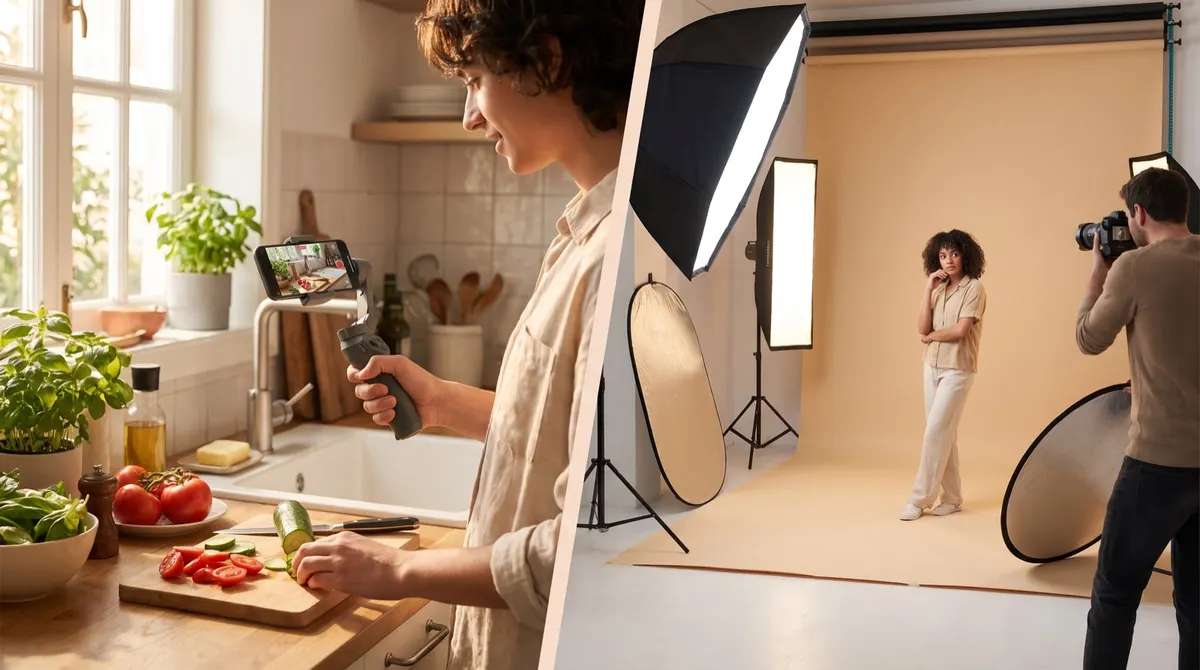
Because the feed does not visually separate an ad from a post: same vertical frame, same pace, same way of speaking. An over-produced creative is spotted in half a second and ignored. What gets through is a video that looks like the ones the person already watches.
Running from the creator's account or from yours
Six differences to know before choosing.
From the creator's account, the ad keeps their identity and history.
From yours, the video becomes a creative like any other.
From the creator, an authorisation is required, dealt with above.
From yours, no code is needed.
From the creator, the interactions stay on their post.
And from yours, measurement is simpler to isolate.
When to choose one or the other
Six markers for deciding quickly.
A video already performing organically: run it from the creator's account.
A video produced only for advertising: run it from yours.
A test of ten variants: from yours, simpler to manage.
A creator recognised in the category: from their account.
A long campaign: from yours, to avoid expiry.
And a large budget on a single creative: from yours.
Which formats to respect
Seven technical points, to check before delivery.
The vertical format, full frame.
A short duration, matched to the message.
Burnt-in subtitles, systematically.
Sound recorded separately from the music.
A first frame legible with no text.
An export at the best available quality.
And the exact specifications, to check in the tool at campaign time.
The music question
Six rules to write into the brief.
Never use protected music in an advertising creative.
Deliver a version with no music, always.
Prefer the sounds offered by the advertising tool, if you use any.
Keep the voice on a separate track.
Check that the setting's sound effects are usable.
And redo a take rather than fix sound in the edit.
How to brief a creator
Seven mentions, written down in full.
The hook expected, in three seconds.
The objection to remove, worded.
The number of hook variants requested.
The mandatory shots.
The ban on protected music.
Delivery with no text burnt over the interface.
And the running authorisation, if you run from their account.
How many hooks to test
Six markers for a clean test.
Three hooks on the same video.
A single variable changing at a time.
The same budget per variant.
Two full weeks of distribution.
The same audience for every variant.
And a written decision before launching.
How to build variants without reshooting
Six things doable in the edit.
Replace the first three seconds.
Change the first line of subtitles.
Open on the result rather than the problem.
Cut the introduction entirely.
Test the same video with no music.
And swap the order of two shots.
What usage rights to provide for
Seven elements to write into the quote.
Advertising distribution, named explicitly.
The duration in months.
Running from the creator's account, if planned.
The right to recrop and re-edit.
The number of variants permitted.
Use on other platforms, kept separate.
And the fate of the rushes.
What to measure
Six indicators, in this order.
Three-second retention, to judge the hook.
Fifteen-second retention, to judge the body.
Cost per click.
Acquisition cost, the only final judge.
Exposure frequency.
And the creative's lifespan.
What makes a good hook
Seven characteristics, all checkable in three seconds.
It starts already speaking, never on a silence.
It names a situation, not a product.
It shows something from the first frame.
It avoids any welcome formula.
It contains a concrete word, not an adjective.
It works with no sound.
And it makes you want to know what comes next.
How to write the first three seconds
Seven ways to open, to test separately.
With the objection, said out loud.
With the result, shown before it is explained.
With a closed question.
With a gesture, and no words.
With a comparison visible on screen.
With a sentence contradicting a common belief.
And with the product held in hand, no introduction.
What to ask for besides the edit
Six deliverables that multiply the variants.
The rushes, sorted by shot.
A version with no music.
A version with no subtitles.
Three alternative hooks, filmed the same day.
A product shot reusable on its own.
And three stills pulled from the shoot.
How to organise a test calendar
Six markers, across two weeks.
Launch the variants on the same day.
Change nothing for seven days.
Look at the figures after a week, without acting.
Decide after two weeks.
Keep the winner, stop the others.
And prepare the next batch while the test runs.
How to source cheaply
Six methods, from the fastest to the slowest.
Filter a marketplace by category and language.
Order a batch of three videos rather than one.
Ask for three edits of the same shoot.
Recruit among your current customers.
Reuse the rushes from a previous batch.
And keep two recurring creators, cheaper to brief.
What to settle before ordering
Seven decisions, made before the first message to the creator.
The campaign's single promise.
The objection to remove, worded.
The distribution budget per variant.
The number of hooks requested.
The licence duration wanted.
The distribution mode, and from which account.
And the person who approves, with their turnaround.
What works in this format
| Element | What works | What does not |
|---|---|---|
| The opening | A gesture or a named problem | A logo or a greeting |
| The pace | One idea every three seconds | A long static shot |
| The edit | Deliberately simple | A commercial aesthetic |
What sets this context apart
The audience's expectation. A video that looks too much like an ad is identified in one second, and the only way to hold attention is to resemble what surrounds it.
What must appear in every case
The partnership disclosure, from the start and legible without pausing. A consideration received creates the obligation, whatever the sincerity of the content.
The most expensive mistakes
Six reflexes that waste a campaign.
Launching a single creative and drawing conclusions.
Letting an authorisation expire mid-flight.
Using protected music.
Delivering with no music-free version.
Changing two variables at once.
And judging a creative on views rather than acquisition cost.
One last marker: on this platform, the first second decides everything else. Test hooks, not whole videos.