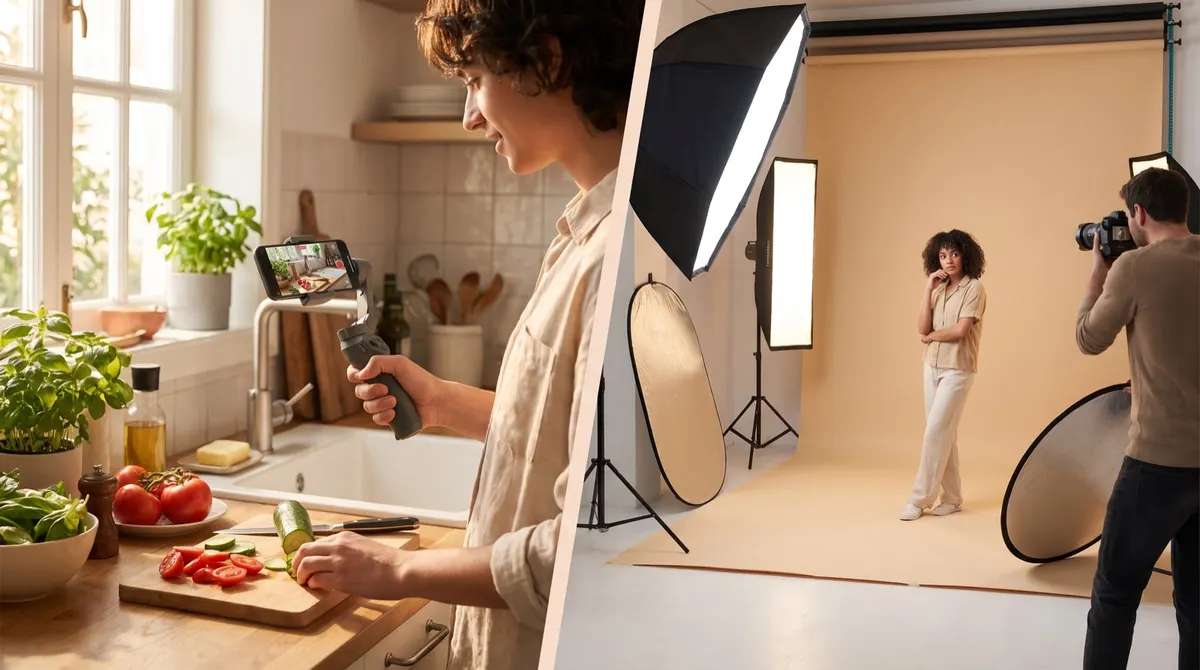
Influence buys reach, this format buys content you own and can sponsor. Here is the comparison on cost, control and volume.
The real difference
One buys access to an assembled audience, the other buys a video file and the right to distribute it. Everything else, the price, the contract, the measurement, follows from that distinction. A brand that confuses the two pays for reach it will not use, or gets a file it has no right to push.
How the costs compare
Seven items, set side by side.
In influence, a fee per post, indexed to the audience.
In influence, no distribution cost, reach is included.
In influence, usage rights often limited or absent.
Direct, a price per video, indexed to production.
Direct, a distribution budget to plan on top.
Direct, rights negotiated and invoiced separately.
And in both cases, an internal coordination cost.
Who controls the message and the rights
Six real differences.
In influence, the creator keeps control of the wording.
In influence, the post stays on their account.
In influence, the partnership disclosure is theirs.
Direct, the brand approves every sentence before release.
Direct, the brand publishes and carries the disclosure obligation.
And direct, the usage duration is written into the contract.
Which one scales for testing
Six reasons that tip towards buying files for a test.
You can order ten variants at once.
You can change a hook without going back to anybody.
You can stop a creative that does not work, with no awkwardness.
You can compare at equal budget, which is impossible in influence.
You can reuse the rushes to produce other edits.
And you can measure per video, not per person.
When each one wins
Six situations where it remains the better option.
A launch that needs an announcement effect.
A category where personal recommendation decides.
A market where your brand is entirely unknown.
A product better understood when seen by somebody already followed.
A goal of awareness rather than immediate sales.
And an event, which happens only once.
When bought content wins
Six symmetrical situations.
A need for volume to test messages.
A distribution budget already in place.
A product page to feed.
A category where the objection is technical, not social.
A team able to steer distribution.
And a measurable cost-per-acquisition goal.
Can you combine the two
Yes, and it is often the best structure. Three ways to do it.
Run an existing post as advertising from the creator's account, with their written agreement.
Start by buying videos to find the message that works, then fund an influence campaign on that message.
And negotiate, in every influence contract, a usage licence on the content produced.
What to write into an influence contract to keep the content
Six lines that turn a post into an asset.
The right to rerun in paid advertising, with its duration.
The right to recrop and re-edit.
Delivery of the original file, not only the link.
Use on product pages and in emails.
The exact duration, in months.
And the matching price, calculated apart from the fee.
How to measure each one without going wrong
Seven indicators, separate by nature.
In influence, real reach, not the stated audience.
In influence, attributed traffic on the day of publication.
In influence, sales with a dedicated code.
Direct, the cost per video actually run.
Direct, the acquisition cost per creative.
Direct, the video's lifespan in advertising.
And in both cases, the internal cost in hours.
How to split a budget between the two
Seven allocation markers, to adjust to the objective.
An unknown brand puts the larger share on awareness.
An already known brand puts the larger share on production.
A test budget is split across three creatives, never one.
Paid distribution should be at least as large as production.
A single influence partnership is compared with three bought videos.
A seasonal campaign keeps a reserve for the second batch.
And nothing goes to a channel whose results nobody will steer.
What the brand must prepare before launching
Six elements, written once and for all.
The single promise, in one sentence.
The three objections to remove, in order of importance.
The distribution budget, decided before ordering.
The person who approves, with their turnaround.
The measurement table, ready before the first release.
And the decision on what to stop if nothing works.
How to start without a big budget
Six decisions for a realistic first attempt.
Start with three videos, not with a campaign.
Choose three different creators, not three formats from one.
Write a single promise, the same for everybody.
Plan an equal distribution budget per video.
Wait two weeks before concluding.
And keep the rushes, they will serve the second batch.
When to stop a test
Five signals that allow a conclusion.
Two full weeks of distribution have passed.
Every video received the same budget.
No variable moved along the way.
The acquisition cost has settled.
And one creative clearly stands out from the others.
The most frequent mistakes
Six confusions that cost dearly.
Paying for an audience in order to get a file.
Running content in advertising without holding the rights.
Comparing a cost per thousand with a cost per video.
Judging a creative on views rather than acquisition cost.
Stopping a test before two weeks.
And changing two variables at once.
Two approaches, two objectives
| Point | Producing for a brand | Influencer marketing |
|---|---|---|
| What the brand buys | Files and rights | Access to an audience |
| Where the video runs | On the brand's channels | On the creator's account |
| What sets the price | Use and volume | Reach and engagement |
| What is measured | Cost per result | Visibility and interaction |
What misleads most often
Believing one replaces the other. A brand needing thirty variants to test will not find the answer with a followed account, and the reverse is just as true.
What combines well
Producing for advertising and distributing in parallel through followed accounts. Those are two budgets, two contracts and two measurements, and mixing them makes the results unreadable.
What the platform simplifies
On UGC MATCH, the brief travels with the order, the brand pays at ordering without the funds being released straight away, the video is delivered in a private space, and payment goes out on approval. Joining is free and there is no subscription.
One last marker: ask yourself one question before choosing. Do you want to be seen once, or do you want something you can rerun for a year?