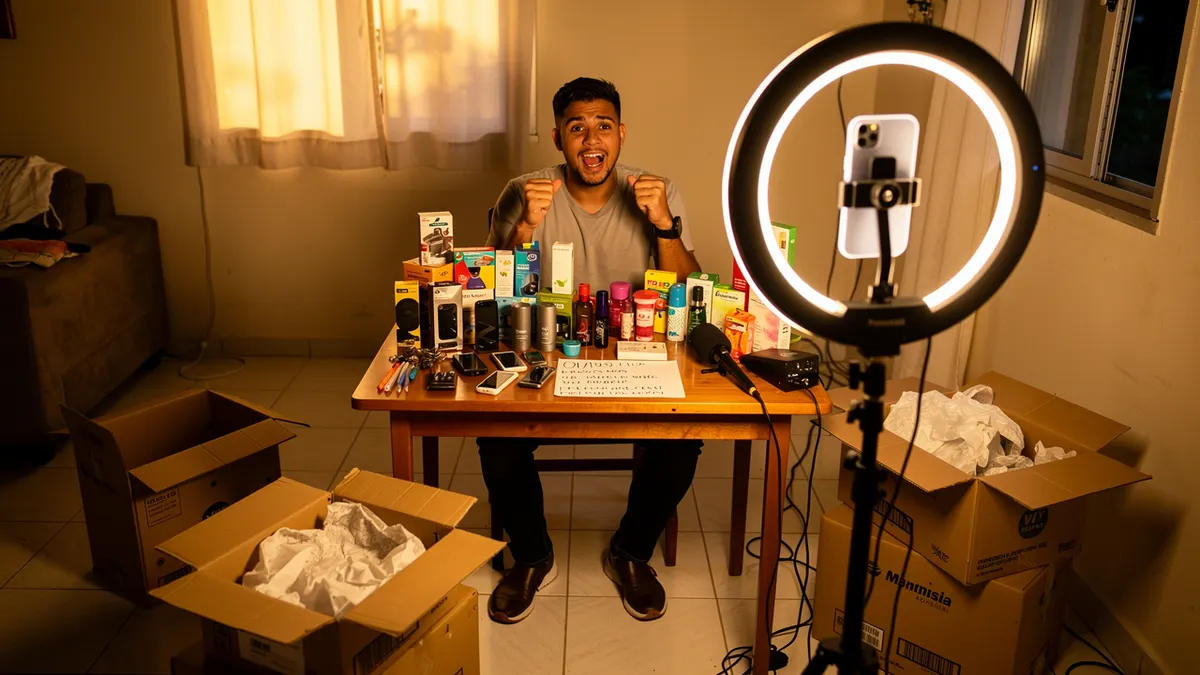
How marketplace sellers in Brazil use UGC to boost listings and ads on the big marketplaces.
Why a marketplace buyer needs video
Seven reasons specific to this context.
Listings all look alike, with the same photos supplied by the same manufacturer.
The buyer compares five offers in two minutes and looks for what distinguishes them.
A low price creates doubt about quality, which only proof of use removes.
Descriptions are often machine translated and inspire little confidence.
Dimensions written as figures mean nothing to anybody, unlike an object held in a hand.
The buyer wants to see the product out of the box, not in a studio.
And existing reviews sometimes concern different versions, which a dated video corrects.
Where the video actually goes on marketplaces
Seven placements, with what each requires.
The listing gallery, where the video often plays without sound.
The photo carousel, where the first image serves as thumbnail.
The platform's internal advertising, with its own format constraints.
The platform's video search, where it exists, barely used by sellers.
The seller's social accounts, which point back to the listing.
Customer service messages, which send the video to answer a frequent question.
And external advertising, which requires a version with no mention of the platform.
The three jobs of a marketplace video
Seven points to cover, spread across those three jobs.
Showing the real size with a familiar object, job number one.
Showing the material close up, job number two.
Showing the product working, job number three.
Showing what the box contains, omitting nothing.
Showing assembly or installation, timed.
Showing the product after a few days, which almost no seller does.
And saying what the product is not for, the only sentence that genuinely removes returns.
The video that prevents a return
Six elements to film first, according to your category.
For clothing, the size worn and the measurements, stated out loud.
For homeware, the real footprint once installed.
For electronics, the accessories included and those missing.
For childcare, the safety notices shown as they are.
For beauty, the real volume of the bottle in a hand.
And for anything to assemble, the real assembly time and the tools needed.
Finding creators who sound Brazilian
Seven selection criteria.
An accent and vocabulary matching the region where you sell most.
An ordinary domestic setting, resembling the buyer's own.
An ability to film in natural light, with no equipment.
The habit of buying on these platforms, which is audible in the vocabulary.
Fast delivery, since these sellers work to a weekly rhythm.
A price compatible with series of several videos a month.
And availability to refilm a variant, which happens constantly here.
What platform rules require
Five points to check with the platform and with a lawyer before release.
The accepted formats, durations and file sizes, which differ between platforms.
The frequent ban on mentioning a competitor or another platform.
The ban on displaying contact details or encouraging people to leave the platform.
The claims specific to the category, which remain subject to general regulation.
And the display of mandatory notices, whose exact form is checked with the competent authority.
What the seller has to give the creator
Seven items without which the shoot takes twice as long.
The exact product sold on the listing, not a sample from another batch.
The reference and the name as they appear on the platform.
The three questions buyers ask most, taken from the message inbox.
The two most frequent reasons for returns, with their actual wording.
The category's mandatory notices, copied as they are.
The format and duration accepted by the target platform.
And the publication date, so the delivery arrives before the campaign and not after.
What a marketplace imposes
| Constraint | What it changes | Where to read it |
|---|---|---|
| The maximum length | A tighter edit | The listing rules |
| The accepted aspect ratios | Centred framing | The seller documentation |
| Forbidden content | No price, no external link | The publication terms |
What gets a video rejected at review
Another platform's logo, a watermark, a promotional mention and any call to leave the listing. Those four are detected automatically, not debated.
What is checked before export
Aspect ratios, file size, length and the presence of subtitles. Each marketplace has its own thresholds, and they change: reread them before every delivery.
Reusing a single shoot across every channel
Seven production rules that multiply usage.
Shooting vertical, then cropping, never the other way round.
Burning nothing into the picture, since each platform has its own rules.
Recording the voice separately, so as to produce a silent version.
Planning a three-second opening usable as a thumbnail.
Filming each benefit in a separate shot, to allow re-editing.
Delivering a fifteen-second and a thirty-second version.
And keeping the rushes, indispensable when the seller changes platform or packaging.
One last marker: on these Brazilian marketplaces the winning seller is not the one with the prettiest video, it is the one whose listing answers questions before they are asked. Every question avoided is a rating preserved, and visibility follows reputation far faster than it follows the advertising budget.