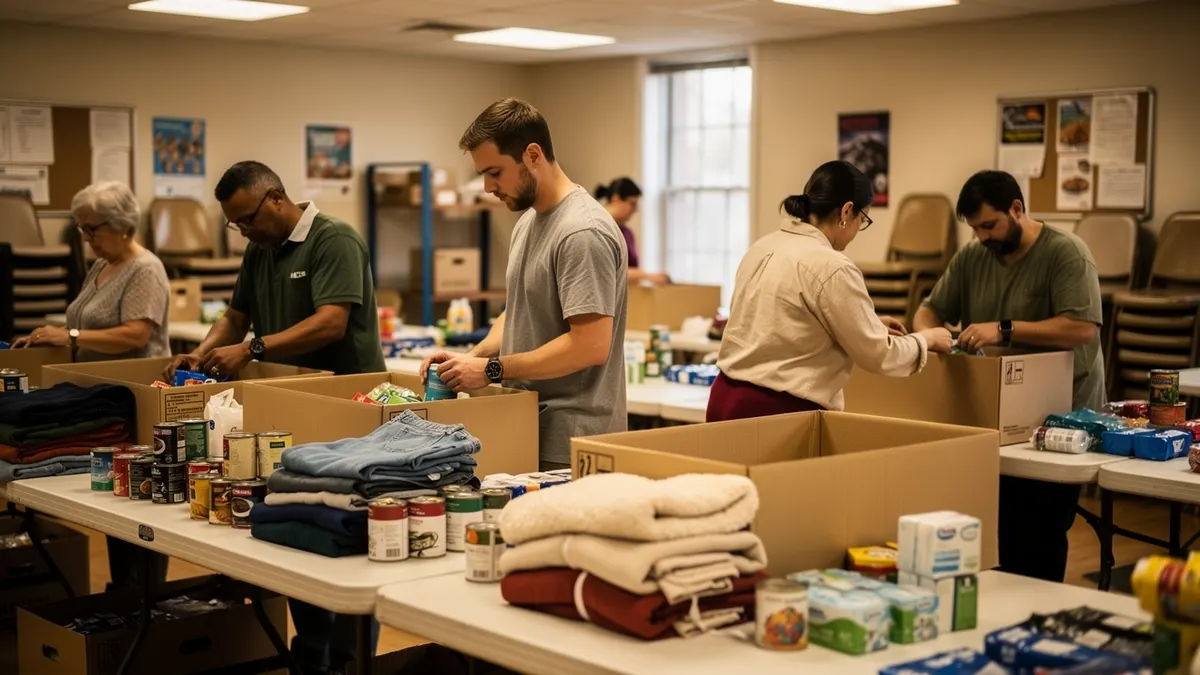
Small budgets, donors who check where the money goes, and rules on how an organisation may solicit.
Small budgets are not a handicap
That is the reversal specific to this sector.
An over-produced video works against you: the audience wonders how much it cost, and that question cancels the message.
Three practical consequences.
Film with the means visible on the ground: a phone, the light of the place, the real sound.
Show the place as it is, including what is worn or improvised.
And let the people doing the work speak, not the management.
One production note: the edit must stay simple, with no heavy music. In this sector, sobriety is not a budget constraint, it is proof of seriousness.
Beneficiaries take part, they do not feature
That is the ethical rule of the category, and it is also a legal one.
A person receiving help is not an argument: they are a person, and their image belongs to them.
Four precautions, without exception.
Written permission, explained in the person's language, with the duration and the channels.
The possibility of refusing with no consequence for the help received, stated explicitly.
A right of withdrawal, planned in advance, with what happens then.
And particular attention to minors and to people in vulnerable situations, whose framework is checked with a lawyer before any shoot.
Three ways of telling without exposing: voice alone, hands, or the account given by a team member with the agreement of the person concerned.
Soliciting has rules
That is the point separating this sector from all the others.
An organisation soliciting donations is subject to a precise framework: what it may claim about the use of funds, how it issues receipts, and what it must state in its communications.
Three checks before publication. What the video claims about the allocation of donations must match what is actually done. Any mention of a tax advantage must be exact and verified. And the rules applicable to soliciting, including by province, are checked with the competent authorities and with a lawyer.
One consequence for the writing: avoid overly precise arithmetic promises about what a given amount funds, unless the organisation can document them.
Volunteers are the second campaign
That is the resource these organisations seek as much as money, and nobody films it.
Three pieces that work, alongside the arrival video.
A volunteer's account after six months, saying what they learned and what surprised them.
The honest description of a thankless task, filmed without prettifying it: that is the one attracting serious people.
And the real schedule: how many hours, at what rhythm, with what flexibility.
What is filmed, and what is protected
| Subject | What is possible | What requires a written form |
|---|---|---|
| The premises and the activity | A wide shot, with no faces | Nothing |
| A team of volunteers | The gesture at work | Everyone's consent |
| A person being helped | Nothing without informed consent | A written form, always |
What replaces a beneficiary's testimonial
A volunteer's words, the substance of an action, a verified figure. A video can convince without exposing the people it is meant to protect.
What is checked on every figure announced
The source, the period and the scope. An amount raised, a share passed on or a number of people helped are proven by a public document, to be confirmed with the management.
What to measure
Three indicators, and the first is not the donation.
The number of people watching the video to the end: in this sector, retention predicts better than clicks.
The number of new contacts, donors or volunteers, who mention the video when asked where they came from.
And the rate of repeat donations at six months, which judges the quality of the relationship rather than that of the campaign.
One last marker, specific to the local calendar: the end of the year concentrates a large share of donations, but the least crowded period remains the spring. A campaign launched in April costs less to distribute and meets less competition, for an audience just as available.