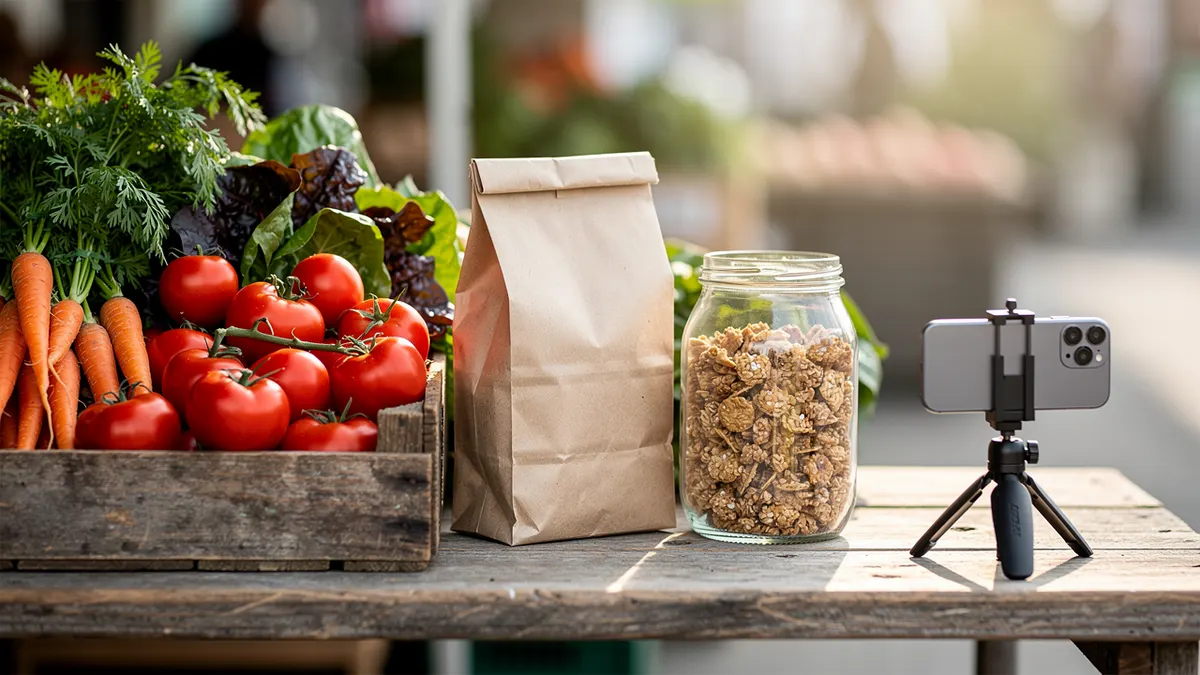
Ninety-five percent is the share of organic ingredients, salt and water excluded, a product needs before it may call itself "organic" on the front of its package in the United States, and it is one of four thresholds the Department of Agriculture's National Organic Program sets. A creator standing in a farmers market with a jar of granola who says "it's all organic" has, in a sentence, made a claim that the USDA defines to the percentage point, ties to a certification with one small-producer exemption, and forbids on the front panel of any product that is not certified. The vocabulary of a creator video about food, farming and the grocery shelf is full of the word, and the word is regulated.
The category's craft, the kitchen and the harvest, is in the guides to UGC for food and beverage brands and to food brands in the United States, which covers the FDA's claim categories and the word "natural". The other word is the subject here: what "organic" means under the USDA's rules, what a brand may let a creator say about it, and where farm and grocery content meets the same disclosure as every other category.
Four labels, four thresholds
What each label means
The USDA's page on labeling organic products sets out four categories. "100 Percent Organic" is for a product that contains 100 percent organic ingredients, excluding salt and water, and most raw or minimally processed farm crops qualify; it may carry the USDA organic seal. "Organic" is for a product with a minimum of 95 percent organic ingredients, up to 5 percent being nonorganic agricultural or nonagricultural products on the National List; it may also carry the seal. "Made with Organic" followed by named ingredients is for a product with at least 70 percent organically produced ingredients, with constraints on the rest, and it may not carry the seal, represent the finished product as organic, or say "made with organic ingredients" without naming them. Below 70 percent, specific organic ingredients may be listed as organic in the ingredient statement only, and the front panel may carry neither the seal nor the word.
Certification is the condition
The USDA states that a business that wants to claim its product or its ingredients are organic probably needs its final product certified, and that without certification it must not make any organic claim on the principal display panel or use the seal anywhere on the package; it may only identify certified organic ingredients as organic on the information panel, with the percentage. The same page states one exemption: producers who market less than $5,000 worth of organic products annually are not required to apply for certification, must still comply with the organic production and handling requirements including recordkeeping for at least three years, may not display the USDA organic seal, and cannot supply organic ingredients to another operation's processed products. The farmers market stall is often that case, and a brand at that scale should know which side of the $5,000 line it is on before a creator says the word. Certified products are overseen by a USDA-authorized certifying agent and produced without excluded methods, the page's examples being genetic engineering, ionizing radiation and sewage sludge. For a creator brief the consequence is direct: a certified product carries the sentence its label category allows, whereas a product the brand has neither certified nor placed under the small-producer exemption is a product the creator does not call organic, whatever the farm looks like on camera.
Textiles, honey, pet food
The same page answers the edge cases a lifestyle creator meets. Textiles may be labeled organic and carry the seal only if the finished product is certified to the USDA regulations; a label may claim specific fibers are organic when every instance of those fibers is certified; and textiles meeting the Global Organic Textile Standard may be sold as organic in the United States. Honey, mushrooms and pet food may be certified to the current standards. A creator who says a cotton T-shirt is "organic" because the brand's feed says so is making the textile claim without the certification the USDA describes.
| What the creator says | What the USDA label allows | What the brand needs |
|---|---|---|
| "It's 100 percent organic" | The "100 Percent Organic" category, seal allowed | Certification, and every ingredient other than salt and water organic |
| "It's organic" | The "Organic" category, 95 percent minimum, seal allowed | Certification (or the under-$5,000 exemption, seal excluded), and the 95 percent threshold met |
| "Made with organic oats" | The "Made with Organic" category, 70 percent minimum, no seal | Certification, and the named ingredient organic |
| "Some of the ingredients are organic" | Ingredient-statement listing only, no front-panel claim | Certified organic ingredients identified on the information panel |
| "Organic cotton" on a garment | A finished-product or specific-fiber claim under the textile policy | Certification of the finished product, or of every instance of the fiber |
The farm on camera, and the claim it makes
Farm and grocery content sells a picture: a field, an animal, a hand in the soil. The picture makes claims the way words do, and the USDA's definition of organic is about production practices, resource cycling, ecological balance, soil and water quality, minimal synthetic materials, biodiversity, overseen by a certifying agent. A video that shows a farm and lets the word "organic" hang over the whole brand, when only one product line is certified, has let the picture claim more than the labels do. The brief should say which products are certified, which are not, and which sentences the creator may attach to each, and the creator's job is to keep the word with the product it belongs to.
What the USDA's rules do not cover is the rest of the vocabulary: "local", "regenerative", "grass-fed", "pasture-raised", "sustainable". Whether any of those words carries rules of its own under another program is a question this guide does not answer; all of them are advertising claims a brand has to be able to support under the Federal Trade Commission's general standard, which reads a claim as a reasonable consumer would understand it. A creator who reaches for "sustainable" because the field looks green is making a claim the brand will have to defend, and the honest brief supplies the sentences the brand can stand behind and asks the creator to stay inside them.
The disclosure, at the market and in the box
Farm and grocery brands seed generously: a box of produce, a subscription, a market visit with a full bag at the end. The FTC's influencer guidance treats a free product or perk received so that the creator will post about it as a material connection, asks for the disclosure to be clear, placed with the endorsement and hard to miss, in the video itself and not only in the description, and says to disclose even when the brand never asked for a mention. The farmers market video, filmed with a bag the brand handed over, is that case exactly.
The brief for a farm or grocery brand
- List the certified products and their label category, 100 percent, organic, made with, or ingredient-listed, and give the creator the sentence each category allows.
- Forbid "organic" for anything not on that list, including the farm as a whole, and forbid "100 percent" unless the product carries that label.
- Treat textiles as their own case, with the finished-product or specific-fiber rule stated in the brief.
- Supply the sentences for "local", "grass-fed", "regenerative" and the rest that the brand can support, and ask the creator not to add adjectives to the field.
- Write the disclosure of the box, the subscription or the market bag into the brief, and check it in every video.
Sources
- USDA Agricultural Marketing Service, Labeling Organic Products
- Federal Trade Commission, Disclosures 101 for Social Media Influencers
- Federal Trade Commission, Health Products Compliance Guidance
Checked on 20 September 2026. This guide is not legal advice. Where this guide and the official source disagree, the official source prevails.