It is the sector where regulatory constraint decides everything: what can be shown, what can be said, and by whom. What remains possible works very well.
What the law changed in 2023
That is the starting point of every brief in this sector.
The French framework now explicitly regulates commercial promotion by creators, and forbids or strongly restricts certain categories linked to health, aesthetics and devices.
What counts for a brief: the product's category decides what is allowed, not the tone of the video. A product can be entirely free, regulated, or out of reach.
The practical consequence: the first question asked of the brand is not "what is the message" but "which category exactly does this product belong to". The answer conditions all the rest, and is checked with a lawyer.
What still works, and works well
Four formats, all compatible with a strict framework.
The routine
It shows the gesture and the product's place in a day, without asserting anything about a result.
It is the safest and most effective format in the category.
The texture close-up
A cream absorbing, a powder dissolving, a gel spreading. The image informs without the voice having to promise anything.
The question to the pharmacist
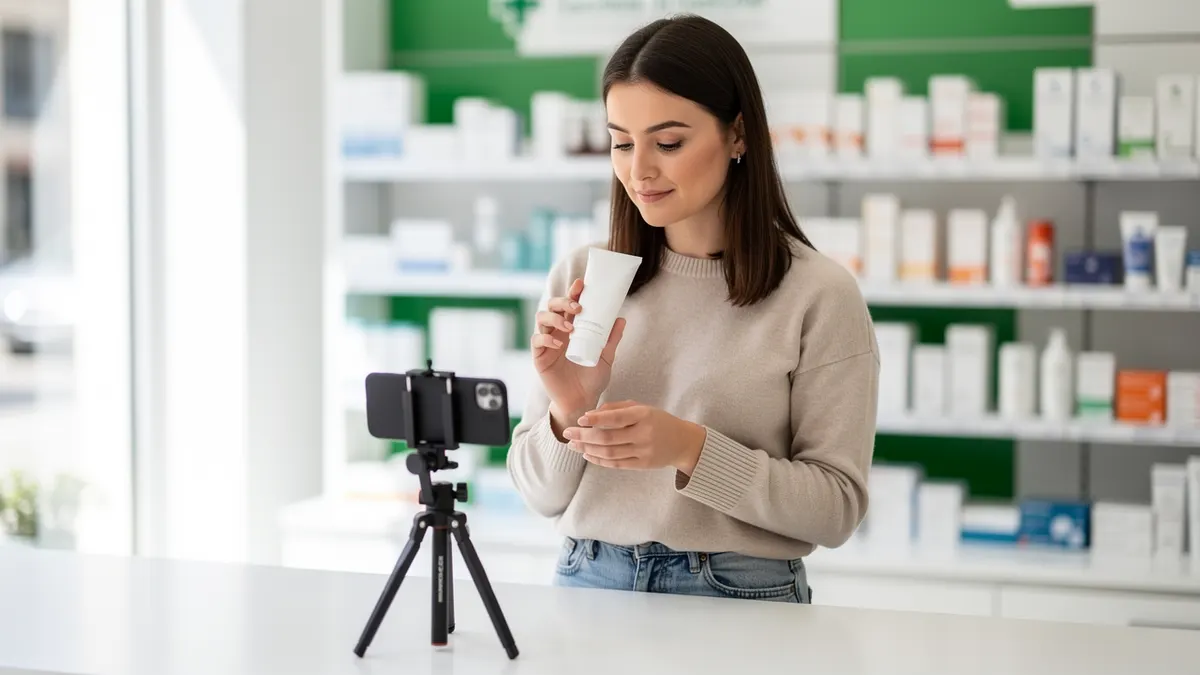
Filmed in the dispensary, with agreement, it answers a concrete query: the difference between two forms, the time of day, the length of use.
It requires the caution described above, and it is very widely watched.
The seasonal brief
Back to school, winter, allergies, sun, travel. Those are moments when the audience actively searches, and when useful content lands better than promotion.
The lines a creator must not cross
Four, and they are easy to remember.
Never assert a therapeutic effect, nor suggest a product treats, prevents or replaces a treatment.
Never present a personal case as proof of general efficacy.
Never show a misuse, a modified dose, a mixture.
And never allow a commissioned video to look like a spontaneous opinion: identifying the commercial nature is due, without exception.
In case of doubt over a sentence, the rule is simple: it is deleted rather than argued about after publication.
What is never claimed in a pharmacy
Six limits fixed before the shoot.
No effect equivalent to a treatment.
No comparison with a prescription product.
No recommendation without professional grounding.
No portrayal of someone as a health professional.
No statement about an illness.
And nothing beyond what the leaflet says.
What is possible depending on the product
| Category | What remains possible | What is ruled out |
|---|---|---|
| A cosmetic | Showing the texture and the gesture | A therapeutic claim |
| A device | Showing the packaging and the leaflet | Personal usage advice |
| A medicine | Referring to the pharmacist | Any promotion |
What is read on screen rather than spoken
The label, the composition and the leaflet. Filming the official text avoids rephrasing it, and rephrasing is often what turns a permitted sentence into a forbidden one.
What is approved before release
The full script, the mandatory notices and the product's exact status, to be confirmed with a lawyer and with the responsible pharmacist.
Practical notes for the brand
Five points that save time and money.
Supply the written list of authorised claims, with their exact wording, validated internally.
Supply the list of forbidden words too, which avoids half the retakes.
Approve the script before the shoot, never the video after.
Plan two versions: one for the creator's account, one for paid advertising, whose constraints are not the same.
And keep the dated record of every approval. In this sector, traceability is worth as much as the content.