A portfolio is not a gallery. It is a commercial document, and it is read in thirty seconds.
What a creator's portfolio is
It is proof that the result is reproducible.
A buyer is not wondering whether you have already made a good video, they are wondering whether you will make theirs. So it is not a collection of your best pieces, it is a demonstration of consistency.
Three comparable videos beat ten different ones. The first option proves a method, the second proves luck.
How many pieces are enough
Three, then six, never twenty.
Three pieces are enough to land the first jobs, provided they demonstrate three different skills: showing a product, speaking to camera, answering an objection.
Six pieces are enough to specialise, by adding three examples in the target category.
Beyond that, a portfolio becomes harder to read and no more convincing. Remove rather than add: the weakest piece sets the perceived level of the whole.
What to film when you have no client
What you already own.
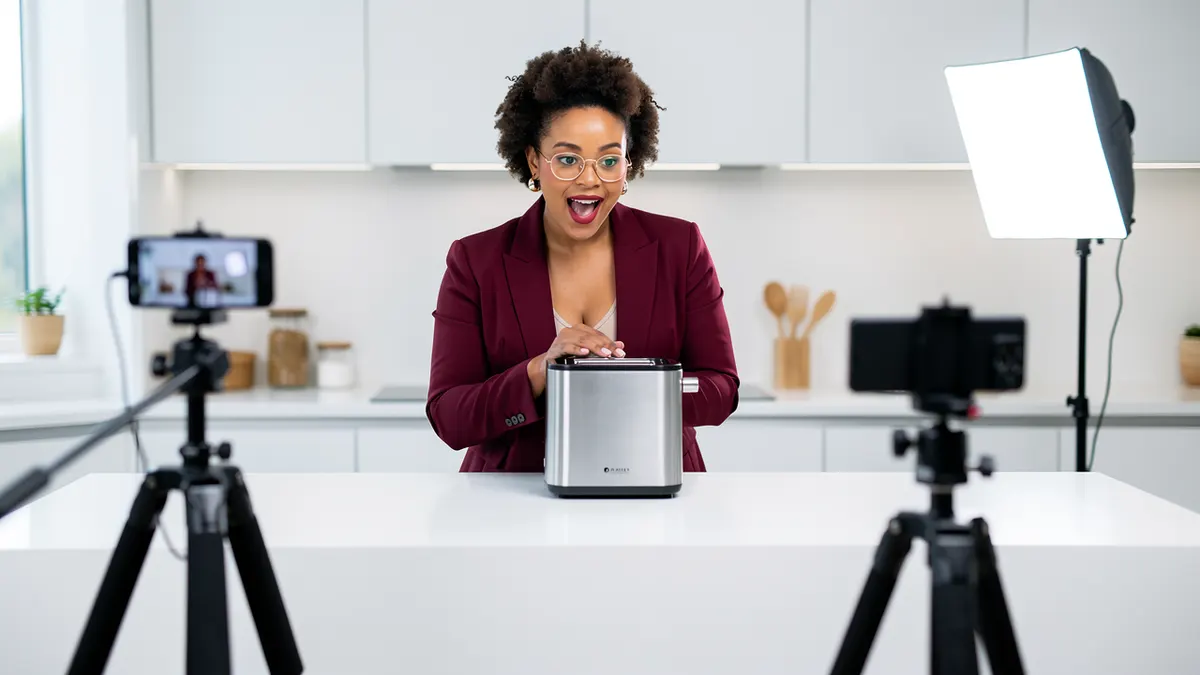
Take a product you actually use, in a category that buys advertising, and treat it like an order: a brief written by you, defined formats, a set deadline.
Three ideas that work with no partner brand. The rework of an existing advert, presented as an exercise. The answer to an objection you read in a product's reviews. And the product page of an item whose current visuals are weak.
One absolute rule: an uncommissioned example is presented as such, always, and never carries the logo of a brand you have not worked with.
The French market's trap
It is specific and it costs dearly.
Many creators there present heavily edited videos, with music, transitions and grading, thinking they are demonstrating craft. The result is the opposite: the buyer can no longer see what they are buying, namely the person, the product and the sound.
The brands in that market are mostly looking for content that does not look like an advert. An over-polished portfolio therefore downgrades its author, even though it took more work.
The second trap is the text: long introductions, a speech about one's passion, agency vocabulary. The three lines in the box replace all of that.
How to present it
Simple, visible, with no obstacle.
A place viewable without signing up and without a password, opening in a few seconds on a phone.
Videos playable directly, with no download.
Under each, the three lines described above.
And at the top of the page, four pieces of information: what you film, your usual timescale, the languages you deliver in, and the fact that you invoice.
Add a direct contact, written in plain text. A form loses half the enquiries.
What makes a portfolio readable in thirty seconds
| Block | Content | What it avoids |
|---|---|---|
| The hook | Three videos, no text around them | Endless scrolling |
| The card | City, languages, formats, lead time | One question per message |
| The contact | One channel, only one | A choice to make |
What you put forward depending on the target
A cosmetics brand wants to see hands and a close-up of texture, a service brand wants to hear clear speech. The same portfolio, two different orders.
What is removed without hesitation
A sample from three years ago, a video with poor sound, and any job whose result cannot be shown because it was never released.
How it evolves
By replacement, not by accumulation.
Each new job replaces the weakest piece in the portfolio, provided the rights allow you to show it. That point is written into the agreement: the right to cite the job in your portfolio is not automatic.
Review the whole thing every three months, in the diary. A dated piece, a category you no longer want to work in, an example that no longer resembles your work: each costs you jobs without anybody telling you.