A UGC script is nothing like an advertising script. No flawless voice over, no solemn closing line: someone speaking the way people speak, getting to the point before the thumb moves.
In Spain a material constraint is added, and it can be measured: the language takes up space.
A translated script always overruns
An idea written in English gets longer when it moves into Spanish. The constructions are longer, the words more extended, and a sentence that fitted into eight seconds needs eleven once spoken.
The consequence is concrete. An international brief asking for thirty seconds with a translated script produces a forty second piece, which the edit then has to amputate. What gets cut is what should have stayed: the proof, or the exit.
The practical rule: write the script directly in Spanish, never by translating. And calibrate by speaking, not by character count. Read aloud with a stopwatch before shooting. If you overrun, remove a whole idea rather than shortening every sentence, otherwise you end up with a dense text nobody follows.
The first three seconds
Do not open with an introduction formula. It announces an ad and loses half the audience before the verb.
Come in through the problem, the result or the contradiction. Those three openings share one thing: they start in the middle of a story already under way, and the viewer stays to find out the rest.
In Spanish, pay attention to the first syllable as well. An opening starting with a long word loses half a second before the meaning arrives. Start with the word carrying the information.
The structure that holds
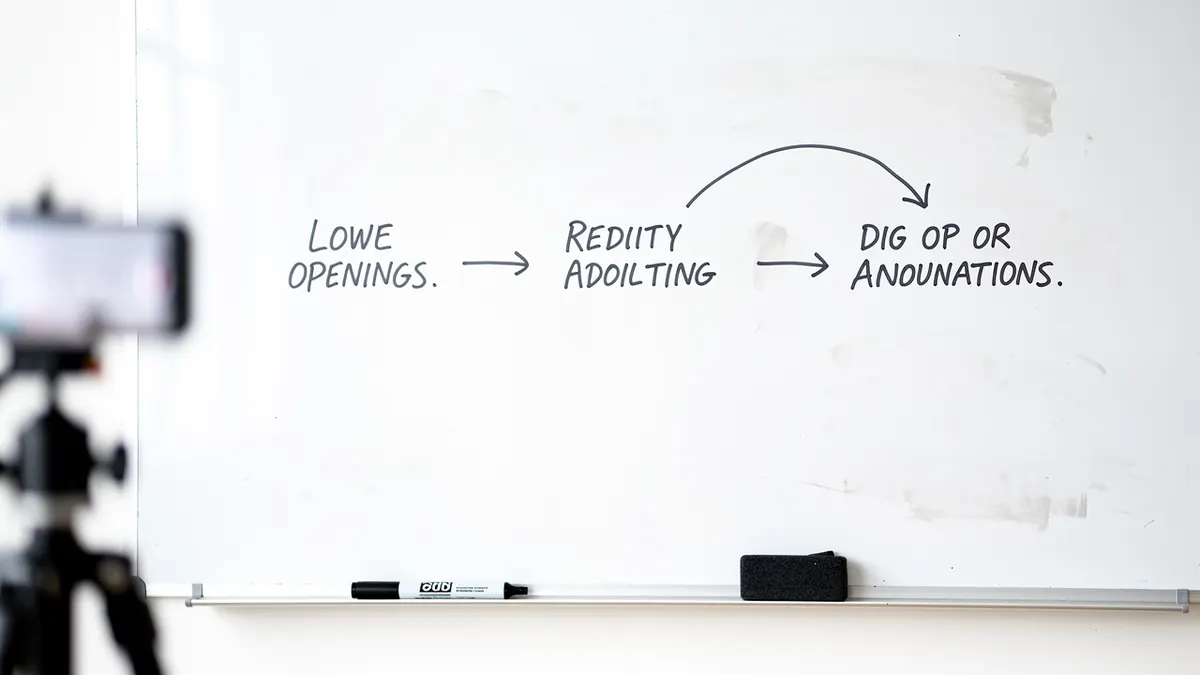
Hook, situation, proof, exit. Fifteen to thirty seconds in total, measured out loud.
The situation is one sentence placing you: who you are and why this problem concerns you. The proof is what can be seen, not what is asserted. The exit is an action, not a goodbye.
Write three hooks, not one
That is what separates a creator from a video supplier. For one product, deliver three openings: one emotional, one rational, one that divides opinion a little.
It justifies a higher rate, and above all it gives the brand something to optimise. In a market where many commissions go through an intermediary who has to show results, delivering something testable is worth more than one beautiful piece.
What to cut before shooting
Adjectives that describe nothing. Sentences longer than two lines, which nobody says out loud. Technical specifications no one asked for. And any promise of a result you could not stand behind, which exposes the brand along with you.
If the video is also meant for Latin America, remove strongly marked expressions too: they are understood, but they locate the video, and a brand running on both sides prefers a version that travels.
Subtitles are part of the script
A large share of the audience watches with the sound off and therefore reads your text before hearing it. Write with the screen in mind: short sentences, one idea per line, and the word carrying the meaning placed at the start.
What a thirty-second script contains
| Block | Word count | Role |
|---|---|---|
| Hook | 8 to 12 | Hold attention |
| Proof | 25 to 35 | Convince |
| Close | 8 to 12 | Prompt action |
What can be cut with no loss
Politeness formulas, technical details, adjectives and anything that repeats the image.
What is read aloud
The whole script, once: whatever cannot be said in one breath will not be said on camera.
How to practise with no equipment
Take three videos that stopped your scrolling this week and transcribe their first five seconds, word for word. Do it for a month.
You will end up with a bank of openings that worked on you, in your language and in front of your audience. No generic template gives you that.
Spanish from Spain is not neutral Spanish
A hook written for a Latin American audience is spotted here in three words, and the viewer drops off before understanding why.
What gives away a hook written for another market
Everyday vocabulary changes across the Atlantic: it is móvil, not celular, ordenador, not computadora, zumo, not jugo. Direct address works everywhere in Spain, while an overly formal turn of phrase sounds like a translation. And a hook quoting a price in another currency disqualifies itself in a second, however good the offer. The proofreading rule fits in one question: would someone from Madrid say this line out loud, exactly as written.
Sources
- Agencia Tributaria, Spanish tax authority
- Spanish Social Security, self-employed registration (RETA)
Checked on 4 September 2026. Thresholds and rates change: where this guide and the official source disagree, the official source is right.