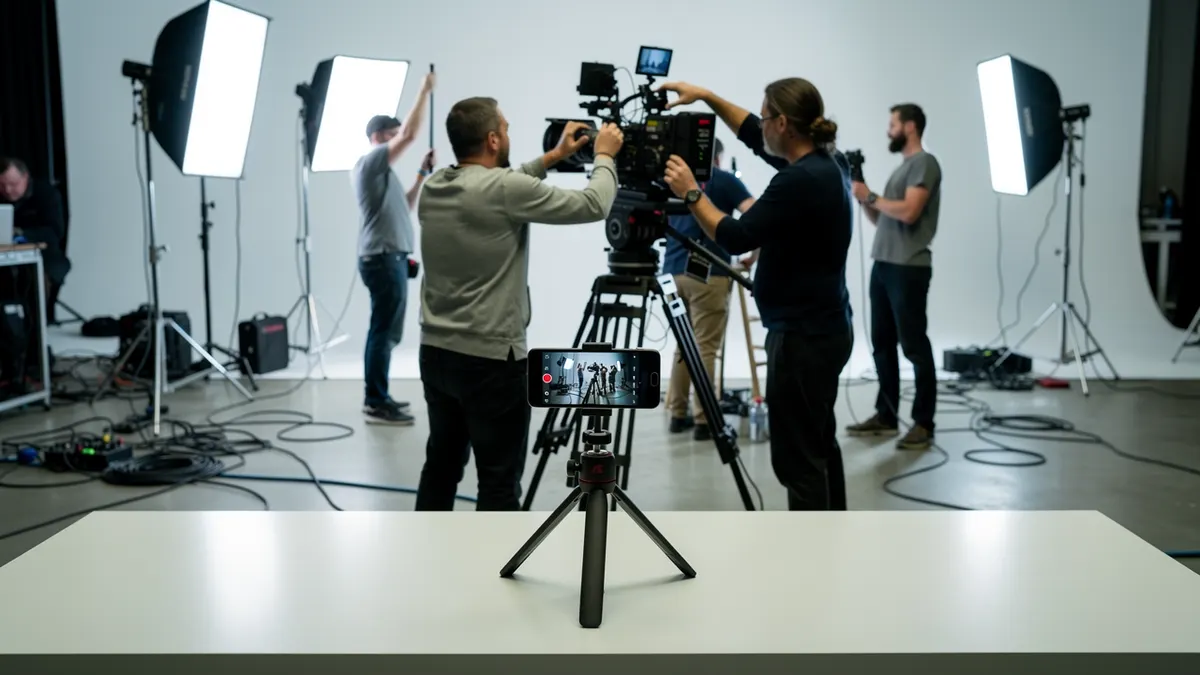
Stock footage is not bad. It is simply answering a different question from the one your viewer is asking.
Why it is dear when it is cheap
The purchase price is not the cost.
A stock image costs little and does not convert, which amounts to paying for its distribution for nothing. A shot video costs more and lowers the acquisition cost, which pays it back in a few weeks.
So compare the cost per result, never the cost per file. It is the only comparison that means anything in a paid campaign.
What the audience spots immediately
Three things, in less than two seconds.
Somebody handling an object they have never used. An interior belonging to nobody. And an emotion arriving at the right moment, which never happens in real life.
The viewer does not think this is stock footage. They think this is an advert, and they scroll.
Where stock footage still works
It remains useful, and it would be silly to do without it.
For context shots showing nobody: a city, a road, a sky, a texture. To illustrate an abstract idea in a video whose speech comes from elsewhere. For a neutral background under a piece of text.
Those are scenery uses. None of them requires credibility.
The honest comparison
Three criteria, not one.
The cost per usable variant, the length of time the file stays effective, and the extent of the rights you actually obtain. A stock image can be used by your competitors in the same month, which is no small matter in a crowded category.
The Italian case
The market is particularly sensitive to the fake.
An overly commercial tone, a house resembling no house here, a staged meal: those elements produce faster rejection than elsewhere, and they get commented on publicly.
Conversely, a true detail is worth a great deal: the way of holding a cup, the tiling, the noise of the street, the expression used. Those are things you cannot buy from a catalogue.
The arrangement that works
Mix, but not anywhere.
The creator carries the speech, the proof and the use. Stock footage carries the transitions, the wide shots and the backgrounds. Never do it the other way round: a bought voice over product shots convinces nobody.
What each source brings
| The criterion | The stock library | The creator video |
|---|---|---|
| The lead time | Immediate | A few days |
| The exact product | Rarely available | Filmed as it is |
| Exclusivity | None, a competitor may use it | Real if the contract provides for it |
What a stock library cannot solve
Showing your product. A generic image illustrates an idea, it does not demonstrate a use, and a buyer instantly recognises a scene already seen at three other brands.
What a creator video demands in return
A brief and a lead time. That is the price of specificity: where stock is chosen in ten minutes, a bespoke video needs a clear order and a week of production.
What to check in the licence
Three points, before use.
Paid advertising use, often excluded from the simplest licences. The real duration. And the restrictions relating to visible people, particularly for sensitive categories.
Those checks are done before going live, and documented: the purchased file does not by itself prove the right to use it.