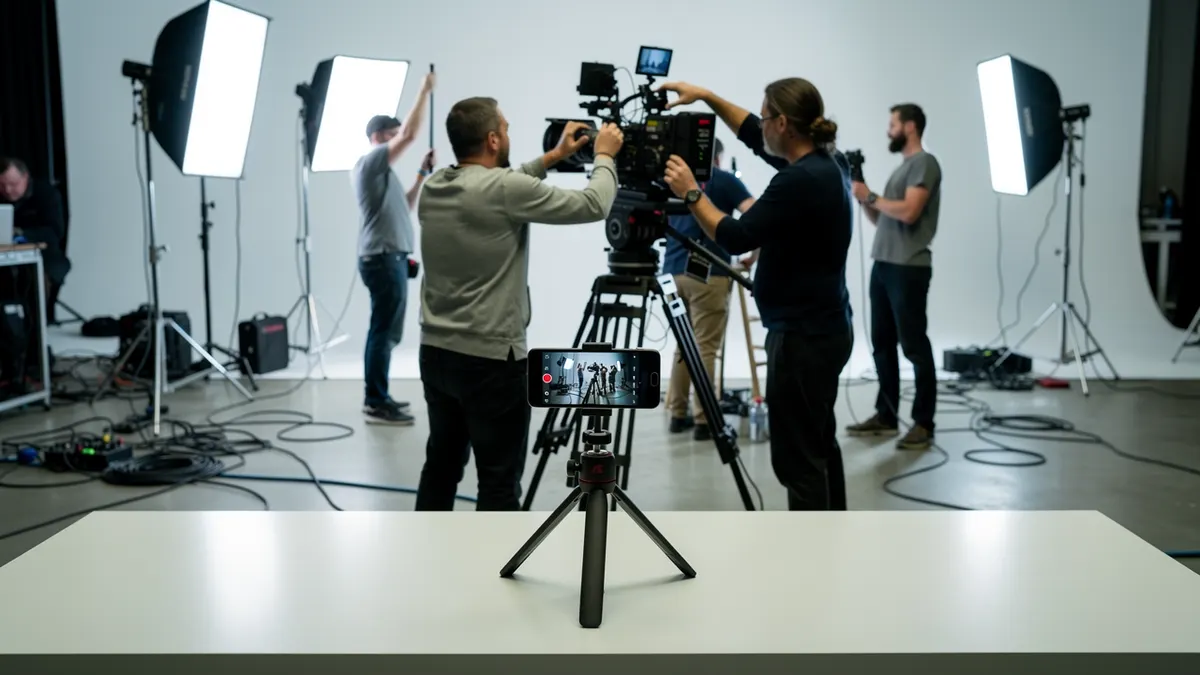
The question is rarely asked in the abstract. It comes up when a company has been working for years with a local studio or photographer, and needs something that person cannot supply.
That is what makes the trade-off uncomfortable in Italy: it is not technical, it is relational.
What the long-standing supplier does better than anyone
They know the product, the company, the family running it, the colours, what is not shown.
They produce the images meant to last: the catalogue, the website, the sales documentation, the film shown to a distributor.
And they are reliable in the most concrete sense: they pick up the phone, and they know the workshop.
None of that is replaceable, and a company that breaks the relationship to save money often finds itself rebuilding it two years later.
What they cannot supply
Twenty vertical variants a month, with different faces and different interiors.
A piece shot in two days because the offer has changed.
And above all the appearance of something that is not an advertisement. That is a limit of nature, not of talent: a studio produces a controlled image, and the control shows.
The split that works
To the studio: identity, the catalogue, still images, institutional videos, everything that will still be in use in three years.
To creators: the demonstration, the opinion, the comparison, the advertising variants, everything that lives a few weeks and has to be replaced.
The first is an investment, the second a running cost. Confusing them is the most frequent source of misallocated budget.
What it really costs
Comparing the price of a studio video with a creator video makes no sense: the first is made to last, the second to be replaced.
The right unit is cost per usable variant over the period. A production yielding one piece is expensive per variant; a batch of decent pieces yielding fifteen is cheap, and that is what a campaign needs.
Count internal time too: approvals, meetings, back and forth. It is real, it is simply not on the invoice.
How to make the two work together
Give the creator the brand constraints written by the studio: colours, forbidden words, what is not shown. That prevents the off-brand video you will have to redo.
Give the studio the creator videos that worked: they tell it what catches attention, and it can use that in its own pieces.
And have them speak once. In small organisations, a twenty-minute conversation prevents six months of silent rivalry.
What each route allows
| Need | Creator | Production company |
|---|---|---|
| Four variants in a week | Yes | Rare |
| Two people in dialogue | Difficult | Yes |
| Cost per variant | Low | High |
What tips toward a creator
A monthly need, a product that films at home, a budget per piece, a release on social media.
What tips toward a production
A location to close off, several cameras, a television release, a casting to organise.
The mistake not to make
Asking the studio to produce content that looks spontaneous. It will do it well, it will cost full price, and the viewer will see it is an advertisement.
And the reverse: asking a creator for a production aesthetic. You will pay for a light shoot to obtain an imitation, and you will lose the one thing you came for.