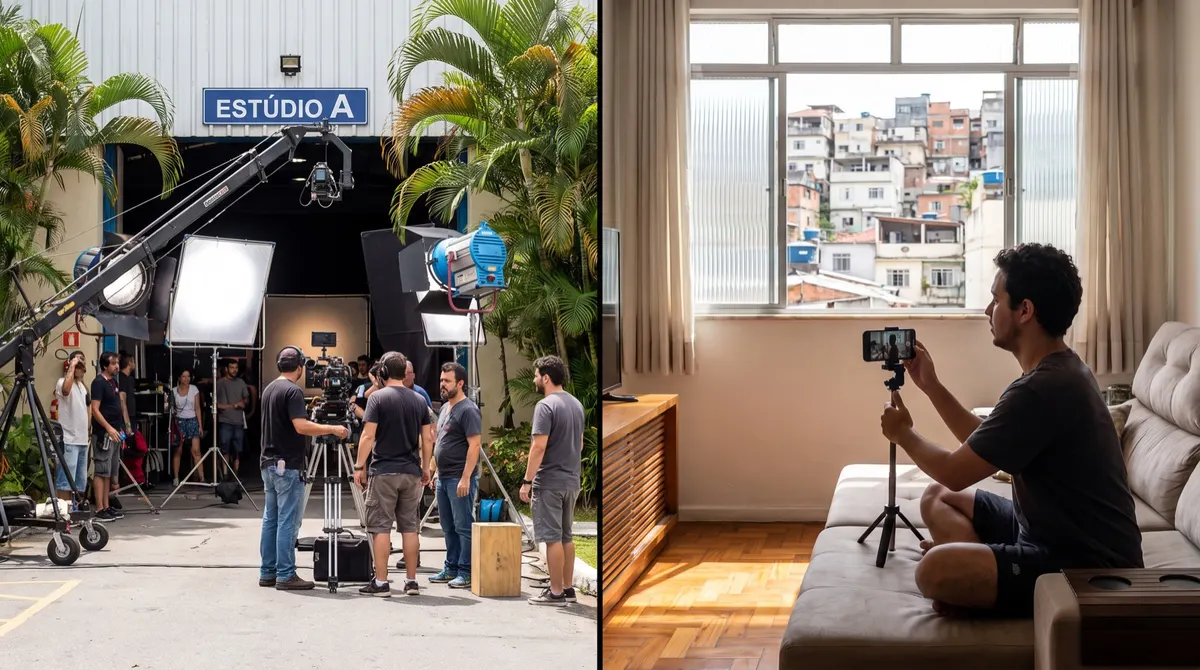
An honest comparison for brands: UGC versus classic studio production in Brazil, cost, speed, volume and performance.
What a studio shoot really costs
Seven items, four of them invisible on the initial quote.
Writing and preparation, often invoiced separately.
Hiring the location and the equipment, with set-up and take-down time.
Casting, whose cost depends on the rights granted and the duration.
The crew: camera, sound, lighting, production, depending on scale.
Editing and grading, with approval back and forth.
The rights of the people filmed, to be renewed at expiry.
And the cost of refusal: if the production does not suit, everything has to be redone.
Speed and delivery times
Six direct comparisons.
Start-up: a few days in UGC, several weeks in studio.
First delivery: one to two weeks against one to two months.
Correction: a few hours against a new studio slot.
Reaction to an event: possible in UGC, almost impossible in studio.
Mass production: faster in studio for one film varied, faster in UGC for different films.
And availability: a creator can be replaced, a studio crew has to be rescheduled.
Volume of variations for advertising
Five points that decide a campaign's profitability.
An advertising creative wears out in a few weeks, which forces renewal.
The marginal cost of a variant is very low in UGC and very high in studio.
Testing five different openings is trivial in UGC, exceptional in studio.
The diversity of faces and settings multiplies in UGC without multiplying the budget.
And volume allows learning: three average campaigns teach more than one successful film.
Authenticity and advertising performance
Six reasons UGC often performs better in paid distribution.
The video resembles the rest of the feed, which delays the scrolling reflex.
The face is ordinary, which makes the objection concrete and the answer credible.
The setting is real, therefore recognisable by the target audience.
Proof of use is visible, which a studio film cannot simulate without losing credibility.
The format is natively vertical, whereas a studio film is often recropped from another format.
And the content is shared in conversation, which extends reach with no budget.
When the studio still wins
Seven situations where classic production remains the right choice.
The institutional brand film, meant to last several years.
Products requiring controlled lighting: jewellery, watches, high-end cosmetics.
Complex shoots: movement, effects, several coordinated people.
Categories where brand image is the product, notably luxury.
Content destined for a television screen or large-format display.
Campaigns where a well-known personality is at the centre.
And catalogue visuals, which must be consistent across hundreds of items.
What each approach can do
| Need | A studio | A creator video |
|---|---|---|
| Pixel-perfect imagery | Its very purpose | Approximate by nature |
| Ten variants in two weeks | Costly | The best-suited format |
| A credible everyday scene | Hard to simulate | Immediate |
What costs most in each case
In a studio, the shooting day and the crew. In creator video, coordination once you pass ten contributors. Both cap out, but not in the same place.
What really decides
The end use. An institutional campaign calls for a studio, a performance campaign calls for volume and variation. Using one in place of the other costs dearly in both directions.
How to choose in practice
Six questions to ask, in order.
Are you trying to make known, to lift a doubt or to trigger a purchase?
How many different hypotheses do you need to test?
How soon does the content have to be online?
Does the product demonstrate itself, or does it have to be made beautiful?
How long does the content have to stay usable?
And do you accept discovering late that the chosen promise does not work?
A mixed answer is the most frequent and the most effective: a brand film every two years, and continuous UGC production for advertising, product pages and retargeting. The two do not replace each other, they occupy different stages.
One last marker: in Brazil, most brands hesitating between the two are asking a budget question when it is a question of rhythm. The studio produces a definitive answer to a question you have not yet validated. UGC lets you ask the question several times before answering it expensively.