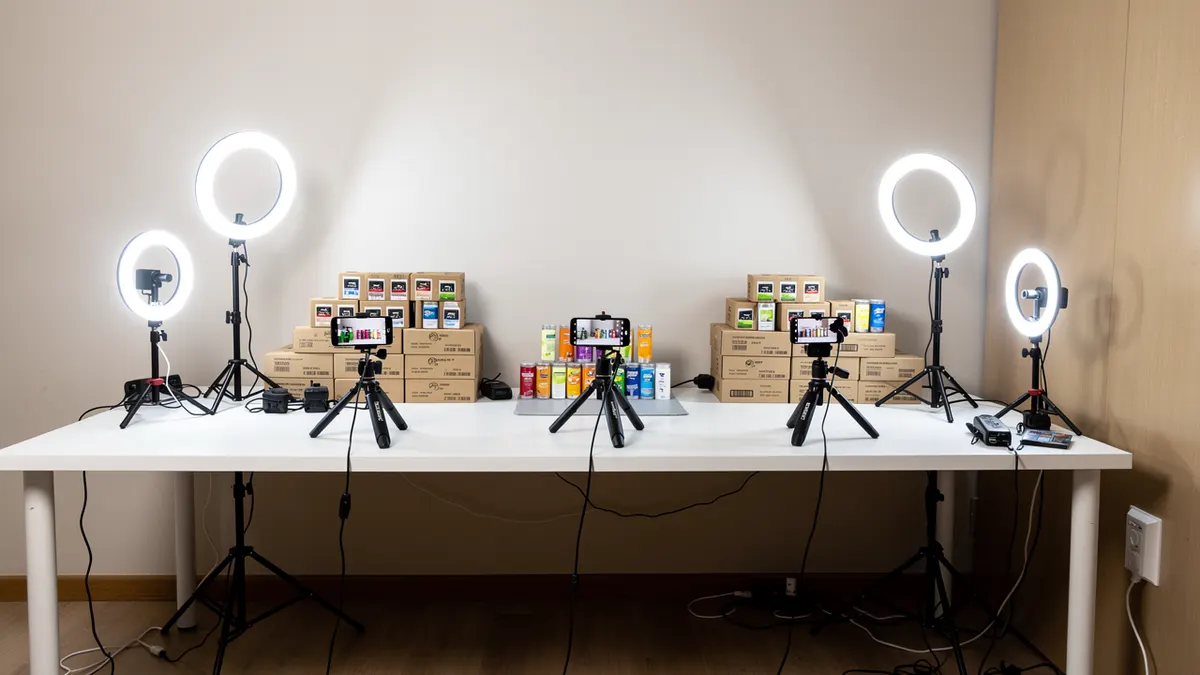
Volume breaks on approvals and payments, not on creators. Here is what to build before growing.
What breaks first
Three bottlenecks, in order of appearance.
Approval: at ten videos, one person reviews everything; at fifty, they become the blockage and deliveries pile up.
Payment: more creators means more invoices, more different statuses, more special cases, and cash management becomes a full-time job.
And rights tracking: with no table, nobody knows any more which video may still be shown or until when.
One counter-intuitive note: the number of available creators is almost never the problem. What is missing is the capacity to process what they deliver.
Organising product shipping
Four decisions, all structural.
Ship in grouped batches, once a month, rather than parcel by parcel.
Leave permanent stock with regular creators, with a written inventory and quarterly renewal.
Plan a real lead time per region, and write it into the campaign calendar.
And decide in advance who takes the product back at the end, or whether it stays where it is.
One cost consequence: beyond a certain volume, grouped shipping and remote stock cost less than unit logistics, while removing the main cause of delay.
The pool by region
Three rules for building it.
Four to six regular creators per region covered, not one, to absorb absences.
One tested replacement for each profile, because unavailability always happens at the wrong moment.
And an assumed diversity: the country does not have one accent, one cuisine or one climate, and a campaign shot by a single region is immediately visible in the rest of the country.
One habit stabilising the pool: paying on fixed dates. In volume work, regular payment retains creators better than a higher rate.
What stays in-house
Three functions, not delegable.
The testing strategy: which angle, against what, and what is being watched.
Reading the results, which writes the next brief.
And compliance: mandatory statements, permitted sentences, checking before publication. Those rules are verified with a lawyer and apply to every video, whatever their number.
Three functions can be delegated with no risk: shooting, editing, versioning into formats.
The permanent brief
That is what replaces the meeting as volume rises.
Five elements, identical from one order to the next.
The product and its reference.
The sentence to remember, written out in full.
The formats, lengths and versions expected.
What is forbidden: claims, brands, music, locations.
And the delivery date, in working days after the product arrives.
One rule of form that holds at scale: a brief not fitting on one screen will not be read by forty people.
What must exist before multiplying orders
| Element | What it avoids | Form |
|---|---|---|
| A standard brief | Ten identical questions | One page |
| A naming convention | Files nobody can find | Three lines |
| A standard contract | Ten negotiations | One document |
| A shared calendar | Two deliveries on the same day | A table |
What you measure to steer the scale-up
The on-time delivery rate, the number of revisions per order and the cost per usable video. Those three figures are enough to know whom to call back.
What breaks a scale-up
Paying late, changing the brief after the shoot, and asking for exclusivity without paying for it. The best creators leave quietly, never explaining why.
What changes as volume grows
| The line | At three videos a month | At thirty videos a month |
|---|---|---|
| The brief | A message is enough | A written template is mandatory |
| File naming | Improvised | A strict convention |
| Approval | One person | A route and deadlines |
What breaks first when you multiply orders
Sorting. Thirty videos delivered by ten creators without a naming convention take a full day to classify, and that day cancels the saving made on production.
What to set up before increasing volume
A single brief template and one product sheet per reference. That is the only way to get comparable videos, therefore usable in ad testing, rather than thirty isolated pieces.
The signal to accelerate
One single one, and it is simply checked.
The same format has worked twice in a row, with two different creators, in two different regions.
Two consequences.
You can order in batches, because the format is reproducible.
And you can set a delivery standard, which reduces the back and forth and makes approval manageable.
Two opposite signals, saying wait: the message is not stable, or paid distribution is not in place. In both cases, producing a hundred videos means filling a folder nobody looks at.