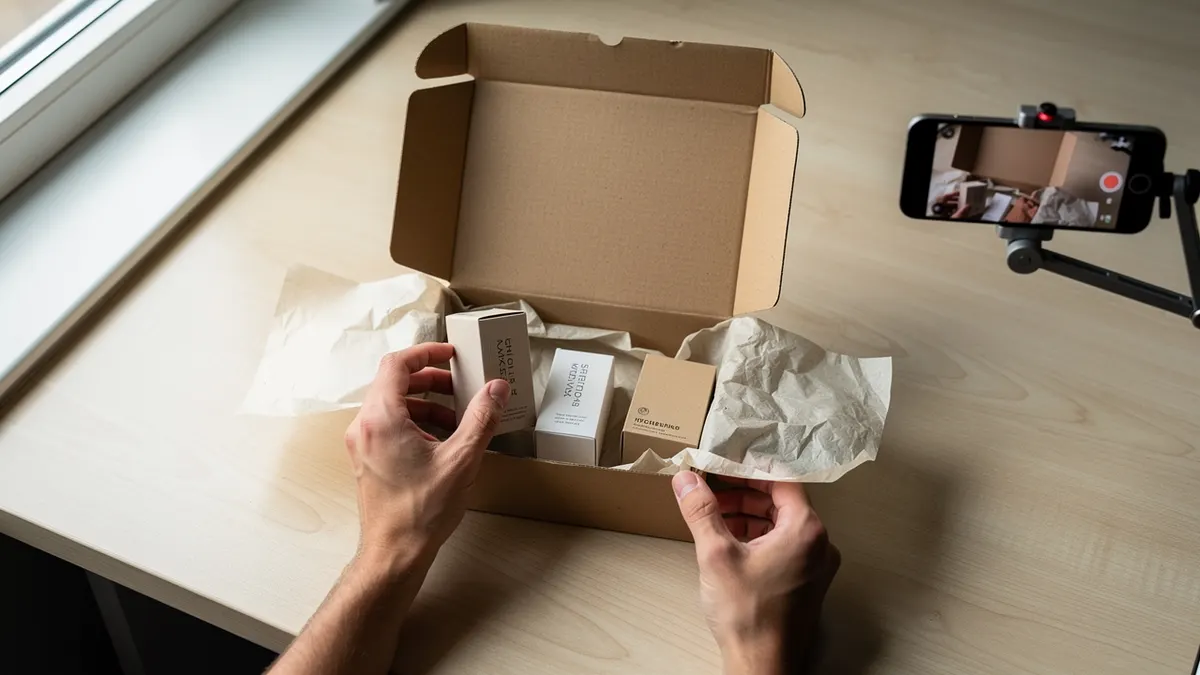
Subscription boxes are more established in the United Kingdom than almost anywhere else in Europe: coffee, razors, pet food, recipe kits, wine, books, cosmetics, dog treats. Most of them buy creator video, and most of them buy exactly one kind of it.
They buy the unboxing, which is the right instinct for the wrong reason.
The unboxing is a rehearsal, not an advert
A subscription customer is not buying a product once. They are buying a repeated moment: a box arriving, being opened, and being worth the interruption of a Tuesday evening.
The video does not persuade them the product is good. It shows them, in advance, exactly what that moment looks like, and the closer the video is to what actually happens, the better it performs and the longer the customer stays.
What that changes about the framing
Film it at the pace a person would open it, with the packaging they will actually receive, including the bits that are unglamorous. A video where the box opens perfectly and everything is arranged face up is not a rehearsal, it is a photograph in motion, and the real first delivery reads as a disappointment against it.
Two seconds of the cardboard being wrestled with does more good than harm. It sets an expectation the product can actually meet.
The content nobody commissions
Every subscription brand buys acquisition content and almost none buy retention content, which is strange, because retention is where the money is in this model.
A customer who cancels in month three has cost more than they paid. A customer who stays fourteen months has funded the acquisition of two others. And what makes people stay is not another advert, it is knowing what to do with what arrived.
| Retention content | What it prevents |
|---|---|
| How to use the thing that confused people | A cancellation blamed on the product |
| What is coming next month | Boredom, which is the real churn driver |
| What to do with the leftovers or the packaging | A guilt that quietly builds every month |
| A customer showing their own version | The feeling of being sold to rather than belonging |
| The person who chooses the products | The suspicion that nobody chooses anything |
The last row deserves a note. A box brand that shows the buyer, the roaster, the person who tastes forty things to pick four, stops looking like a logistics company and starts looking like a curation, and that is the whole promise a subscription makes.
The box is the set
Physically, a subscription brand has an advantage most brands do not: a standard object arriving in a standard way. That makes the content cheap to produce and consistent across a year.
The trap in the cardboard
Brown cardboard eats light and turns everything slightly orange, so a box opened under a warm ceiling lamp looks dull no matter how good the product is. Shoot near a window, on a plain surface, with the box angled so its inside is not in shadow.
The second trap is the table. Every unboxing looks the same because every unboxing happens on the same anonymous white or wood surface, and a brand that shoots on something recognisable, a specific kitchen, a specific floor, an office desk, is instantly distinguishable from its competitors doing the identical thing.
The monthly rhythm
The great advantage of this model for content is that it repeats, and the great mistake is to film each month as it arrives.
Filming a box before it exists
Work one month ahead. The box being filmed should be the one shipping next month, not this one, so the content is ready when the shipment goes out rather than a fortnight after.
Practically that means a filming session in the last week of each month, with a creator who receives the product early and knows the pattern. After the second month it takes half a day, because the setup, the surface and the pacing are already decided.
And keep one clip from every month. After a year that archive is the best acquisition asset the brand owns, because it shows twelve genuinely different boxes rather than a claim about variety.