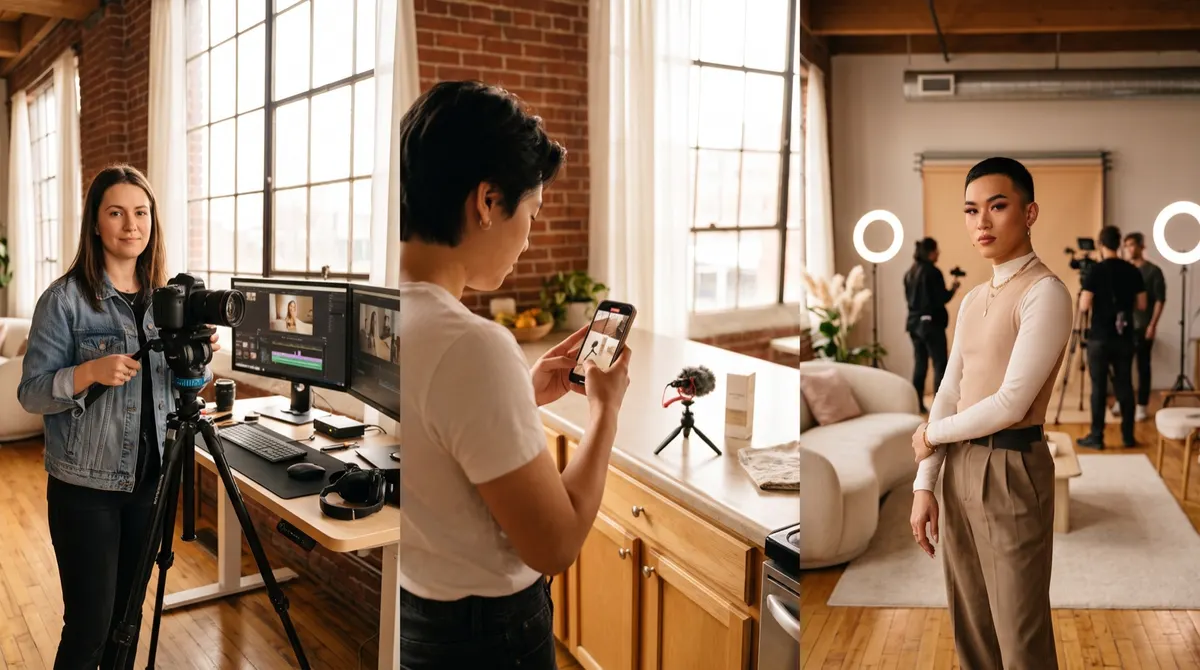
A content creator is someone who produces media (photos, videos, articles) for an audience or a brand. The difference with a UGC creator and an influencer comes down to one thing.
What a content creator actually does
Seven tasks that make up the reality of the job, well beyond the shoot.
Understanding the request, meaning translating a commercial brief into a filmable idea.
Writing, which often takes longer than filming.
Shooting, with a phone, a tripod and a light source.
Editing, cutting, subtitling and levelling the sound.
Delivering in the requested format, with the requested naming.
Invoicing, chasing and archiving, the part nobody shows.
And starting again with variants, because a brand rarely buys an isolated video.
Content creator vs UGC creator vs influencer
Content creator
The broadest term: it covers anyone producing media, for themselves or for others. A wedding photographer, a newsletter writer and a video editor all fall into this category. It is a production job, not an audience job.
UGC creator
A speciality inside the previous one: producing videos for a brand that look like an ordinary recommendation, and granting usage rights. The brand publishes, pays for distribution and measures the result. The creator's follower count does not enter the equation.
Influencer
Here what is sold is access to a community. Publication happens on the creator's account, its reach is organic, and the price follows the size and engagement of the audience. Production work exists, but it is not the product.
Roles that overlap more than people think
Six overlaps everyone meets in practice.
An influencer who also hands their rushes to the brand is doing UGC that day.
A UGC creator who posts the video on their own account steps outside the initial contract, and that is invoiced separately.
A content creator employed by a brand produces for an account that is not theirs.
A photographer who now shoots vertical videos is doing the same job with a different tool.
A UGC creator who builds an audience ends up receiving influence offers.
And many professionals alternate all three within the same month, which is rather a sign of economic health.
Which route requires no followers?
Five reasons UGC is the most accessible entry point.
The buyer looks at delivered videos, not at a follower curve.
A portfolio of three videos is enough to apply, with no publishing history.
The kit comes down to a recent phone, a tripod and a clip-on microphone.
The decisive skill is clarity of message, which is learned in a few weeks.
And the income is predictable: it depends on the number of orders, not on an algorithm's mood.
Three trades people often confuse
| The trade | What it sells | How it is paid |
|---|---|---|
| Producing for a brand | Files and rights | Per deliverable |
| Influencing | An audience | Per post |
| Managing social accounts | An ongoing service | Per month |
What separates them in practice
Where the content is distributed. A video handed to the brand runs on the brand's channels, a post stays on its author's account, and account management keeps someone else's account alive.
What combines, and on what condition
All three, provided each service is invoiced separately. One shoot used on two different channels is two sales, and merging them means giving one away.
Where to start
Seven steps, in the order they actually happen.
Choose two categories you already consume, so you can speak accurately without effort.
Film three videos with products you own, each handling one objection.
Take care of the sound before the picture, the first reason for refusal.
Build a short portfolio, where the weakest video is still good.
Set up your invoicing structure, because no brand pays without an invoice.
Set a production price and a rights price, from the very first assignment.
And apply every week, targeting brands whose products you genuinely use.
One last marker: the title you write on your profile means nothing to a buyer. What they assess is the question asked above, who publishes and who pays for distribution, and then the quality of what you deliver. Answer both clearly, and the label will follow on its own.
Sources
- Portal do Empreendedor (MEI), Brazilian government
- Receita Federal, Brazilian tax authority
- Simples Nacional, official portal
Checked on 4 September 2026. Thresholds and rates change: where this guide and the official source disagree, the official source is right.