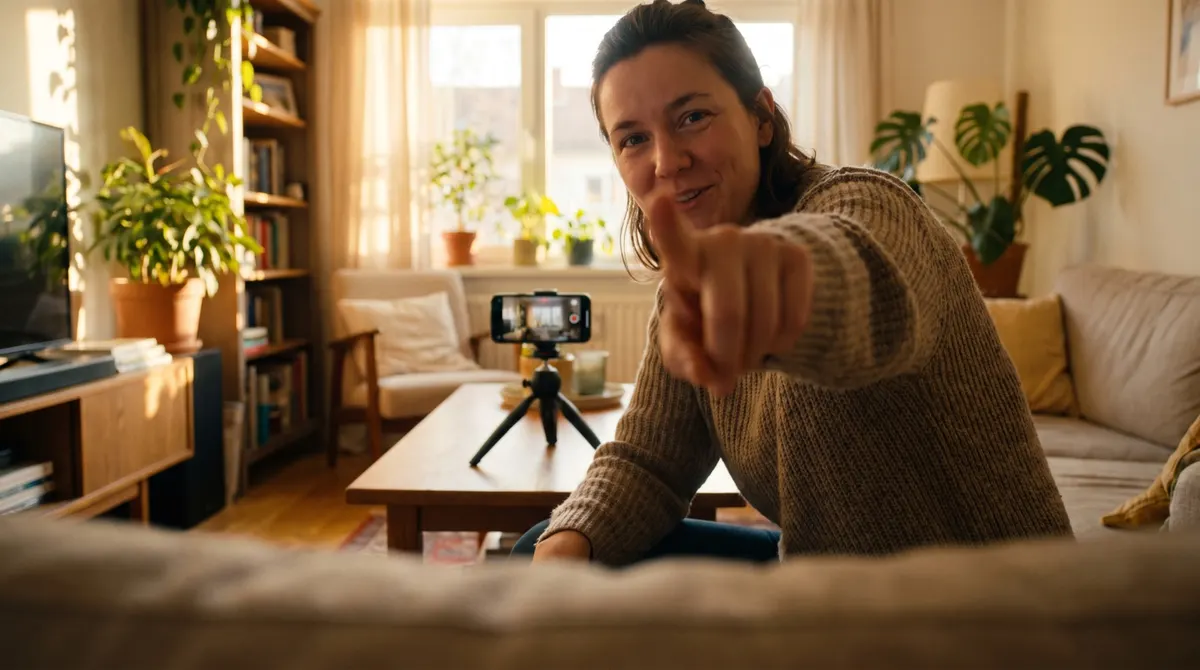
A hook is the first 1 to 3 seconds of a video, the opening sentence or visual that captures attention and decides whether the person keeps watching.
Why the hook decides everything
Watch time starts at second one
Nobody decides to watch a video, one decides not to leave it. That decision is taken before understanding the subject, on a face, a movement, a sentence.
Algorithms reward early retention
A video abandoned early is pushed little, whatever its later quality. That is not a punishment, it is a consequence: the system observes that the first viewers did not stay.
Brands buy results
In advertising, a weak hook is paid for in cost per view, immediately and visibly. That is why a creator able to produce several hooks is worth more than a creator producing one perfect video.
The five most common types of hook, with examples
Five families covering almost all videos that work.
The named problem: the viewer's exact difficulty is stated, without detour.
The contradiction: the opposite of what everybody believes on the subject is announced.
The immediate demonstration: the result is shown before anything is explained.
The closed question: a question the viewer answers mentally in one second.
And the admission: starting with what you got wrong, which disarms mistrust.
How to write an effective hook
Write the hook last
Write the body first, then look in what you said for the strongest sentence, and move it to the opening. The best hook is almost always a sentence that already existed in the middle.
Speak to one person
A hook addressing everybody holds nobody. Name the precise situation, not the audience category.
Match the words to a visual
The sentence and the image have to carry the same information. A strong hook delivered over a neutral shot loses half its effect.
Put the promise or the pain first
The first word counts more than the sentence. Start with what interests the viewer, never with a presentation of yourself or the brand.
Stay concise
A hook has to be said in one go, without taking a breath. If you have to breathe in the middle, it is too long.
How to test your hooks
Five steps, applicable with no paid tool.
Shoot several openings over the same video body, in the same session.
Publish or run the variants separately, never mixed.
Read the retention curve, dealt with above, and not the number of views.
Keep the winning opening and reuse it on another subject, to check it really is the one working.
And keep a written list of the hooks that worked, with the context: that is the only asset that accumulates in this trade.
Four families of hooks, four effects
| The family | How it opens | What it produces |
|---|---|---|
| The direct question | With a known problem | The viewer recognises themselves |
| The result first | With the end of the story | Curiosity about the rest |
| The contradiction | With what everyone believes | The urge to check |
| The silent demonstration | With a gesture, no word | Attention before sound |
What kills a hook
A second of logo, a greeting, or a sentence announcing what you are about to say. The viewer decides before the sentence ends.
How you find one that works
You write five, shoot them back to back in one session, and cut five versions of the same body. It is the only method that costs little and actually settles the question.
Where the hook sits in your script
Four structural markers.
Seconds 0 to 3: the hook, one idea only.
Seconds 3 to 8: the confirmation of what the hook promised, otherwise the drop comes here.
The body: the demonstration, the product, the proof.
And the end: one action requested, not three.
One last marker: a hook is not a slogan, it is a door. It should not summarise the video nor charm, it should make leaving costly. That is why a simple, precise and slightly uncomfortable sentence holds better than a brilliant formula.