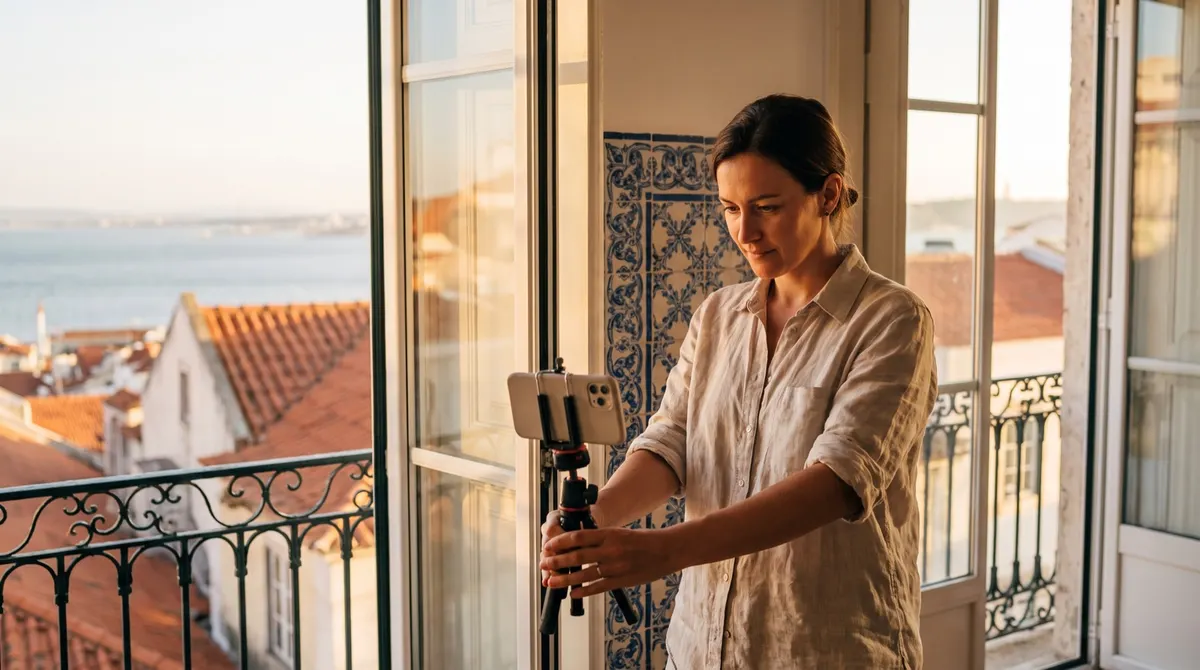
A UGC portfolio is a small set of sample videos, often 3 to 6, showing a creator's style and level to brands, with no need for followers.
What a UGC portfolio really is
Six characteristics distinguishing it from a social account.
It shows deliverables, not posts: format, duration and use count more than views.
It holds three to six videos, because a buyer never looks beyond that.
It reads in under two minutes, the real time a buyer gives it.
It is consistent: same level, same care, same dominant category.
It is accessible with no sign-up, no request and no password.
And it contains a price or a range, without which it cannot be compared.
What goes into it
Six elements, in order of importance for a buyer.
The videos themselves, in full-frame vertical with corrected subtitles.
One line under each, stating the type of product and the format asked for.
Your availability, expressed as a turnaround from receipt of the product.
The categories you work in, and those you refuse.
The languages and accent you carry on screen.
And a working way to contact you, checked recently.
Why it counts more than followers
Five reasons, specific to the trade.
A UGC order buys a file, not an audience: the follower count enters no calculation.
The brand will run the video from its own accounts, with its own budget.
What it wants to estimate is production quality and reliability, two things only the portfolio shows.
A private or empty account therefore changes nothing, and many well-paid creators have no audience.
And a large account is not an advantage: it may even raise fears of an influence rate for production work.
The formats to include
Piece to camera
The most requested and most revealing format: it shows your voice, your delivery, your ability to hold a text without reading it.
Demonstration or tutorial
It proves you can film hands, a gesture and a product in close-up, a skill distinct from speaking to camera.
Unboxing
The market's most ordered entry format, fast to produce and immediately legible to a buyer.
Voice-over on cutaways
It shows you can produce a video without appearing, which opens up orders where a face is not wanted.
A fifth format, often absent and much appreciated: the answer to an objection, where you handle a precise question a buyer is asking.
Where to show it
Five options, with their real use.
A dedicated public page, the most legible and the only one that belongs to you.
A profile on a matching platform, useful because buyers are already looking there.
A social account reserved for work, separate from the personal one.
A shared folder, practical for sending heavy files but poor as a shop window.
And a one-page document, still requested by some agencies.
The practical rule: one main page, and everywhere else a link to it.
What a portfolio must prove
| What it shows | What the brand infers |
|---|---|
| Three videos of equal quality | Consistency, not luck |
| Three different formats | The ability to adapt |
| A product demonstration | Technical command |
What has no place in it
Personal tests, videos from three years ago, and edits shot with gear you no longer own. A brand judges a profile on its weakest link.
The difference with a social account
An account shows what you publish, a portfolio shows what you deliver. The first is judged on reach, the second on adherence to the brief, and different videos win in each case.
Next step: build yours
Six steps, achievable in a week.
Choose a category you know and in which you already own products.
Shoot four videos covering the four formats above.
Deliver them as if they were orders: vertical format, corrected subtitles, named files.
State clearly that they are samples if they are not real orders: nobody holds it against you, and the lie is discovered at the first question.
Remove the weakest, dealt with above.
And replace one video a month rather than adding one, so the set stays consistent and recent.
One last marker: a portfolio is not there to show everything you can do. It is there to make a decision easy and fast for somebody hesitating between you and three other profiles. Fewer videos, better chosen, decide quicker.
Sources
- Portal do Empreendedor (MEI), Brazilian government
- Receita Federal, Brazilian tax authority
- Simples Nacional, official portal
Checked on 4 September 2026. Thresholds and rates change: where this guide and the official source disagree, the official source is right.