
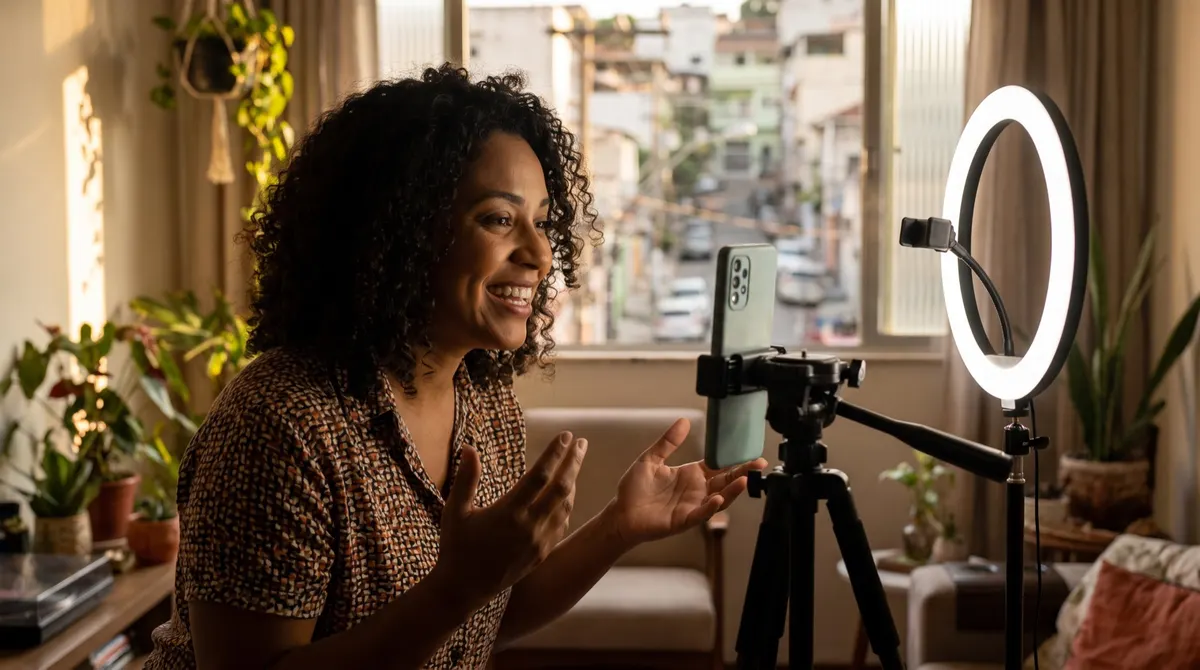
A clear definition of user-generated content, its difference from influence and advertising, and why it matters in Brazil.
What UGC concretely means
Five characteristics of a video of this kind.
It is shot by an ordinary person, with a phone, in a real place.
It shows a use, a gesture or an opinion, not an advertising staging.
It is delivered as a file to the brand, which publishes it.
It comes with written usage rights, with a duration, a territory and channels.
And it remains a commercial communication, which supposes clear identification when it is published.
UGC and influencer marketing: the difference
Who publishes the content
In one case, the creator publishes on their account and their audience sees the video. In the other, the brand publishes on its own channels, and the creator's audience is not involved.
What you are paying for
In one case, you pay for an audience, visibility and a recommendation. In the other, you pay for a production and the right to use it, which is a service.
The cost
The first is paid according to audience size and fame. The second is paid according to production time, the number of deliverables and the rights granted, which makes it far more predictable and generally cheaper at equal volume.
The use
An influencer post lives a few days. A file delivered to the brand can serve for months, across several channels, provided the rights allow it.
Why UGC matters so much in Brazil
Five reasons specific to this market.
Vertical video holds a dominant place in product discovery there, which makes the format central rather than incidental.
The country is huge and diverse: one video cannot speak to every audience, which pushes towards producing several variants rather than a single production.
Trust runs through the person speaking, more than through the brand, which gives ordinary faces an advantage.
Commerce happens a great deal through messaging and recommendation, a context where a short video travels better than a page.
And the local production cost allows several angles to be tested, which makes the method accessible to small brands as well as large ones.
What this format is, and what it is not
| It is not | It is |
|---|---|
| An influencer post paid for reach | A video produced for the brand |
| A spontaneous customer review | Commissioned, paid work |
| An ad shot in a studio | A shoot in real conditions |
Who owns the video in the end
The brand, strictly within the rights bought: media, territory and term. Outside those bounds it bought nothing, even holding the file.
What explains its effectiveness
The point of view. Viewers recognise a bedroom, a kitchen, a hesitating hand. That familiarity carries an argument the same words, said in a studio, would not have carried.
Common UGC formats in Brazil
Six formats, by frequency of use.
The piece to camera, thirty to sixty seconds, a problem and a solution.
The demonstration of use, filmed in close-ups, with the real sound of the product.
The unboxing, useful when the packaging and the quantity are part of the argument.
The three reasons format, much requested because it adapts easily.
The answer to a frequent question, which also feeds customer service.
And the comparison between two versions of the same product, more credible than a comparison between brands.
One useful clarification for brands: whatever the format, the video has to be identifiable as commercial communication, the statements about the product have to be justifiable, and regulated categories, health, food, finance, follow specific rules. Those points are checked with a lawyer before the shoot.
One last marker: UGC is not a visual style, it is a way of buying. What the brand acquires is neither an audience nor an aesthetic, it is a video file it can publish itself, for a written duration, on defined channels. All the rest, including the phone held in the hand, is only a consequence of that definition.