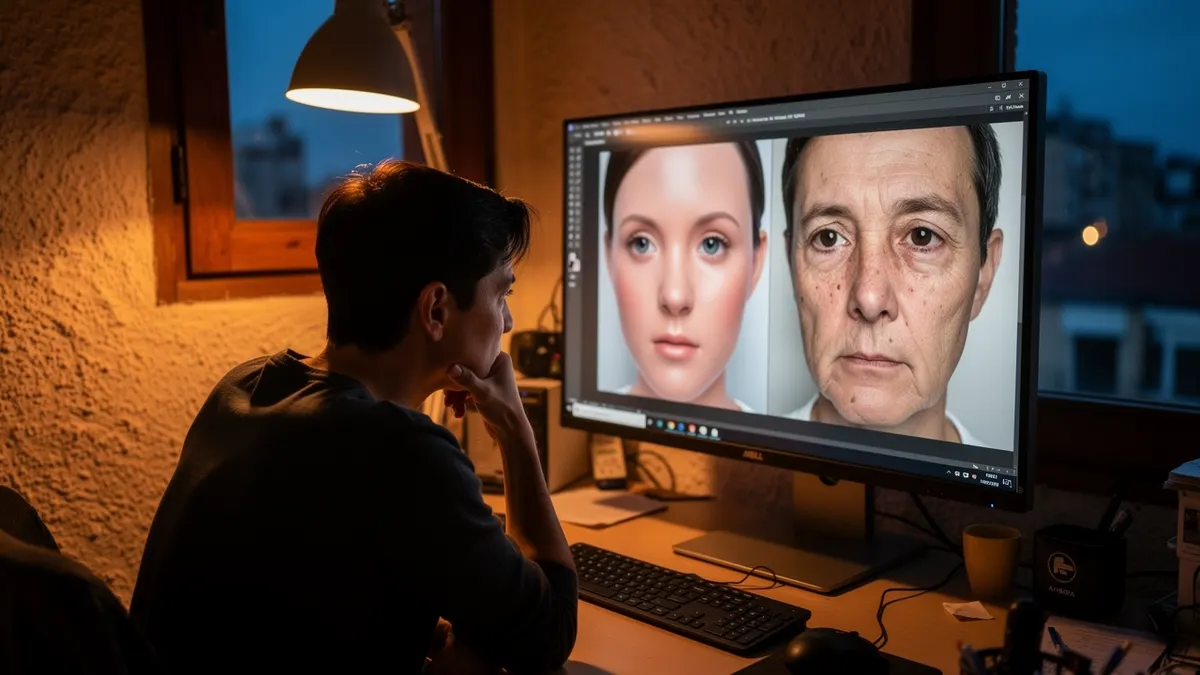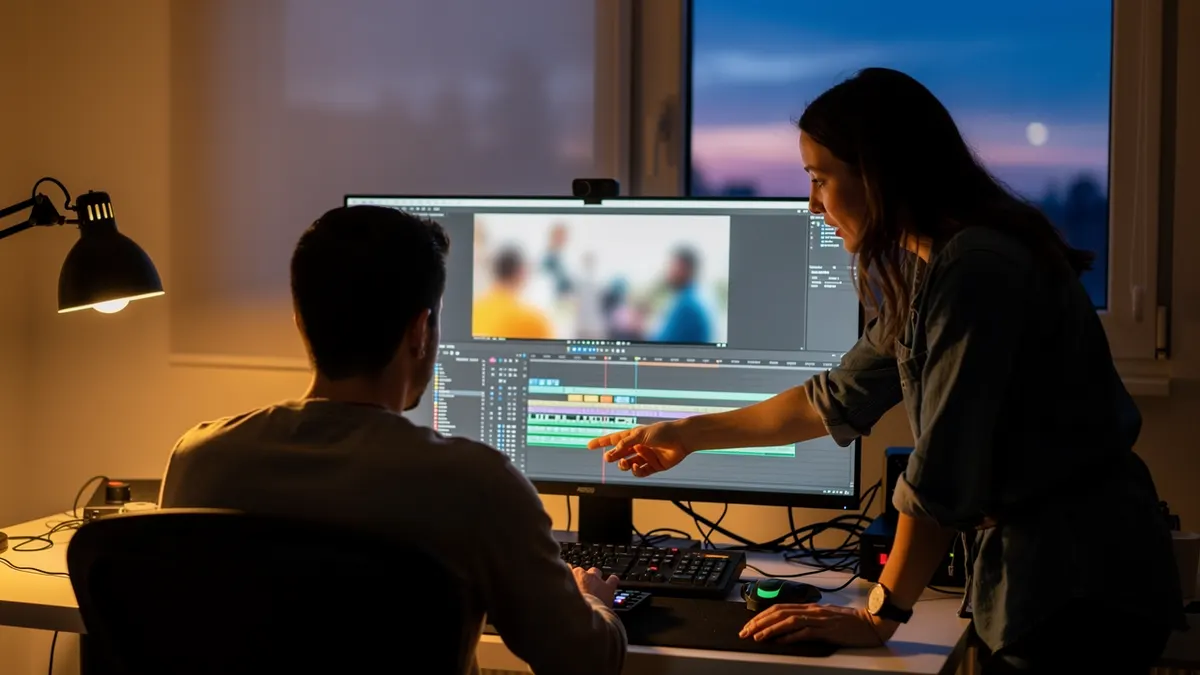
The promise sells itself: one shoot, then twenty variants without calling anybody back in. The brand builds an avatar from its creator and generates the whole catalogue from there. The problem shows up three months later, when something has to change and nobody wrote down what would be needed to change it.
What the build session really requires
An avatar does not come out of the videos that already exist. It comes out of a session recorded expressly for it, and that session looks nothing like a UGC shoot.
Neutral background and flat light. Anything with character in the image (a window behind, a nice shadow) becomes a fixed element that will appear in all twenty variants.
A stable, constant frame. The same distance, the same height, no reframing. What you are after is not a good take, it is homogeneous material.
Long, neutral speech material. Complete sentences, normal pace, no marked gestures and no jokes. Expressiveness gets added later; what is needed now is phonetic coverage.
Several wardrobe passes. If the avatar has to appear in two seasons, both are shot the same day.
Why this is decided before, not after
Because a build session cannot be half finished. If the mid-shot or the wardrobe variant is missing, the person has to be called back and the whole thing restarted, and the saving that justified the project disappears on the first rebuild.
What the avatar can do, and what it cannot
| Task | With the avatar | When you have to reshoot |
|---|---|---|
| Say a new script | Yes, that is its function | Never, as long as the script is spoken |
| Hold a new product | Not credibly | Whenever the product is handled |
| Change setting | Only if that background was shot | If the background matters to the message |
| Show a specific gesture | Rarely | Demonstrations, textures, before and after |
The second row decides whether the project makes sense at all. An avatar is for speaking, not for demonstrating. If the brand's catalogue needs hands on the product, most of the work will still be a real shoot.
The split that works
The avatar covers the repetitive and spoken: price announcements, product introductions, seasonal messages. The real creator covers what has to be shown. Almost nobody replaces the second with the first without it showing.
What breaks credibility
An avatar does not fail in the face, which is where everybody looks first. It fails at the edges, and the viewer notices without being able to name it.
The hands. The most frequent and most visible flaw. As soon as a hand enters the frame and moves, the illusion suffers. Scripts that work keep hands out or still.
The held object. A product in the avatar's hand rarely behaves like a real object: it has no weight, it does not turn properly, it casts the wrong shadow. No script saves this one.
Gaze and blinking. A rhythm that is too regular reads as strange within seconds. It shows sooner in a close shot than in a mid shot, which is why the mid shot ages better.
Audio that is too clean. A voice with no breath and no room tone sounds like a voice-over, not a person. A little ambience recorded in the original session helps more than any later adjustment.
The shot that forgives most
The mid shot, hands out of frame, background with no depth. It is not the prettiest, and by contrast it is the one that survives repetition without the viewer starting to study details instead of listening to the message.
The objection you always hear
"Nobody is going to notice." Sometimes that is true, and it still misses the point. People who notice rarely say so: they stop watching. The cost is not somebody calling it out in the comments, it is the piece underperforming with nobody able to explain why.
And when somebody does say it, they say it publicly, about a brand that had not announced it. That is the difference between using an avatar and hiding one.
The expiry date
An avatar ages, and not because of the technology. It ages because the person changes their haircut, because the packaging gets redesigned, because the brand changes typeface.
It pays to fix in advance how often the session is redone, and to budget for it. A planned annual rebuild costs considerably less than an emergency rebuild mid-campaign.
What shortens the useful life. A background with datable decor, a seasonal garment, a product visible in the frame. The more neutral the source material, the longer it lasts.
What to test before building
Here is the advice that saves the most money, and it is a test, not a theory.
Before commissioning the full build, ask for a short sample using the actual script you intend to use, in the markets where you intend to use it. Not a demo text: the scripts the brand has planned, with its product names and its figures.
What to look at in that sample
How proper nouns and brand names sound, which is where the most visible errors appear. How a figure reads out loud. And, if the brand sells across several Spanish-speaking countries, how the same text sounds to an ear from each market.
There is no general answer to whether an avatar performs equally in Spain and in Latin America: it depends on the material it was built from and on the tool. That is why you test rather than assume, and why you test before paying for the full build.
The disclosure, where it applies
Where the video shows a real person whose likeness or voice has been generated or manipulated, a transparency obligation under the European AI regulation comes into play: that content has to be identified as artificially generated or manipulated.
In practice that comes down to two actions. Mark the content with the tool the platform provides for it, and do not strip that mark when re-exporting the file.
And there is a third action that is not legal but common sense: tell the person whose avatar it is. Finding out from the published post is the fastest way to lose the creator the project was built on.
Sources
- Regulation (EU) 2024/1689 on artificial intelligence
- European Commission, regulatory framework for AI
- YouTube, disclosing use of GenAI content
Checked on 8 September 2026. This guide is not legal advice. Where this guide and the official source disagree, the source prevails.