
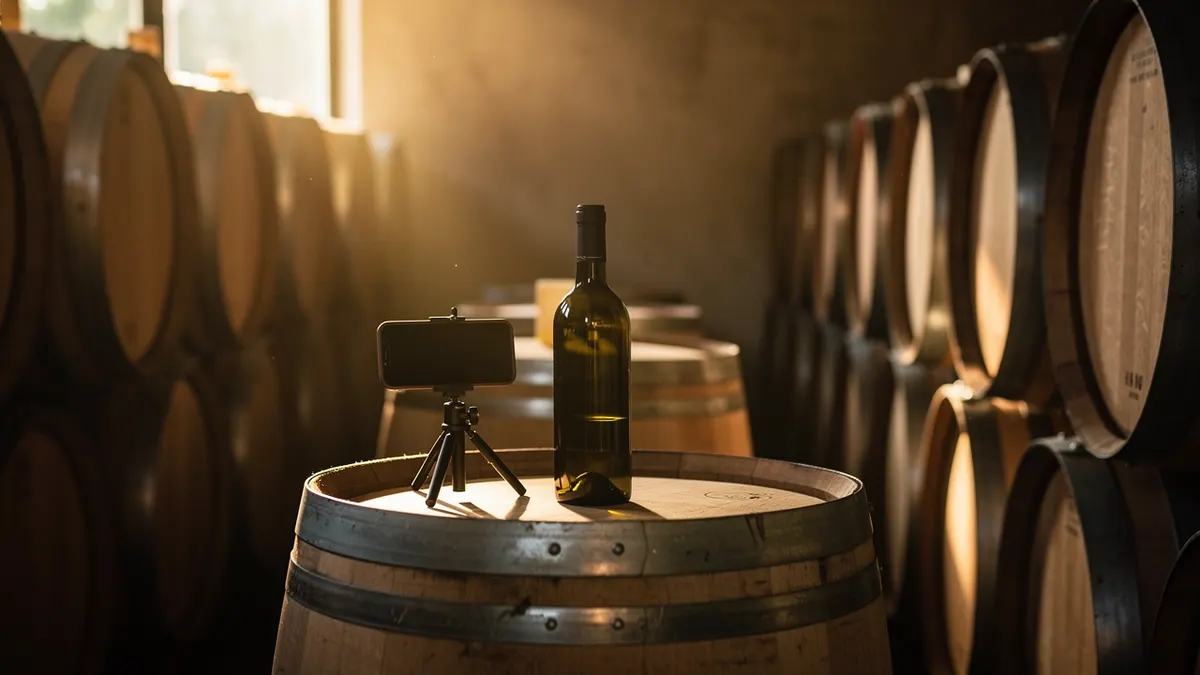
The video shot at the winery is beyond reproach: hands in the harvest, a vat, a label in close-up, nobody drinking. The house lawyer refuses it anyway, and the reason is not in the picture: the video was meant to run as an insert before requested content, on an account part of whose audience is under eighteen.
In France, an advertisement for an alcoholic drink is judged first on its medium, then on its content. The code de la santé publique (the French public health code) does not say what is forbidden, it says what is permitted, and whatever is not on the list falls.
The medium before the content
Article L3323-2 of the code de la santé publique lists the media on which advertising for an alcoholic drink may appear. The list is exhaustive and short. It covers the print press (excluding publications aimed at young people), radio broadcasting in set time slots, outdoor posting, traditional fairs and festivals, and online public communication services.
That last entry is what matters to a creator campaign, and it carries three reservations: services principally aimed at young people are excluded, as are those published by sports associations and federations, and on those that remain, the advertising must be neither intrusive nor interstitial.
That last condition decides everything. A video a user reaches by scrolling their feed is neither intrusive nor interstitial; an ad slotted in before the requested content is, by contrast, the exact reverse, since it imposes itself. The same file is therefore compliant on one buying line and out of bounds on another.
The creator account whose audience is under eighteen
The exclusion targets services principally aimed at young people, which is not the same as a general account followed by minors: a creator who talks about cooking or interior decoration does not publish such a service.
The room exists, but it has to be documented. Ask for the account's demographic export before signing: that is the exhibit showing the choice was not made blind. Switch on the age restrictions on the media line, and set aside creators whose editorial line speaks to minors.
Advertising or terroir content, the 2016 boundary
Since 2016, article L3323-3-1 has provided that content relating to a region, a terroir, a know-how or a heritage, tied to a drink under an appellation d'origine or a geographical indication, does not constitute advertising in favour of an alcoholic drink.
Its reach is considerable and remains little used. Content whose real subject is an appellation, a landscape or a cellar gesture does not enter the regime: no list of media, no restricted content, no health warning, because it is not advertising. A house under an appellation has room its competitor does not.
Three things tip terroir content back into advertising. The brand pushed as a product to buy, when the name of the cuvée comes back in every shot or a promo code accompanies the post. The encouragement to drink, which sometimes lies in a gesture. And the shift of subject, as soon as the content stops talking about the region and starts on the bottle.
The text qualifies content, not a budget: a paid collaboration can bear on terroir content, but the more tightly the house frames it, the more the subject drifts towards the product. The exception exempts nothing on the transparency side: the disclosure required by the 2023 law is still owed, a subject our guide to the UGC brief in France covers.
The closed list of what an advertisement may show
When the content really is advertising, article L3323-4 says what it may contain, and nothing else. Our article on UGC for wine and spirits in France walks the list through in shooting language; only three points are missing there, and each changes a script.
The packaging may be reproduced: the container, the box, the label as it stands. An unboxing shot of a gift case is not irregular in itself.
Olfactory and gustatory characteristics have been on the list since 2005. A tasting note, the nose, the palate, the length, is permitted content, and that is more material than brands which rule out taste tend to keep.
Then comes the word that closes the list: what is not on it is forbidden, even when true. An evocation of conviviality, of celebration or of social success is not discouraged, it is off the list, and the authenticity argument has no purchase.
The live and the aperitif
Live is the format where the list breaks without anyone noticing. Nothing is edited, so nothing is removed: a commented tasting, a glass raised to camera, a line about the evening ahead, and the content leaves what the text allows.
Live is therefore not ordered like any other campaign format here. A house set on it writes the run of show sequence by sequence, plans a permanently superimposed health warning and accepts that the replay will be cut. The difficulty is the same for a venue filming its own service, covered in our article on UGC for restaurants and cafés in France.
The indirect advertising nobody sees
Article L3323-3 extends the regime to what it calls indirect advertising: advertising in favour of a product or an article other than an alcoholic drink which, by its graphics or by the use of a trade mark or another distinctive sign, recalls an alcoholic drink.
Translated onto the set, that means objects no script mentions. The sweatshirt bearing the house logo worn throughout the video. The engraved glass in close-up. The syrup or the sparkling water that shares its name with a spirits brand. Each of them tips content that says nothing about alcohol into the regime for alcohol advertising: same media, same restricted content, same health warning.
This is the most frequent hole in a creator campaign, because it does not travel through the script but through the parcel. List what goes into the crate, and read the costume and the background with the attention reserved for voice-over.
The prize draw
A prize draw whose prize is a bottle is a promotional operation, therefore advertising: authorised media, restricted content, health warning. Two difficulties come on top. The usual mechanic, tag two friends or reshare to a story, manufactures an encouragement and pushes the message to accounts whose age nobody knows. And the rules have to exclude minors, which a self-declared tick box holds badly. The soundest prize is the experience on site, with age checking and no relay.
The distribution decisions come down to this.
| Distribution situation | Applicable regime | Condition to hold | Text |
|---|---|---|---|
| Video published on a creator's account | Advertising permitted | Content limited to the list, health warning on screen | L3323-2 |
| Ad slotted in before the requested content | Advertising prohibited | A format that does not impose itself on the viewer | L3323-2 |
| Distribution on a service aimed at young people or published by a sports federation | Advertising prohibited | A service outside the two excluded categories | L3323-2 |
| Content on an appellation, with no brand pushed | Outside the advertising regime | Subject centred on the region or the know-how | L3323-3-1 |
| Video showing a garment bearing the house logo | Indirect advertising, same regime | Treat the garment like the bottle | L3323-3 |
The health warning in a vertical video
Every advertisement in favour of an alcoholic drink comes with a health warning, and its wording does not belong to the brand. The core imposed by the code de la santé publique is that the abuse of alcohol is dangerous for health; the trade uses it in its full form, « L'abus d'alcool est dangereux pour la santé, à consommer avec modération » (abuse of alcohol is dangerous for health, drink in moderation), which the ARPP recommendation allows to be cut back to its first half on a small medium. What is not done is rewriting it in one's own words.
The text fixes the wording, it does not say where to place it in a vertical format. Three decisions remain, taken in the edit.
Placement. The warning lives in the image, never in the description: it folds behind a button, does not follow the file picked up for paid media, and disappears when the content changes platform. Within the image, the bottom of the screen belongs to the interface, buttons and automatic subtitles: a warning placed there is legible in the edit and covered on the phone, so it goes in the safe zone of that format.
Duration. The warning accompanies the advertising, not one shot. A one-second appearance at the end leaves most views without a warning.
Version. Ask for the clean source alongside the delivered edit, and decline it per placement rather than recropping a single overlay.
Who pays, and for what
The advertiser answers for the advertising it has distributed, and that responsibility is not delegated by contract. The creator who publishes on their own account distributes an advertising message in their own name and answers for it too, even when the script was handed to them word for word. The agency that chose the placements is not out of it either.
The penalty in the code de la santé publique is not a flat amount to be provisioned, and it is designed to stay proportionate to the scale of the operation, so to the distribution budget more than to the cost of the creative. In practice, Evin litigation does not arise only from an administrative inspection: accredited associations also go to court.
The ARPP Alcool recommendation adds a layer the text leaves open: it is not the law, it is the professional rule advertisers and agencies undertake to apply. The ARPP also gives an opinion before distribution, the only outside view a brand can get before going live.
The order of checks is the one a lawyer follows before signing off.
- List every planned placement: the creator's account, the brand's account, paid media, later reuse. Each is a separate medium, and one is enough to bring the operation down.
- Remove the placements the text excludes, a service principally aimed at young people, a medium belonging to an association or a sports federation.
- Test the format of the placements that remain: whatever imposes itself before the requested content goes out, whatever is reached by scrolling stays in.
- Only then read the content, the L3323-4 list or the terroir exception. This is where you look at the pictures.
- Check the health warning on every delivered version, and set down in writing who pays for the reshoot if it is missing.
The order is the heart of the matter: the first four questions are settled in a meeting, the fifth on set.
The foreign brand distributing into France
The test is neither the brand's head office, nor the creator's nationality, nor the country hosting the platform: it is the direction of the message. Advertising aimed at the French public falls under French law, and a Spanish house buying audience in France applies the French regime.
Two arbitrations exist: exclude France from the targeting, which is verified on the media line, not on the intention, or produce a compliant French version. The expensive scenario is the third, the international version that lands in France without having been thought through for it.
Sources
- Code de la santé publique, article L3323-2 (supports autorisés)
- Code de la santé publique, article L3323-3 (publicité indirecte)
- Code de la santé publique, article L3323-4 (contenu autorisé et message sanitaire)
- ARPP, Recommandation Alcool
- DGCCRF, Influenceurs : quels sont mes devoirs ?
Checked on 19 September 2026. This guide is not legal advice. Where this guide and the official source disagree, the official source prevails.