A restaurant does not sell the same thing at lunchtime and in the evening. Yet most publish the same videos at both moments, and wonder why the room stays empty during the week.
Lunch is a market under constraint
Someone looking for a weekday lunch has an hour, sometimes less. They decide while walking, on their phone, a few streets from work.
They are not looking for an experience. They are looking for three pieces of information: how long it takes, how much it costs, and where exactly it is.
A video showing a close-up plate over gentle music answers none of the three. A video showing the street entrance, the queue at ten to twelve, the set menu on the board and the plate arriving in four minutes answers all three.
The evening is decided differently
In the evening the time constraint disappears and another appears: several people have to be convinced.
What decides is no longer speed, it is the certainty that the place suits everyone: the noise level, the room around the table, whether you can linger, what there is for the person who does not eat like the others.
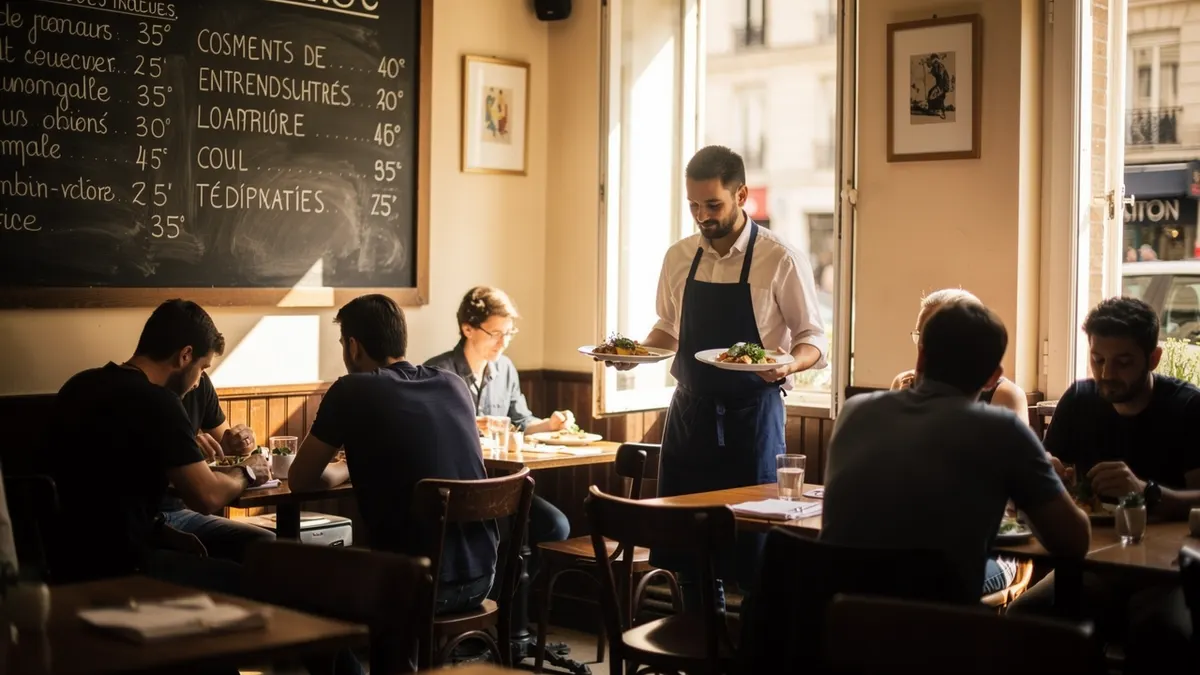
An evening video must therefore show the room more than the plate, and it has to be shot at the real service hour, not at six when everything is empty and perfectly lit.
Filming a room with people in it
This is the practical point everyone discovers while shooting: seated customers appear on camera.
Frame so that faces are not identifiable, or obtain the agreement of the people concerned before publishing. For what applies precisely to your case, the competent authority or your adviser remains the reference, and this question is settled before publication, never after.
Staff are in the same position: a waiter filmed at work must know where the video will be published.
Who films
The regular customer is the best profile: they know the place, they order what they usually order, and it shows.
The team works too, provided you film a gesture rather than a speech: the coffee being tamped, the board being arranged, the morning setup.
An outside creator is useful for more structured formats, provided they come during service and not after closing.
What does not work
Plated shots with no context. They are interchangeable and say nothing about the price, the place or the atmosphere.
Videos shot in an empty room, which give exactly the impression you want to avoid.
And music covering the sound of the room. The noise of a service is information: it says the place is alive.
The calendar that matters
Publish lunch content the same morning, between nine and eleven. Publishing at half past twelve means arriving after the decision.
Publish evening content early in the week for the weekend, because those outings are planned in advance.
And keep closures, public holidays and timetable changes out of videos: they change too often and make a piece untrue within days.
Which content for which goal
| Goal | Content | Length |
|---|---|---|
| Filling lunchtime | The set menu and price stated | 12 s |
| Making a menu known | Three dishes in a row | 25 s |
| Recruiting floor staff | The team before service | 20 s |
What is filmed without disturbing service
The empty room, the mise en place, the cellar, the front, the prep before opening.
What is approved before publication
The exact names of the dishes, the origin claimed, the prices displayed and the consent of those filmed.
What gets measured
Calls and messages received after a post, not views.
And above all the question asked at the table: how did you hear about us. It is the least elegant measure and the only one that tells the truth when the sale closes at the table.
Sources
- Urssaf, official auto-entrepreneur portal
- Service Public, how to become a micro-entrepreneur
- Service Public, crossing the micro-entrepreneur turnover thresholds
- ARPP, French advertising regulator
Checked on 4 September 2026. Thresholds and rates change: where this guide and the official source disagree, the official source is right.