A very large share of Belgian companies are family owned, often in the second or third generation, often technical, and often arriving at social video ten years after everyone else. When they finally do, the friction is rarely about budget.
It is about two people in the same building who genuinely disagree about what a video is for, and neither of them is wrong.
Two generations, two ideas of a video
What the founder wants
Proof. The workshop, the machine that was bought in the eighties and still runs, the certificate on the wall, the customers who have been buying for thirty years. Their instinct is that the business earns trust by showing what it has built.
They also carry a specific fear: that a short, casual video will make a serious company look unserious in front of the buyers who matter.
What the next generation wants
Attention. They can see that nobody watches a corporate film, that the phone is where an audience is, and that a competitor who does badly-lit short clips is getting more visibility than the family firm with better products.
Their frustration is that the founder judges content by whether it looks dignified rather than by whether anyone watched it.
Do not arbitrate, film both
The instinct is to pick a side and produce either a heritage film or a stream of short clips. Both choices lose half the company, and the half that loses stops cooperating, which is what actually kills a content programme in a family firm.
The format that works
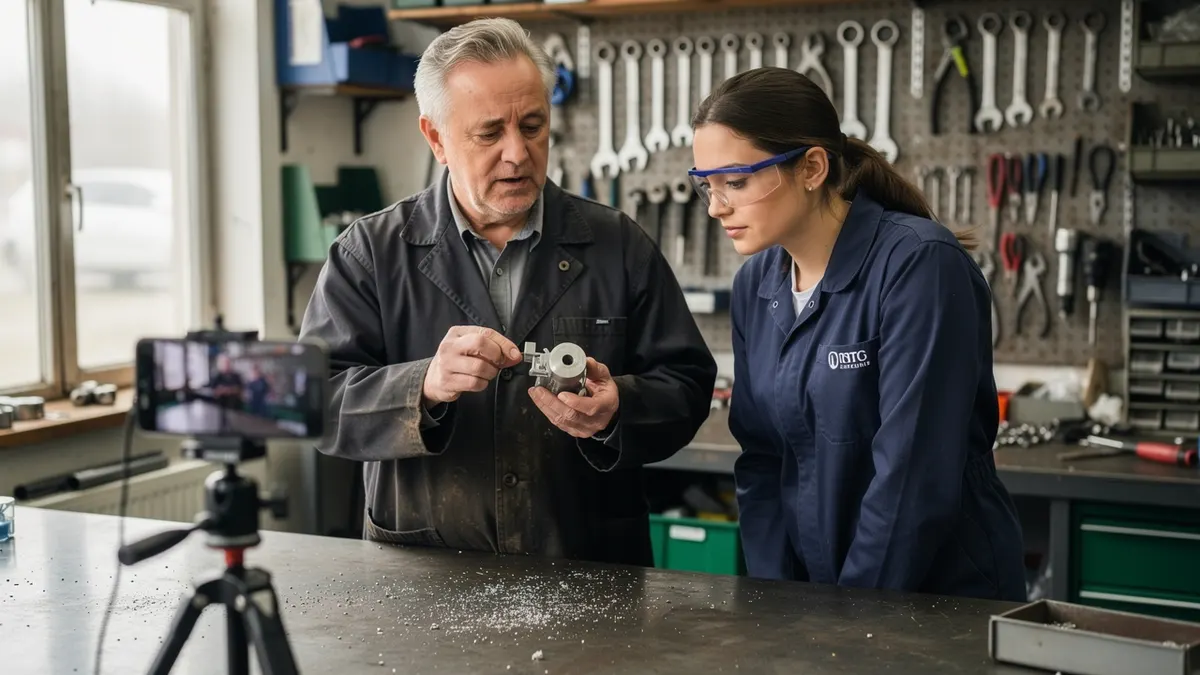
Put them in the same frame. The founder explaining why a step cannot be rushed, the successor asking the question a customer would ask. Two people who disagree slightly on camera are far more watchable than one person delivering a message, and it solves the political problem at the same time.
It also produces something a competitor cannot copy: a company where you can see who is answerable for the work.
The handover is the material
Most family firms treat the succession as private, and it is the most interesting thing about them from outside.
| What is happening in the company | What it gives you to film |
|---|---|
| A founder still on the floor daily | Craft, judgment, a hand that knows |
| A successor changing something | A real before and after, with a reason |
| Old machines beside new ones | Continuity that is visible, not claimed |
| Long-serving staff | Testimony that no script could write |
| A customer of thirty years | The strongest reference the firm owns |
None of that requires a large budget. It requires a decision to talk about the business as it actually is instead of the version that appears in a brochure.
Three mistakes that lose the founder
Filming without telling them why. A founder who is handed a finished clip they did not expect will object to it on principle. Show the plan first, in one page.
Making the first video about the successor. It reads as a takeover announcement inside the company, whatever the intention. Start with the work, not the person.
Publishing something sloppy in week one. The founder's fear is dignity, so the first three pieces should be careful. Once trust exists, the tolerance for looser formats grows quickly, and that is when the volume can start.