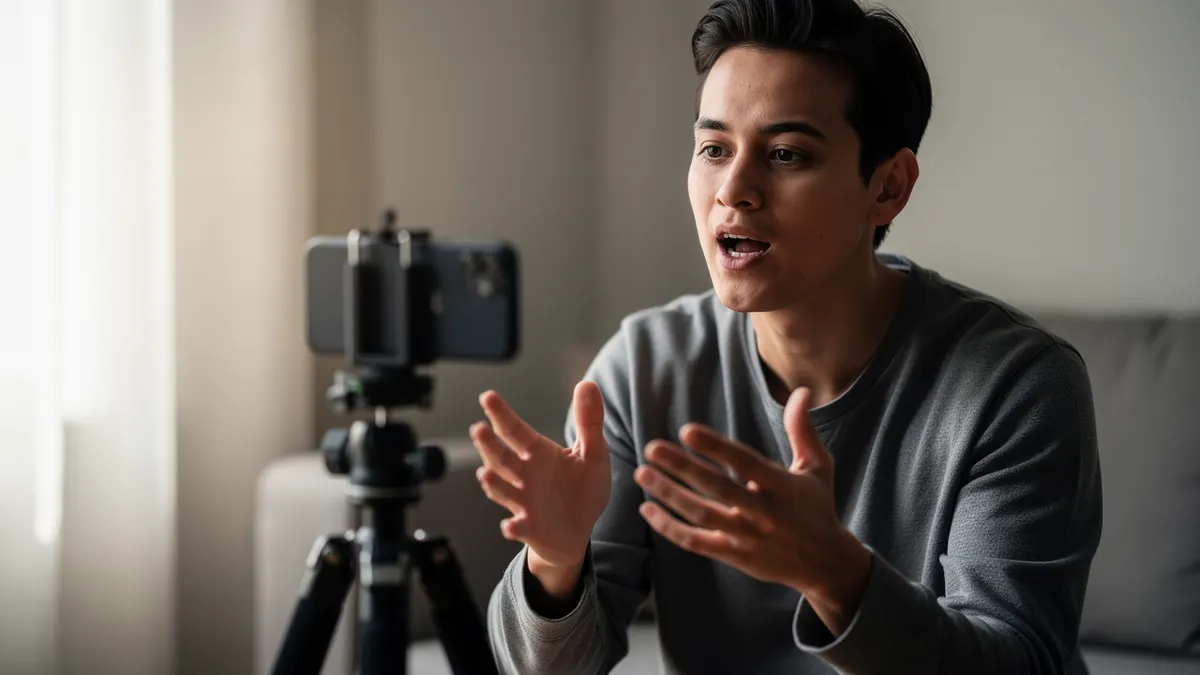
Almost nobody is natural in front of a camera at first. It is not a character trait, it is a situation: you are speaking to an object, with no reply, no gaze, no rhythm given back to you.
Why your voice sounds false
It is not: you are hearing it for the first time.
When you speak, you hear your voice through the bones of your skull, deeper and rounder. The recording transmits only the air, so it is higher and thinner. What you dislike is simply your voice as everybody else has always heard it.
There is nothing to correct. After a dozen videos the sensation goes away on its own.
The exercises that work
Five, from the most effective to the least known.
Record three times in a row without watching back: the third take is almost always the good one, because the self-monitoring runs out.
Speak to one specific person, somebody real, and address the video to them in your head. The tone changes immediately.
Prepare only the first sentence. A learnt text can be heard; a prepared opening is enough to launch the rest.
Move while you speak, even two steps. A body in motion allows the voice to vary.
Listen back to the audio only, without the picture. You will judge delivery and hesitation without being distracted by your appearance, which is not the problem.
How many takes are normal
Many more than you think.
Five to ten takes for a thirty-second video is a common average, including among experienced creators. What marks out a professional is not getting it right first time, it is knowing to stop at the right take rather than hunting the perfect one.
Set yourself a limit: ten takes, then keep the best. Beyond that, tiredness degrades everything.
One remark specific to Italian
Delivery speed works against you in the edit.
A fast delivery, common in speech, produces sentences that overlap and cut badly. So mark a real breath between each sentence, a whole silent second.
That silence will be invisible in the edit and will give you clean cutting points. It is the only technical trick that immediately improves a piece to camera.
What each setting changes
| Setting | Before | After |
|---|---|---|
| Camera at eye height | The gaze drifts | The gaze holds |
| Microphone at thirty centimetres | A distant voice | A clear voice |
| First line learned | A hesitant start | A clean start |
What is rehearsed without the camera
The gesture and the order of the steps: once the hand knows, the voice follows.
What the edit cuts
The breaths, the restarts and the first two seconds of every take.
If it remains an obstacle
There is an honourable way out.
Part of the market needs no face: hands only, voice-over, product demonstration, detail shots. Those formats sell at the same price and some brands prefer them, because they age better and can be produced in several languages.
Start there if speaking to camera blocks you, and come back to it later, or never.