Filming UGC on a phone: light, framing, sound and mobile editing, accessible advice for Brazil.
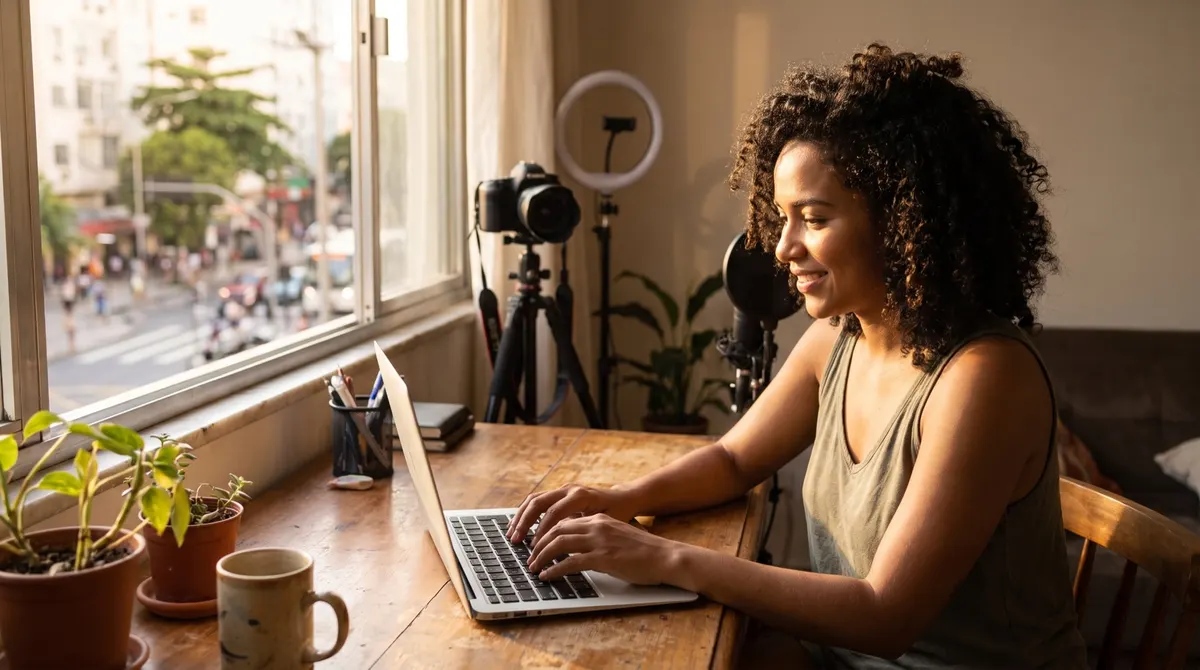
Your phone is enough to start
Six reasons, all verifiable.
Brands buy proof of use, not a studio image: an over-polished look even reduces effectiveness.
Platforms compress video heavily, which erases much of the gap between devices.
Full-frame vertical is native on a phone.
Editing happens on the same device, which removes file transfers.
A phone is held, set down and moved in one second, which multiplies the angles.
And the money not spent on equipment funds the products you film to build your portfolio.
Use the Brazilian light to your advantage
Six rules adapted to the climate.
Avoid the vertical midday sun: it hollows the eyes and burns the whites.
Film late morning or mid-afternoon, when the light comes from the side.
Stand facing a window, never with your back to it.
Use the shade of a wall or a doorway as a natural diffuser, the light there is soft and constant.
Close white curtains rather than adding a lamp: they do the same job.
And avoid mixing daylight and a yellow bulb, which gives a greenish complexion impossible to correct.
Framing and backgrounds
Six settings that make a video look professional.
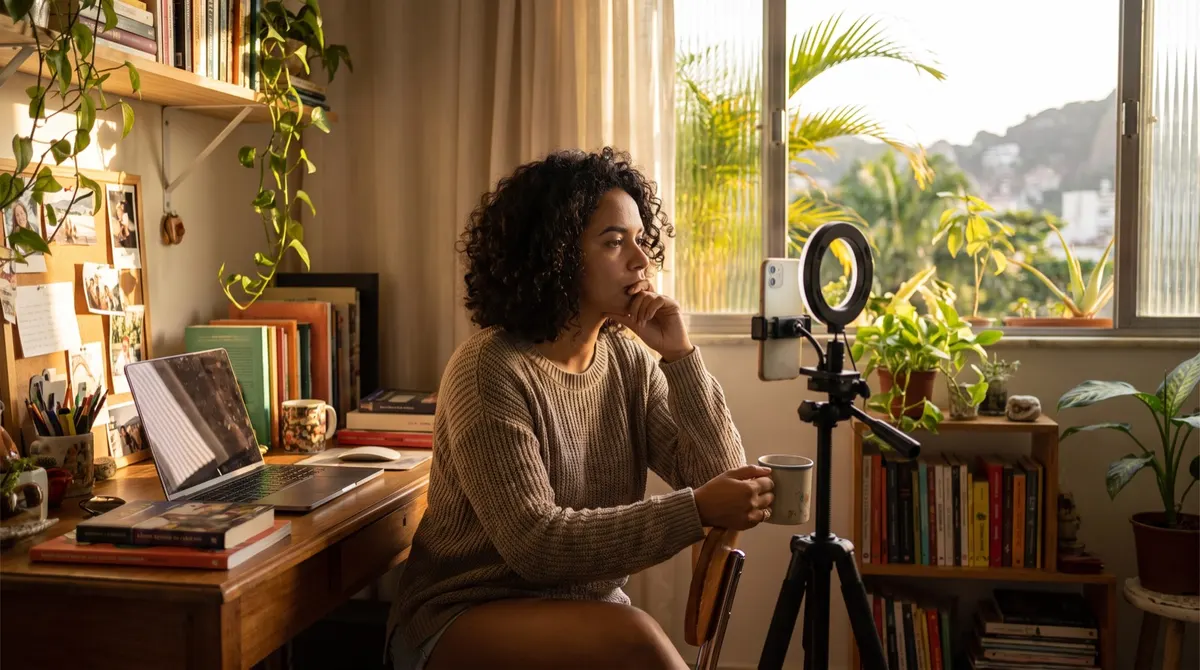
The phone at eye height, never from below.
Room above the head, but not too much: the face occupies the upper third.
A real but tidy background, with one or two objects that place the location.
Depth behind you: a wall against your back flattens the image.
The product held at face height when you show it, no lower.
And the frame checked before every take, because an awkward object is always noticed at the edit.
Sound: the half everybody forgets
Six moves that settle the sound with no microphone.
Filming in a room with fabric: curtains, bed, sofa, clothes.
Switching off the fan and the air conditioning during the take, even if it means filming in short sequences.
Getting closer: at one metre the phone's microphone is fine, at three metres it is not.
Closing the window on the street side, and filming outside traffic hours.
Recording three seconds of silence before speaking, which allows the background to be cleaned at the edit.
And listening to the first take on headphones before continuing, because a sound fault cannot be recovered.
Editing directly on the phone
Six steps, twenty minutes per video.
Cut the start and the end, often one second too many on each side.
Remove hesitations by laying a cutaway over them.
Add automatic subtitles, then correct them by hand, particularly product names.
Place the text away from interface zones, top and bottom, where the platform's buttons hide it.
Export vertically, at a reasonable definition rather than the maximum, which speeds up sending.
And name the file with the brand, the format and the date, because that is what the client will see first.
The settings that change the result
| Setting | What to choose | Why |
|---|---|---|
| Resolution | 1080p at 30 frames | Light files, a natural look |
| Focus | Locked on the subject | It no longer jumps mid-take |
| Exposure | Locked as well | No more brightness shifts |
What matters more than the phone
The distance to the mic. Thirty centimetres in a furnished room beats a pricier device in an empty corridor, and it costs nothing.
What is checked before every session
Storage space, battery, a clean lens, and flight mode. Four points in twenty seconds that save a morning of shooting.
Practice is the real equipment
Five habits that progress faster than any purchase.
Filming one video a day for a month, even with no client.
Redoing the same take three times and keeping the third, never the first.
Watching your own videos with no sound, to see what a scrolling viewer sees.
Comparing one of your videos with an advertisement that works, shot by shot.
And buying, when a purchase becomes useful, in this order: a stable support, then a lapel microphone, then a light. Never a new phone first.
One last marker: in Brazil as elsewhere, what separates a usable video from a rejected one is almost never the device. It is an image that does not shift by itself, clean sound and a chosen frame. Those three things are free.