Handling humidity, the noise of rain and equipment care, and the corner of the house that always works.
A corner that stays set up
Three reasons never to move your set-up again.
Daily assembly and dismantling damage equipment more than use does.
Consistency of image becomes a signature brands recognise.
And settings are not redone: height, distance and exposure stay identical from one order to the next.
Choose a corner of the room rather than a flat wall, with a window to the side, and mark the tripod position on the floor. Two minutes of setting up instead of twenty.
Humidity, the silent enemy
Four steps, from the most important to the most discreet.
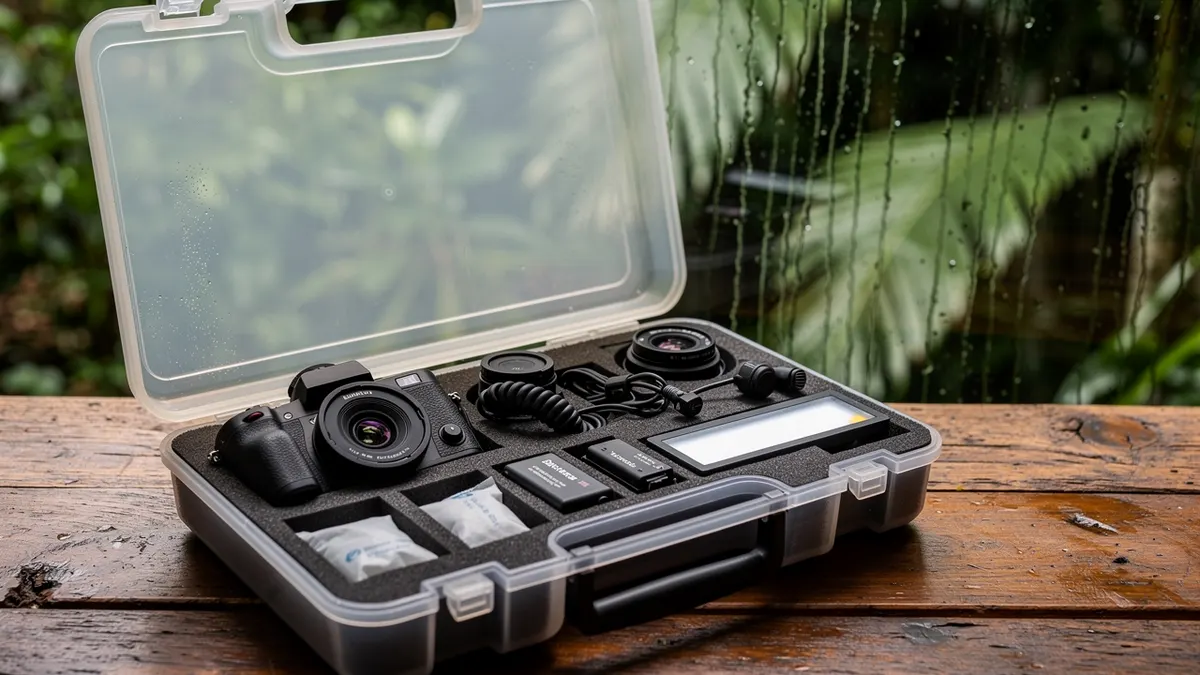
Store in an airtight box with desiccant, as described above.
Never leave the camera near an open window or in an unventilated room.
Take the batteries out after each shoot: they suffer as much as the optics.
And check the glass against the light once a month: a circular spot that spreads is the first sign.
One frequent trap: moving from an air-conditioned room to the outside. The thermal shock produces immediate condensation, and filming in that state marks the lens.
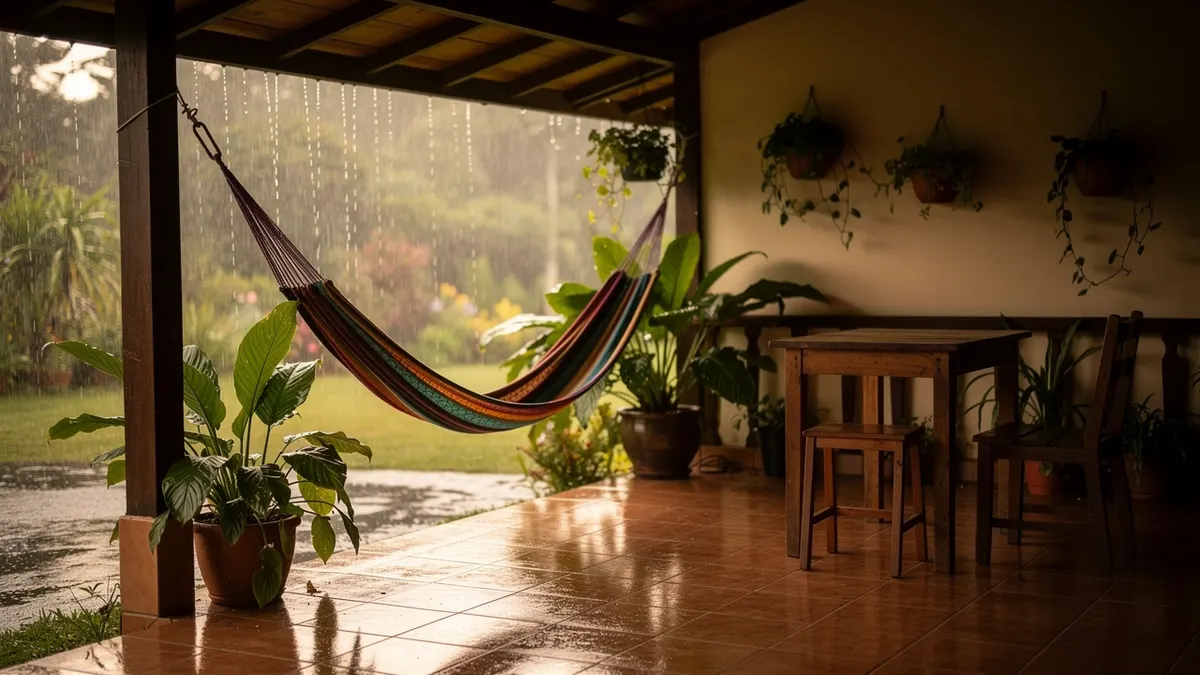
The noise of rain
Three solutions, in order of effectiveness.
Accepting the shift: during the rainy season, the downpour often arrives at the same hours. Shooting in the morning solves half the problem.
Bringing the microphone closer: a lapel mic at twenty centimetres strongly reduces the background noise.
And damping the room: a rug, a curtain, a bed out of frame absorb the reverberation that makes the downpour even more present.
One useful note: do not try to remove the rain in the edit. The processing degrades the voice more than the noise itself, and it can be heard.
Heat on camera
Four visible effects, and their solutions.
Sweat: film the face shots first, during the cool hours.
Make-up that moves: plan breaks, and accept a natural look rather than an impossible match.
The fan that is audible: switch it off during takes, which means shooting in short sequences.
And the camera that overheats and stops: film in the shade, and keep a spare battery somewhere cool.
One arrangement settling almost everything: starting at six in the morning. The light is soft, the air is still dry, the street is silent.
The space, solved
Three tricks costing nothing.
Moving the camera back rather than the subject: distance to the lens creates the impression of space.
Filming a corner and not a wall: the diagonal gives depth.
And using an open door or a veranda as background: a second plane with no extra square metres.
One note on credibility: do not empty the room. Two or three real objects make the image alive, and that is precisely what brands look for in this format.
What can be fixed in an ordinary room
| Problem | The cause | The corrective move |
|---|---|---|
| Echoing sound | An empty room | Film in a furnished room |
| Changing light | A shifting sky | Close the curtain and light it yourself |
| A busy background | Too many objects | Two metres of clear wall |
What is set up once and kept
A corner of the room marked on the floor, a lamp always in the same place, and a neutral background. That fixed set saves twenty minutes on every shoot.
What is checked before each take
The direction of the light, the mic level, the absence of personal objects in frame and of outdoor noise. Thirty seconds that avoid a full reshoot.
Three corners of a home and what they give
| The spot | What it allows | Its condition |
|---|---|---|
| The table near a window | Product and hand shots | A side window, never behind you |
| A plain light wall | The piece to camera | A tidy background, no reflections |
| The shaded terrace | Outdoor shots | A light wall bouncing the light back |
What most often fails at home
The sound. A fan, rain on a metal roof or an empty room ruins a decent take, and recording in a furnished room with the doors closed corrects more than any mic bought afterwards.
What humidity imposes on the kit
Taking it out of the bag gradually and keeping a cloth to hand. The lens fogs moving from a cool interior to the outside, and waiting ten minutes avoids losing the first takes of every session.
The real minimum equipment
Four purchases, in this order.
A wired lapel microphone, which changes the result more than any camera.
An airtight box and silica sachets, even before the tripod.
A tripod, even a simple one.
And a folding reflector, or a large white card.
One last marker, valid here more than elsewhere: the equipment that lasts is not the most expensive, it is the one stored properly. An entry-level camera that is looked after lasts three years in this climate, an expensive one left on a shelf does not survive two seasons.