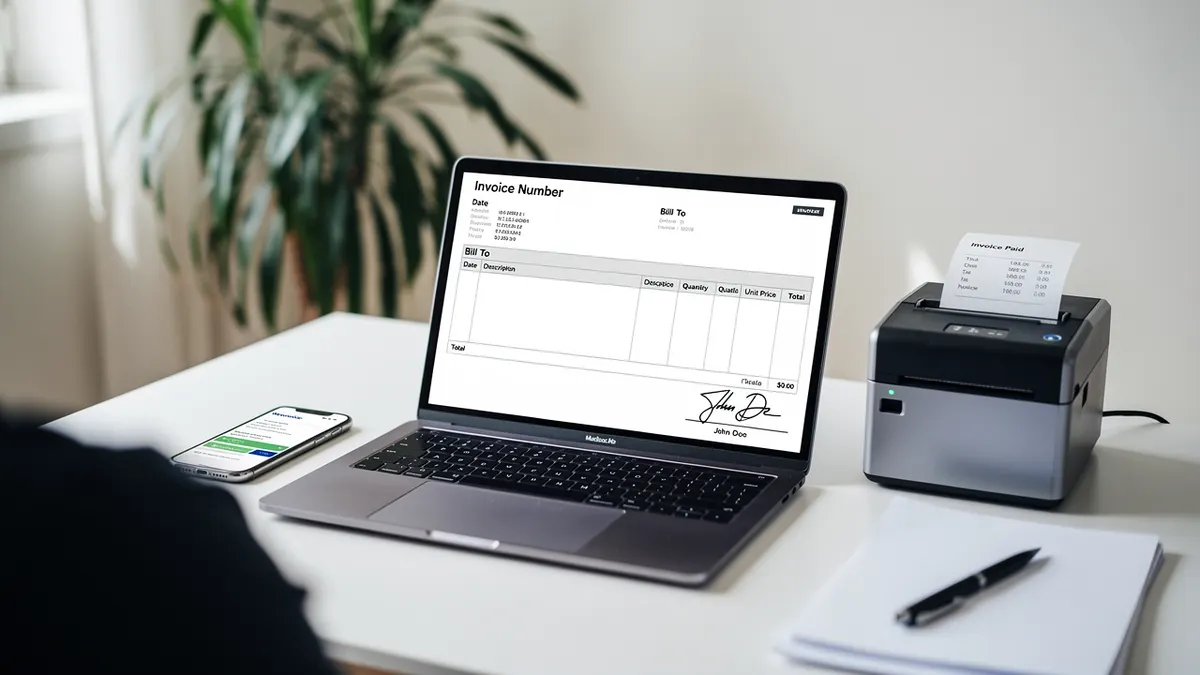
In this market the administrative question does not come after the sale: it decides which clients you can serve. And one technical detail decides the rest.
Why it decides your client base
Because it splits the market in two.
Structured companies, agencies and foreign clients going through a local entity cannot settle a service without a compliant document. With no ability to issue one, you are limited to very small operations and informal payments, meaning the clients who pay least and latest.
So at the start it is rarely a tax question: it is a question of access to clients who have a budget.
What registration involves
Three consequences, and it is better to know them beforehand.
Regular reporting obligations, independent of your actual activity: a month with no invoice is still a month to report.
A compliant issuing tool, which has to work from a phone if that is where you work.
And accounts kept as you go, because catching up six months at once costs more than the service that would have prevented it.
The thresholds, available regimes, rates and conditions depend on your situation and change over time: they are checked with the competent administration and with an accountant, never from somebody's account of it.
What your invoice has to carry
The compulsory statements depend on your regime and are checked with the competent administration.
What depends on no rule, however, are the elements that get you paid faster: the client's internal reference, the exact name of the paying entity, a one-line description of the work understandable by somebody who did not follow the project, the due date written out plainly, and the payment method.
Add a mention of the usage rights granted, with their duration. An invoice describing the licence protects better than a contract nobody rereads.
Clients abroad
That is the most frequent case here, and the worst handled.
The treatment of a service invoiced to a client established in another country, the statements to include and the application of the tax depend on the nature of the client and on the place of supply. They are checked with an accountant before the first invoice, never afterwards.
Add the question of currency and transfer fees: on a small job the latter are enough to wipe out the margin, and the payment term turns the former into an exposure.
What must appear on every invoice
| Block | Content | Common mistake |
|---|---|---|
| Identity | Name, address, registration number | An expired number |
| Service | Format, number of videos, rights granted | A single vague line |
| Payment | Amount, currency, due date | No due date at all |
What is kept and for how long
Issued invoices, proof of payment and signed contracts, in a folder dated by year.
What you ask the accountant
The applicable regime, the rate to apply and the required transmission format, to be confirmed with an accountant.
When to take the step
The marker is simple and it is not fiscal.
The day a serious client asks you for a compliant invoice and you cannot provide it, you have just lost a job and probably the ones after it. If that has happened once, the calculation is already done.
Before that day, the question deserves an hour of advice, not six months of hesitation: the cost of a consultation is far below that of putting things right.
Sources
Checked on 4 September 2026. Thresholds and rates change: where this guide and the official source disagree, the official source is right.