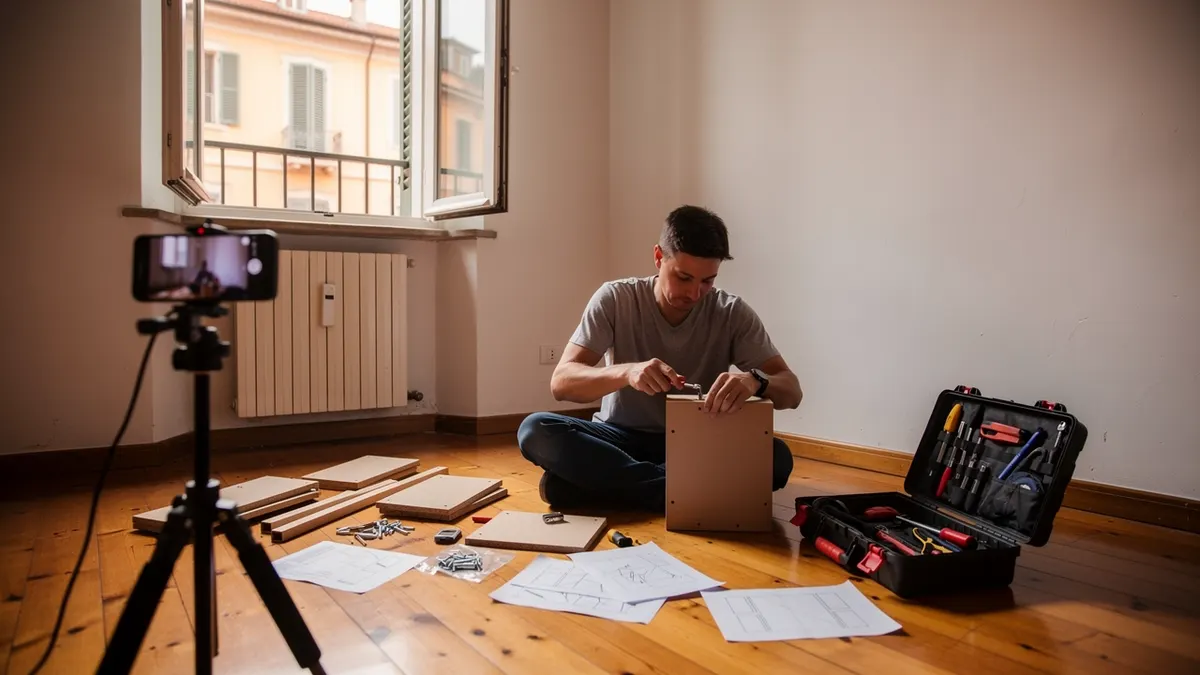
Setting up in a small flat, handling shutters and street noise, and the corner that always works.
The shutter problem
Three situations, three answers.
In full direct sunlight, the light is too harsh and hollows out faces: close partially, and let a blade of light through that you bounce off a pale wall.
In indirect light, often the best case: open completely, place yourself facing the window, and never film with your back to it.
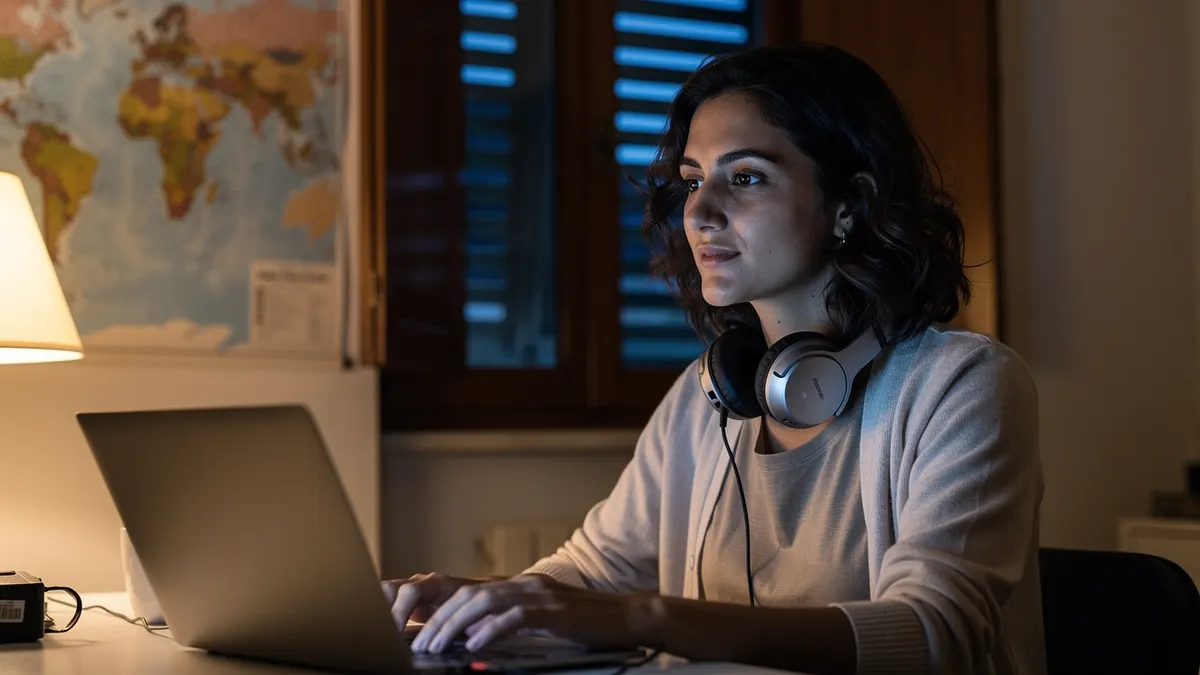
And in the evening, when natural light goes: one single soft source, placed higher than the face, is better than three lamps of different colours.
One rule avoiding bad surprises: note the hour at which your room is best lit, and always shoot at that hour. Consistent light is worth more than extra equipment.
Street noise
Four solutions, from the most effective to the least known.
Bringing the microphone closer rather than raising the volume: a lapel mic at twenty centimetres removes half the problem.
Choosing the hour: in a city building, early afternoon is often the quietest stretch.
Moving the subject away from the wall: speaking a metre from the wall reduces the resonance, which bothers more than the noise itself.
And damping the room: a rug, a curtain, a bed nearby change the sound more than software does.
One frequent trap: closed windows remove the noise and remove the light too. You then have to arbitrate, and sound almost always wins.
The corner that always works
Three characteristics, valid in any home.
A corner of the room rather than a flat wall, which gives the image depth.
A window to the side, at forty-five degrees from the face.
And a background containing two or three real objects, not ten: a shelf, a plant, a half-open door.
One counter-intuitive note: do not tidy completely. An interior that is too smooth looks like a set and loses the credibility that makes this format valuable.
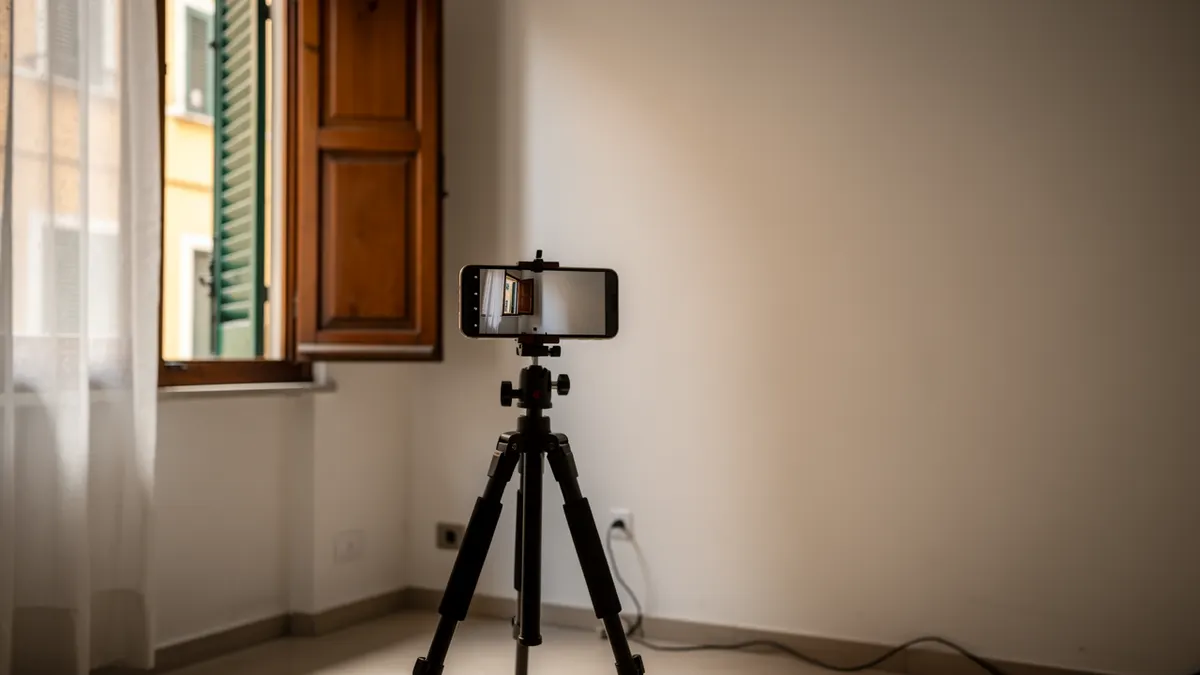
Once that corner is found, mark the tripod's position on the floor. You will be able to reshoot a shot three weeks later without the join showing.
The rest of the technique
Five points, in order of importance.
Sound first: a simple lapel microphone changes the result more than an expensive camera.
Stability next: a tripod, or the camera resting on a pile of books.
Height: the lens at eye level, never from below.
Format: vertical by default, with margin at top and bottom for recrops.
And cleaning the lens, which explains half of blurry images.
What can be fixed in an ordinary room
| Problem | The cause | The corrective move |
|---|---|---|
| Echoing sound | An empty room | Film in a furnished room |
| Tinted skin | A coloured wall | Step away from the wall |
| A busy background | Too many objects | Two metres of clear wall |
What is set up once and kept
A corner of the room marked on the floor, a lamp always in the same place, and a neutral background. That fixed set saves twenty minutes on every shoot.
What is checked before each take
The direction of the light, the mic level, the absence of personal objects in frame and of reflections in a window. Thirty seconds that avoid a full reshoot.
What to deliver
Four files, systematically.
The vertical version, edited, with burned-in subtitles.
The square version, recropped by hand, not automatically.
A version with no burned-in text, to allow adaptations by market.
And the rushes of the product shots, which the brand will use for other purposes.
One last marker useful to beginners: the constraint of a small home is not a handicap in this trade. A recognisable room, always filmed in the same place, becomes a visual signature, and brands come back to people whose videos they can picture in advance.