In a sixty-square-metre flat, an appliance is not judged only when it is running. It is judged above all during the three hundred and sixty days when it is not in use.
The space constraint changes everything
It decides the range bought, not just the model.
The measurements have to appear on screen, compared with a familiar object: a door, a worktop, a chair. An appliance that looks compact against a white background becomes enormous in a corridor, and the buyer cannot picture it without a reference.
Film the unboxing too: the carton, what has to be taken out, the space needed to assemble.
Noise is an argument
In an old building, it decides at what hour you can use it.
Film the appliance running, without music, with the real sound, in an ordinary room. Say at what time of day it is reasonable to use it, and what the neighbour below hears.
No brand does this, and it is exactly what people wonder before buying a tool in a shared building.
What the video must show
Four compulsory shots.
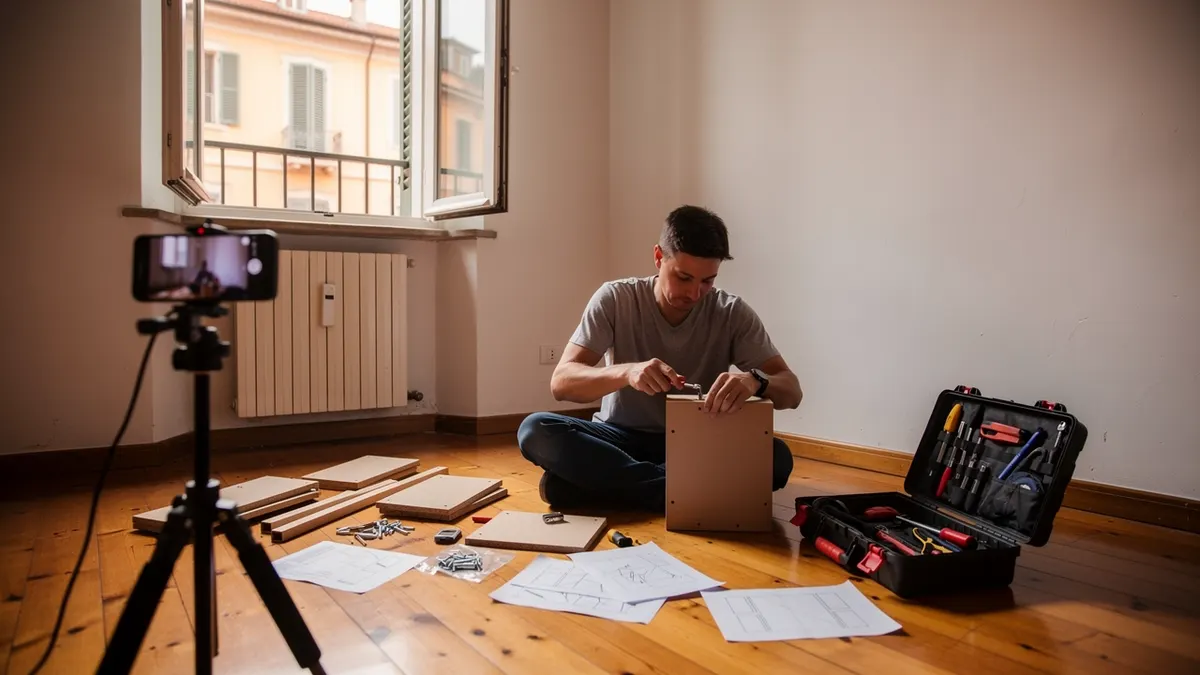
The real assembly time, without speeding up, with the necessary tools laid out beside. The step that sticks, the one the instructions explain badly. The result in place, in a normal interior. And the complete storing away.
Add an honest sentence about what the appliance cannot do: it makes everything else credible.
The wall people actually have
That is the difficulty peculiar to the building stock here.
Old walls, plaster, tiles, hollow partitions, rented homes where you cannot drill: show the fixing on what people have, and say what to do when drilling is not possible.
Claims relating to load capacity, the safety of a fixing or electrical compliance are copied from the manufacturer's documentation, never from memory, and checked before the brief is written.
Seasonality
It follows days off, not collections.
People do jobs when they have time: long weekends, holiday periods, changes of season. The content has to be in place a few days before, not during, because the purchase decision precedes the day of work.
What to buy for a test
Four videos, two creators, two different flats.
An old home and a recent one, with two levels of DIY confidence. You will then know whether your product addresses somebody who knows how or somebody who is learning, and those two audiences do not need the same video.
What this sector orders
| The buyer | Their typical order | What they require |
|---|---|---|
| A tool manufacturer | Assembly and use | Protective gear worn on screen |
| A DIY chain | The product and the key step | A short, clear tutorial |
| A paint or coating brand | Application and finish | A faithful colour |
What makes a DIY tutorial usable
The overhead shot on the bench. Filming the gesture from the front hides the hands, whereas a camera fixed above shows exactly the tool's position, which is what the viewer has to reproduce.
What is always shown, even if it looks less good
Protective gear and the manufacturer's instructions. A commercial video showing a dangerous gesture commits the brand, and the exact instruction is in the manual, not in the filmer's habits.
A tidy home works against the product
It is counter-intuitive and verifiable.
An immaculate, empty, bright interior resembles nowhere anybody does jobs. Leave the normal mess, the cluttered table, the floor to protect: that is what makes the demonstration believable and the product useful.