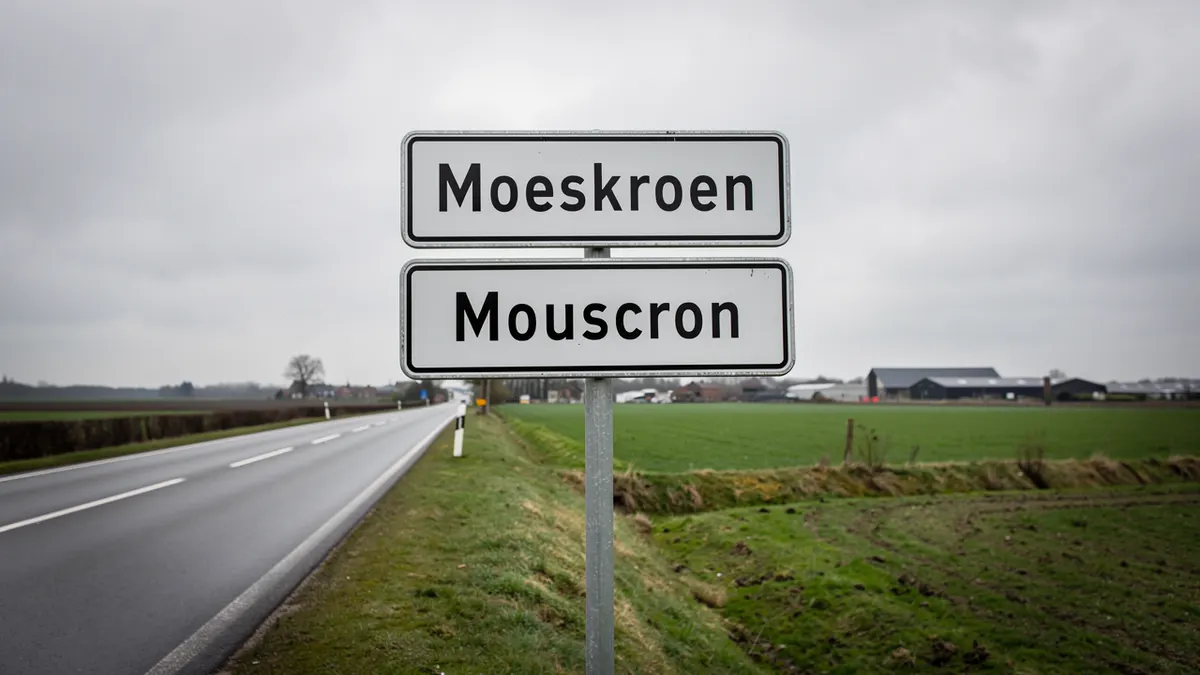
You produced two versions with two creators and it landed on neither side. Your creators probably came from the wrong countries.
The country speaks two borrowed languages
That is the starting difficulty: both main languages also exist elsewhere, on a bigger scale, with bigger production industries. So brands reflexively recruit where supply is most abundant, next door, and assume the language is enough. It is not: the audience here instantly recognises a voice from next door, and that recognition produces exactly the opposite of the intended effect.
What gives away a Dutch video in the north
The accent
The musicality and certain consonants differ markedly. It is not a matter of correctness, it is a matter of belonging: the audience hears a neighbour, not somebody from here.
Register
The acceptable level of familiarity is not the same, and a direct tone that goes down very well across the border can seem brusque here. It is often that detail, more than the accent, that loses people.
What gives away a French video in the south
Numbers
That is the sharpest marker, the one behind the test described above. A price said out loud is enough to place the speaker.
Everyday vocabulary
Meals, some household objects and a few common expressions have different names. Those are precisely the words this format uses, which multiplies the chances of mismatch.
The words that relocate a video
Seven vocabulary families to check before shooting.
Numbers, dealt with above.
The names of the day's meals.
School and administrative vocabulary.
Everyday household objects.
Expressions of politeness and greeting.
Terms relating to shops and services.
And diminutives, whose use differs markedly.
What this means for a brief
Six mentions to write down in black and white.
The target market, specified by region and not only by language.
The expected origin of the creator, written explicitly.
The ban on softening the accent, which produces a voice from nowhere.
The list of words not to use, supplied by somebody from the market.
The person who approves the vocabulary, before the shoot.
And permission to rephrase everything else freely.
What to shoot twice on the same day
Seven elements to double when both versions are planned.
Sentences containing a number, dealt with above.
The product name, whose pronunciation changes.
The call to action, often phrased differently.
Advertising mentions, specific to each market.
The opening shot, where the tone is decided.
The closing thanks, heavily marked culturally.
And any shot showing a local shop or packaging.
How to check before publishing
Six checks, half an hour in total.
Playing the edited version to somebody from the target region.
Asking them what sounds wrong, without telling them what to look for.
Checking the numbers a second time, by ear.
Rereading the subtitles, often machine translated.
Checking that the settings do not contradict the stated region.
And checking the applicable mentions, with the person who approves them.
If the budget allows only one version
Choose the market where you sell most, commit to it fully, and do not run that version in the other region. A frankly located video reaching half the country beats a hybrid version reaching nobody. The second version can be shot later, with the same script and a creator from the other region.
What the audience hears in three seconds
Five signals, in the order they arrive.
The musicality of the first sentence, before the meaning even.
The first number spoken, when there is one.
The greeting formula, highly localised.
The name of a shop or an everyday product.
And the pace, faster or steadier depending on the region.
The test that costs an hour
Six steps, before committing to anything.
Asking every candidate for the recording described above.
Listening to the recordings without looking at the profiles.
Playing them to two people from the target market.
Asking them where the person comes from, with no other clue.
Dropping any candidate misplaced by both listeners.
And keeping the recordings for the next castings.
How to recruit the right creators
Seven criteria, in this order.
Actual origin, verified and not deduced from a profile.
Familiarity with local shops and habits.
The ability to shoot in a setting recognisable in the region.
Availability for two versions, if the budget allows it later.
Experience of the short format, distinct from experience of image-making.
An understanding of the applicable advertising mentions.
And acceptance of a vocabulary review before shooting.
What you ask, and of whom
| The question | Who answers | Why it matters |
|---|---|---|
| The language of exchanges | The client | It sets the tone of the work |
| The language of the voice | The client, per their audience | It is never guessed |
| The language of subtitles | The client | It can differ from the voice |
What is prepared before the shoot
Both scripts written, proofread by a native speaker, and an identical shot list. Recording both versions back to back costs twenty minutes; coming back later costs half a day.
What is said honestly about your level
The real level in each language, and the recommendation of a native review if the video goes into advertising. That transparency reassures and has never lost an order.
The most frequent casting mistakes
Six reflexes that cost a campaign.
Recruiting in the neighbouring country because supply is wider there.
Trusting the language declared on a profile.
Asking for a neutral accent, which belongs to nobody.
Having one version translated into the other language rather than reshot.
Running everywhere a version shot for one region.
And approving the vocabulary after the edit, when it is too late.
One last marker: here, casting does more for performance than editing. An hour of checking before the shoot avoids the whole production you redo after seeing the results.