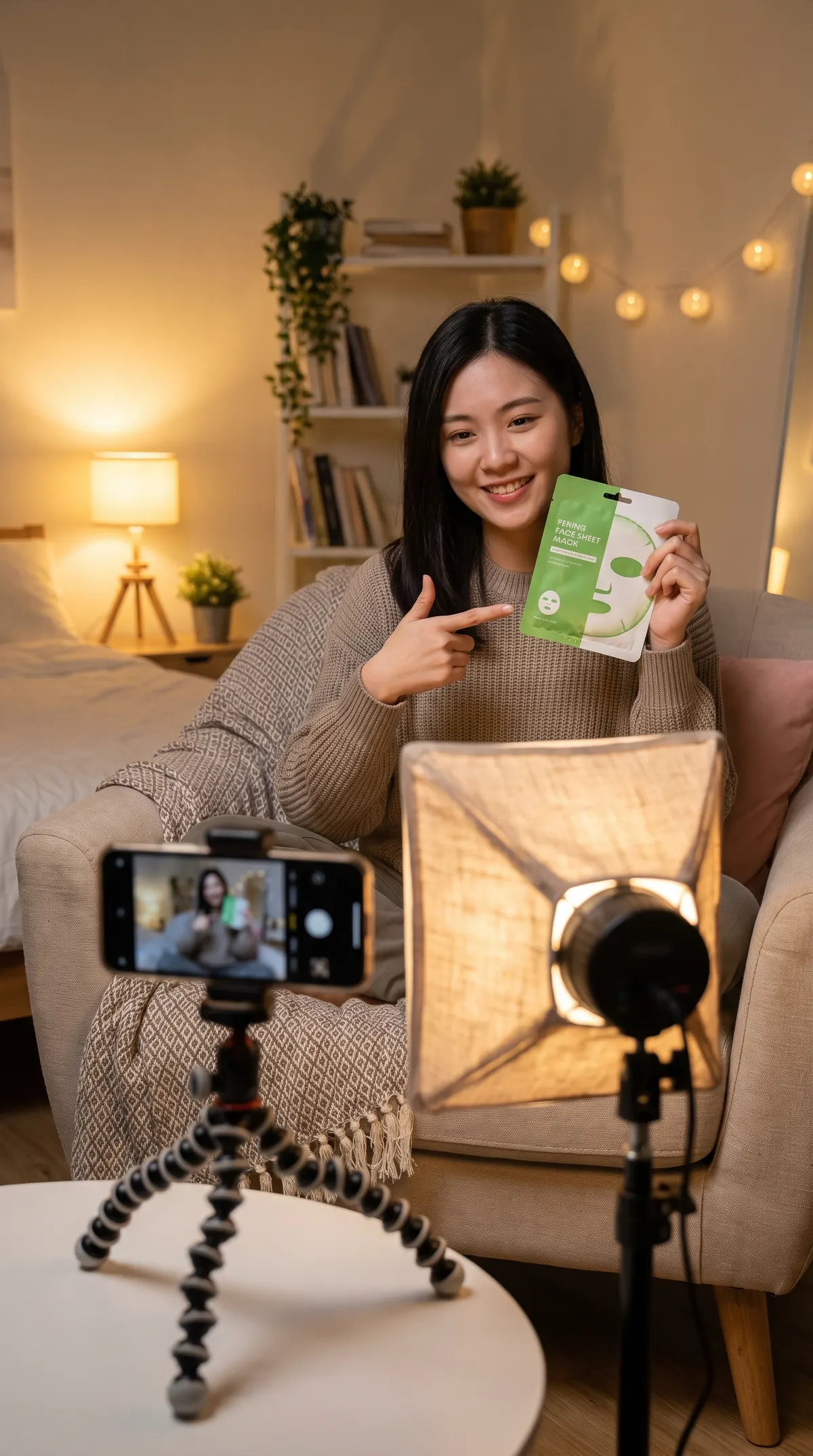
A brand sends a serum, the video says "it cleared my dark spots in two weeks", the piece goes live, and someone asks which rule that sentence was validated against. At that moment it emerges that nobody knew which of the five possible regimes governed the product.
The problem is not the sentence. It is that it was written before anyone knew which framework it fell under, and in health and food the framework changes completely what may be said.
Five regimes, not one
Talking about "health products" is convenient in marketing and means nothing in law. The first step, before the script, is to place the product.
| Product | What governs its advertising | The point that decides |
|---|---|---|
| Medicines | Royal Legislative Decree 1/2015, art. 80 | only those meeting all the requirements of that article may be advertised to the public |
| Medical devices | their own specific rules, supervised by the AEMPS | separate regime, expressly outside RD 1907/1996 |
| Claimed health purpose | Royal Decree 1907/1996, art. 4 | a closed list of prohibitions, testimonials among them |
| Food and supplements | their own special rules on claims | only properties recognised under those rules |
| Cosmetics | their own special rules on claims | no attributing properties other than those recognised |
The product does not decide alone, the claim does too
The same cream can fall into two different frameworks depending on what the video says about it. Presented as cosmetic care, it is governed by cosmetics rules. Presented, by contrast, as a remedy for a skin condition, the reference becomes a health one and with it the whole set of applicable rules.
Article 5 of Royal Legislative Decree 1/2015 adds a nuance worth keeping in mind: its prohibitions also reach products presented as medical devices or cosmetics without being such. Presenting yourself a certain way is not enough to be governed that way.
Medical devices go their own way
This deserves its own paragraph because it is the box most often confused. A blood pressure monitor, a dental aligner, a contact lens or a self-testing kit is neither a cosmetic nor a supplement: they are medical devices, with their own regime and their own authority, the AEMPS.
For anyone producing video, the consequence is that the rules of the claimed-health-purpose decree are not the reference framework, and neither are the food rules. Before writing the script you go to the product's own specific rules, and it is worth doing so with the manufacturer's documentation in hand: a device's category does not always match the intuition of whoever uses it every day.
What Royal Decree 1907/1996 prohibits
This text is residual, and understanding it that way is the key to using it well. Its article 3.1 refers the advertising of medicines and medical devices to their special rules, so the decree deals with what is left: products, materials, substances, energies or methods with a claimed health purpose.
Its article 4 lists the prohibitions. Three matter directly to anyone producing video.
The testimonial, which is the UGC format par excellence
Paragraph 7 prohibits advertising that seeks to provide testimonials from health professionals, from famous or publicly known persons, or from real or supposed patients, as a means of inducing consumption.
Read slowly, it reaches three figures that appear constantly in a campaign: the person in a white coat, the known person, and the person telling their own story. In this specific field the testimonial is not an available format, and that is the largest practical difference from any other product category.
Slimming, food and cosmetics
Paragraph 2 prohibits suggesting specific slimming or anti-obesity properties. Paragraph 10 prohibits attributing to foodstuffs intended for dietary or special regimes preventive, curative or other properties beyond those recognised under their special rules. Paragraph 11 does the same for cosmetics.
Those last two matter for how they are drafted: they refer out to what each special set of rules recognises. They do not draw a list of forbidden phrases but a perimeter of the permitted, which has to be consulted outside the decree.
To this is added, where the piece runs as an audiovisual commercial communication, article 124.1.g) of the General Audiovisual Communication Act, which prohibits promoting body worship and the rejection of self-image through communications about slimming products, surgical procedures or aesthetic treatments.
Food and supplements: a perimeter, not a blacklist
Here the mechanism differs from what people expect, which is why it goes wrong so often. It is not about dodging a few forbidden phrases: it is that you may only assert what the rules on nutrition and health claims recognise, with the wording and the conditions of use set out there.
The consequence in a script is direct. A claim about what a supplement "does" does not go into the video because it sounds reasonable, nor because the brand believes it, nor because the person speaking experienced it. It goes in if it is recognised.
AESAN is the Spanish reference on food safety and nutrition, and it is the right source for that field. It is not the right source for cosmetics, nor for medical devices, and using it as generic backing for a health campaign is a mistake that shows up at the first review.
Cosmetics: the recognised properties
The same mechanism, in its own perimeter. A cosmetic may not be presented with properties other than those recognised for such products, and claims must be capable of being substantiated.
Substantiation is the word that causes the most work on a shoot. A claim the brand cannot back does not improve because a person delivers it in the first person, to camera, in their own bathroom. The format adds no proof.
What remains sayable
An article that only lists prohibitions drives an entire category to produce nothing, and that is neither necessary nor true.
The objective description. What it is, how it is applied, what texture it has, what the packaging says, how it is stored.
The use, shown. The gesture, the dose, the time of day, where it is kept. That is information, not an account of results.
The purchase context. Where to find it, what it costs, in which formats, what to look for on the label.
The pointer to what is authorised. Instead of asserting an effect, pointing to what the product is recognised as able to communicate.
The rule behind all this
Show rather than promise. What the product is and how it is used can almost always be said. What it did to one particular person, in this field, almost never.
Who validates, and when
Validation cannot happen in the edit, because by then the shoot has already taken place from a written script.
The order that works has three steps, and none of them is optional.
- The brand places the product in one of the five frameworks and writes it into the brief.
- Every claim in the script is matched against what that framework allows, before shooting and not after.
- The person shooting receives a list of usable sentences, not a list of forbidden ones: the second is forgotten in front of the camera and the first is read.
Sources
- Royal Decree 1907/1996, advertising of products with a claimed health purpose
- Royal Legislative Decree 1/2015, arts. 5 and 80
- Law 13/2022, General Audiovisual Communication Act, art. 124
- AEMPS, medical devices
- Spanish Agency for Food Safety and Nutrition
Checked on 10 September 2026. This guide is not legal advice and does not replace an examination of the individual case. Where this guide and the official source diverge, the source prevails.