
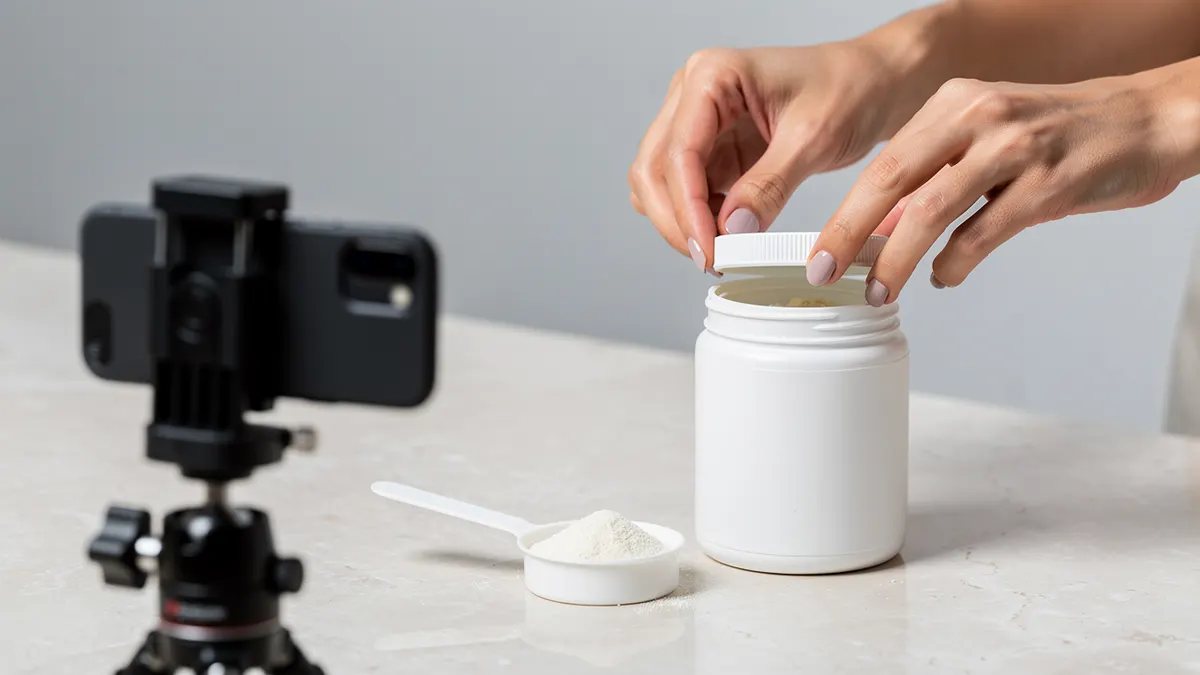
A dietary supplement is not a medicine. For ANMAT it is a food, and that classification, which looks like an administrative formality, is what defines what your video may say and may not.
From it comes the rule that orders the whole category and that almost no campaign fully respects: a product registered as a food cannot be presented as something that prevents, treats or cures. Not because it sounds exaggerated, but because it would be attributing to a food a function the category does not contemplate.
The category decides what can be said
ANMAT oversees seven families of products, and the four that appear most in creator campaigns are: foods, which is where dietary supplements sit; cosmetics, which are preparations for external use; medical products, which are equipment and materials used in health; and medicines.
The distinction matters because each category has a different perimeter of permissible claims, and because the same white pack with serious lettering can belong to any of the four. Looking at the product is not enough: you have to ask which one it is registered in.
When the answer is "dietary supplement", you already know you are filming a food, with everything that implies for the script.
The categories, translated into what can be claimed
| Category | What it is for ANMAT | What cannot be claimed |
|---|---|---|
| Dietary supplement | a food | that it prevents, treats, cures or replaces a treatment |
| Packaged food | a food | therapeutic properties, and if it carries seals further rules apply |
| Cosmetic | preparation for external use | effects belonging to a medicine or a medical product |
| Medical product | equipment or material used in health | results beyond what its registration covers |
| Medicine | a medicinal speciality | practically everything a creator says without a professional framework |
By contrast with a category where the limit is set by good taste, here the limit is set by the registration category, and it is an objective fact the brand holds and can send you in a message.
The testimonial that turns a food into a medicine
This is the mechanism that brings down most supplement campaigns, and it does not happen in the written script: it happens in the unscripted part.
Nobody writes "this cures anxiety". What gets said on camera is "since I started taking it I sleep well", "my knee pain went away", "I stopped crashing in the afternoon". Each of those sentences describes a personal experience, and each one, said about a product being sold, attributes an effect on a health condition.
The difference between the two readings does not lie in the speaker's intent. It lies in what is understood, and Decree 274/2019 looks at exactly that: whether the presentation may induce error, including through what it leaves out.
There is a test that works well before filming. Take the sentence and ask: am I naming a symptom, an ailment or a diagnosis? If the answer is yes, that sentence does not go in, however true it was for you.
What can be said, which is more than it seems
The category communicates as if only efficacy could be discussed, and that is not so.
You can talk about format and convenience: whether it is powder or capsules, whether it dissolves, how it tastes, how many servings it holds, how long the pack lasts. You can show the routine of use, the time of day, how it fits into a breakfast. You can talk about price, where to find it, how far it goes.
And you can say why you chose it, as long as the reason is not an effect on an ailment. "I chose it because it has no taste and I can put it in my coffee" is a perfectly communicable reason.
What collapses is the therapeutic shortcut. The campaign that only works if a health improvement is promised is the one that cannot be made this way, and the problem is not the creator: it is the brief.
Three situations that keep recurring
The product that does not have a registration yet
It happens more than you would think, especially with new brands and imported products: the campaign starts before the paperwork is closed, and the brief says it is "in process".
A product without registration cannot be sold, and a piece promoting it is promoting something that cannot yet be sold. The right question is not how long is left, it is whether it can be sold today. If the answer is no, the shoot date moves.
The health professional who appears in the video
Adding a nutritionist, a pharmacist or a doctor looks like the elegant solution to the claims problem: somebody qualified says what the creator cannot.
It does not work as armour. The claim is still advertising for the product, and the professional's own framework adds its rules of practice and of professional advertising. What a professional does bring is content that does not rest on a promise: explaining what a category is for, how to read a label, what to ask before buying.
The before and after
It is the format that converts best and survives review worst. One image before and another after asserts a result without saying it, and in health products that result is precisely what cannot be promised.
There is a version that does hold up and almost nobody uses: showing the process instead of the result. The routine, the consistency, how it fits in. It sells worse in one video and much better in a series, because it is the only thing that can be repeated without getting trapped in a promise.
The registration number, and why to ask for it
- Ask for the category and registration number of the product, not of the brand. It is data the brand holds and it defines the whole perimeter of the script.
- Ask in writing which claims are supported, and by what. If the answer is "it is what people say", that claim does not go in.
- Mark the sentences naming a symptom or an ailment, and replace them before the shoot, not in the edit.
- Agree what happens with comments. In this category people ask about their own ailment under the video, and replying "it worked for me for that" publishes the claim you took out of the script.
Point four is the one nobody prevents and the one that most often turns a correct piece into a problem. The reply that works is always the same and is worth having written in advance: refer to a professional and do not comment on the case.
The objection coming from the brand is that without talking about results the video does not sell. Sometimes that is true, and then the conclusion is uncomfortable but clear: that product needs another channel, or it needs a different registration. It does not need a creator saying what the category does not allow.
Sources
- ANMAT, product categories under its oversight
- Decree DNU 274/2019, Lealtad Comercial
- Law 24.240 on Consumer Protection
Checked on 12 September 2026. This guide is not legal or medical advice. Where this guide and the official source disagree, the source prevails.