A filmed routine is judged in a second: either people believe the person does this every day, or they do not.
Place the product, do not display it
That is the basic rule of the format.
The product comes into frame because it is being used, not because it is being presented. It is not turned towards the lens, not held at face height, and its label is not angled to be read.
One exception: a short, clean shot where the name is visible, placed at the moment the person picks the object up. That shot serves the brand and does not break the scene, provided it lasts a second and is not repeated.
The Spanish hours change everything
That is the local particularity, and it is often ignored by briefs from elsewhere.
The day is not divided as it is elsewhere: the midday meal comes late, the evening one later still, and going out at ten at night is a normal night out.
Two consequences. An evening routine filmed in daylight corresponds to nothing, and neither does a morning routine assuming a large breakfast at seven.
The rule: film at the hour you announce, or announce no hour. The light behind the window is the first thing the viewer checks.
Fewer wide shots, more gestures
A wide shot shows a room, a close-up shows an action.
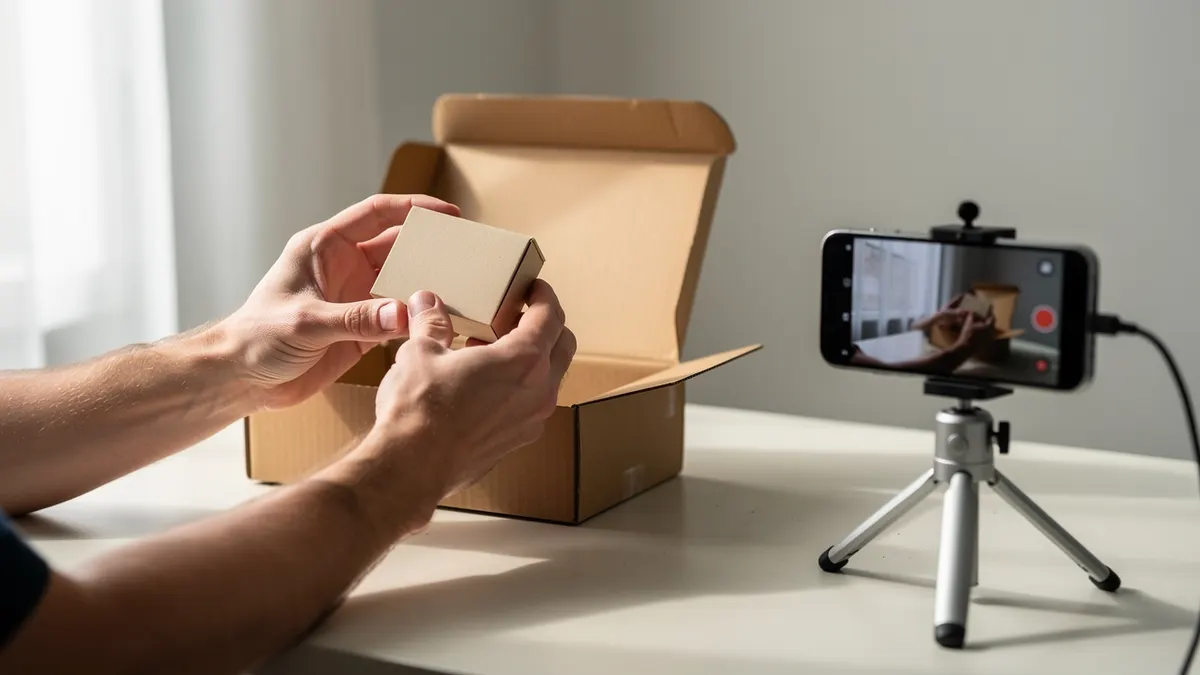
This format lives on gestures: opening, measuring out, applying, closing, putting away. They give the texture, the sound, the material, and they prove the use.
The useful rhythm is simple: one wide shot to situate, then a series of close shots. Many creators do the opposite and lose attention in ten seconds.
Add direct sound. The noise of a cap, a pump, a fabric beats any music.
Speak little and concretely
The commentary is not an explanation, it is information.
What should be said holds in three things: what you are doing, why you do it that way, and what you noticed after several days.
What should not be said: adjectives, promises of results and brand sentences. Any assertion about an effect, a composition or a benefit is a claim, and it commits the brand; what may be said depends on the product and is checked with a lawyer, before the shoot.
Add silence. A routine talking non-stop looks like an advert, a routine where you can hear a gesture looks like a routine.
What brands ask for here
Four concrete expectations.
A version with the advertising disclosure visible from the start, in line with the obligations applicable to your situation, checked with a lawyer before publication.
A master with no burnt-in text, so versions can be made.
A clean, isolated product shot, usable on a product page.
And a real duration: the routine is not sped up on the part that counts, otherwise the gesture becomes unverifiable.
What each step must prove
| Step | The shot | What it demonstrates |
|---|---|---|
| The start | The table laid out, seen from above | How many products are used |
| The middle | The gesture, in a single take | The real time it takes |
| The end | The result, uncut | What has changed |
What is filmed in one session
The whole routine in a row, in its real order. Filming each product on a different day gives light that does not match.
What is said without exaggerating
The real frequency, the length of use before judging, and the absence of a guaranteed result, to be confirmed with a lawyer if the product touches on health.
The test before delivering
Watch your video without sound, on a phone, at medium brightness.
If people can tell what you are doing, if the product is identifiable and if nothing in the setting rings false, the video is ready. If not, the problem is almost never the edit: it is in the frame, and it is fixed before the next take.
Sources
Checked on 4 September 2026. Thresholds and rates change: where this guide and the official source disagree, the official source is right.