Why reading a script kills it, how to prepare without learning by heart, and the detail that makes it credible.
Reading a script kills it
Three signs giving reading away, all visible in one second.
The gaze sweeping horizontally, because the eyes follow a line.
The delivery too regular, without the accelerations and pauses of a thought-out sentence.
And the stress falling in the wrong place, on linking words rather than on the word that matters.
One direct commercial consequence: a read testimonial converts no better than a classic advert, which removes the only reason to order one.
Preparing without a closed script
Four elements to prepare, and nothing more.
The starting situation: what was happening before, in one concrete sentence.
The trigger: the precise moment the decision was taken.
The observed change: what is different, with a verifiable detail.
And the honest reservation: what the product does not do, or what took time to get used to.
Those four points go on a piece of paper off camera, in four words each. They are enough to structure, and they leave the wording free.
The first sentence is the hardest
Three techniques unlocking it.
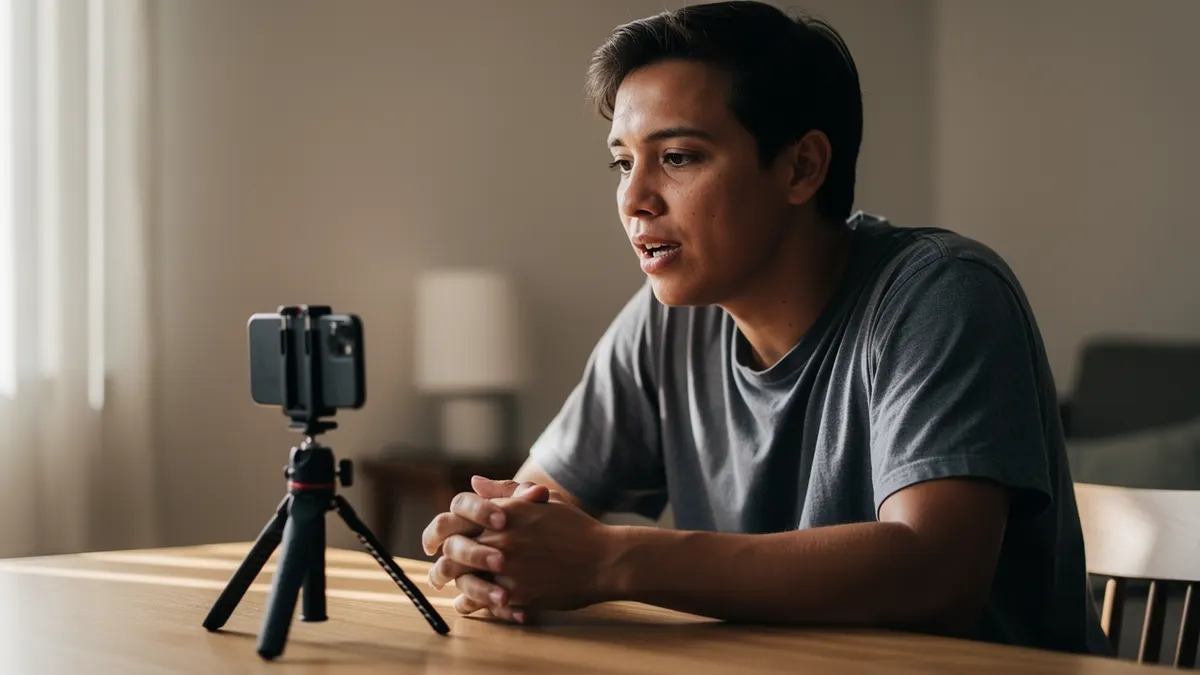
Starting with a spoken, banal sentence that will be cut in the edit: it allows starting without pressure.
Doing the same first sentence three times, without watching the takes: the third is almost always the good one.
And never starting by introducing yourself: the first name and the context are said in the middle, not at the beginning.
One editing note: keep the take where the person hesitates slightly at the start. That is the one resembling somebody talking, not somebody selling.
The concrete detail changes everything
Three types of detail making a testimonial credible.
The time detail: how long for, at what moment of the day, how many times.
The sensory detail: what is seen, smelled or heard, not what is felt in general.
And the awkward detail: the thing that was not expected, the objection you had, the first disappointment.
One example of the mechanism: "I use it in the morning" is weak, "I use it before leaving, I have ten minutes left and it lasts until the evening" is strong. The second contains a real constraint, therefore a real life.
What cannot be said
Four families of claims to handle with caution, and to have approved with a lawyer depending on the category.
Health: effects, cure, relief, comparison with a treatment.
Figures: percentages, timescales, performance, unless supplied and documented by the brand.
Comparisons with a competing product.
And words suggesting a spontaneous opinion when the video is commissioned: the advertising disclosure is said and shown.
One simple rule: tell your experience, not the general truth. "For me, it did this" is a testimonial. "It does this" is a claim.
What makes a testimonial credible
| Element | What works | What rings false |
|---|---|---|
| The opening | The moment of doubt | A self-introduction |
| The middle | A concrete, checkable detail | A list of benefits |
| The ending | An honest limit | A superlative |
What is prepared without writing a script
Three questions asked off camera, and answers given once only. A memorised testimonial is heard in the rhythm and loses everything that made it useful.
What is collected before filming
The person's written consent, the intended duration of use and the media of release. Without that document the testimonial cannot be published, to be confirmed with a lawyer.
Delivery format
Four files, as always.
The edited version, vertical, with burned-in subtitles.
The version with no burned-in text, for other markets.
The unused takes, which often contain a better sentence than the one in the edit.
And a separate audio file, useful if the brand wants to re-edit the video differently.
One last marker, valid everywhere: the best testimonial is not the most enthusiastic, it is the most precise. Somebody describing exactly what they did convinces more than somebody stating that everything is wonderful.