Here the light changes completely with the place and the season, and the same advice does not hold from south to north. One element recurs everywhere, though, and it is treated as an obstacle when it is a tool.
The southern problem: hard sun
It creates strong shadows, squinting eyes and burnt-out areas impossible to recover.
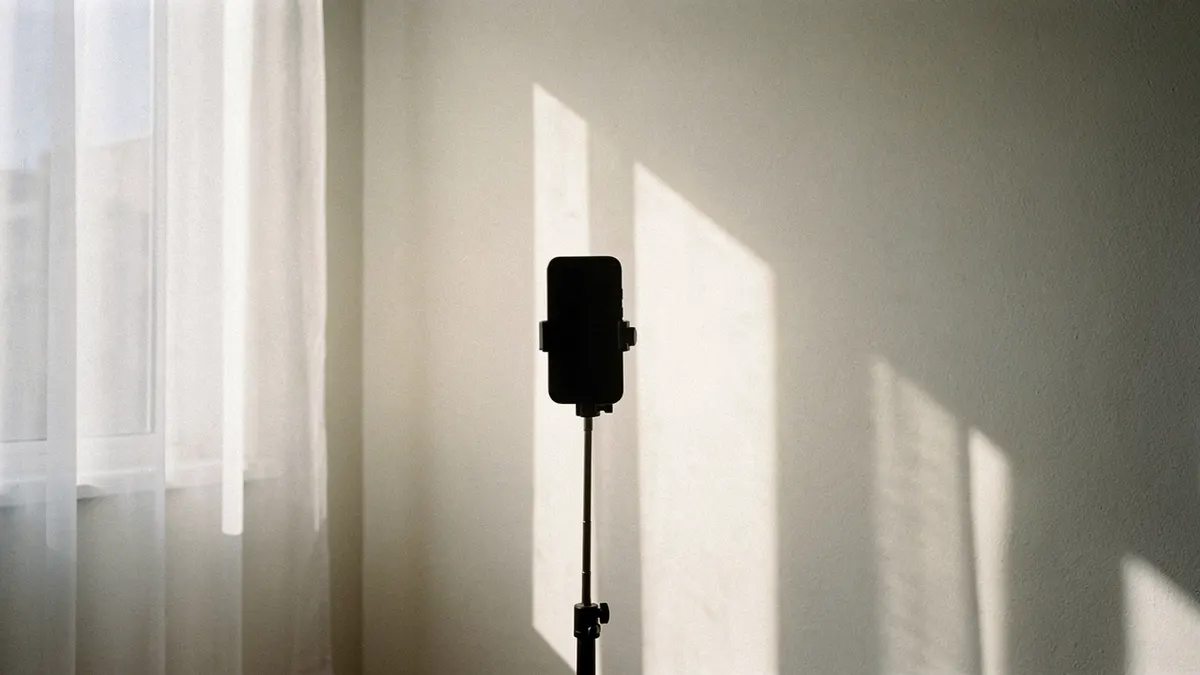
Never film in direct sunlight. Look for open shade: under a balcony, in a doorway, behind a light curtain. The light stays strong but becomes even, and the face stops fighting it.
If you must stay outside, film early or late in the day, and place the sun behind the person while lighting the face with a light-coloured surface.
The northern problem: the grey winter
What is missing is not the quantity of light, it is its direction.
An overcast day gives a flat light that flattens features and makes the image dull. Move closer to the window, stand slightly to the side rather than facing it, and add a light-coloured surface on the other side to recreate relief.
A single lamp does not replace the window: it completes it, never replaces it.
The common problem: dark interiors
Many rooms are deep, with a single opening.
Switch off the ceiling lights: they create shadows under the eyes and a colour that does not match the window. Mixing two light temperatures is the most visible and most frequent fault.
One source, plus a surface that bounces it back: that is almost always enough.
What to buy, in order
Three purchases, and the first is not a lamp.
A clip-on microphone, because sound is forgiven less than image. A light-coloured reflective surface, even improvised. And only then an adjustable panel, useful mainly in the north and in winter.
A dearer camera improves nothing if the light is bad: it is the reverse order that works.
What to check before starting
Three seconds of testing, systematically.
Look at the image on the screen, not at the real scene: the eye compensates for what the camera records. Check the shadow under the chin, the reflection in the eyes, and the colour of white walls.
Do that test at every change of position, and note the setting that worked: you will find it again next time.
Three free sources and what they give
| The source | What it produces | Its limit |
|---|---|---|
| A side window | Soft modelling on a face | Changes fast with the hour |
| An overcast sky | Even light all day | Little relief on materials |
| A light wall in full sun | A powerful, free bounce | A colour cast taken from the wall |
What ruins an image more surely than the gear
Mixing sources. A cool window and a warm bulb in the same shot give a two-toned face, and no global setting undoes what the edit sees immediately.
What to adjust before adding a lamp
The subject's position. Moving a person one metre towards the window changes the image more than any bought accessory, and that adjustment costs nothing.
What shows on screen and not in the room
Backlight from a window behind the person, the reflection of a screen on glasses, a warm bulb at the end of the corridor.
Those three details go unnoticed during the shoot and leap out in the edit. A last look at the frame before the first take costs thirty seconds and saves redoing a day.
Sources
Checked on 4 September 2026. Thresholds and rates change: where this guide and the official source disagree, the official source is right.