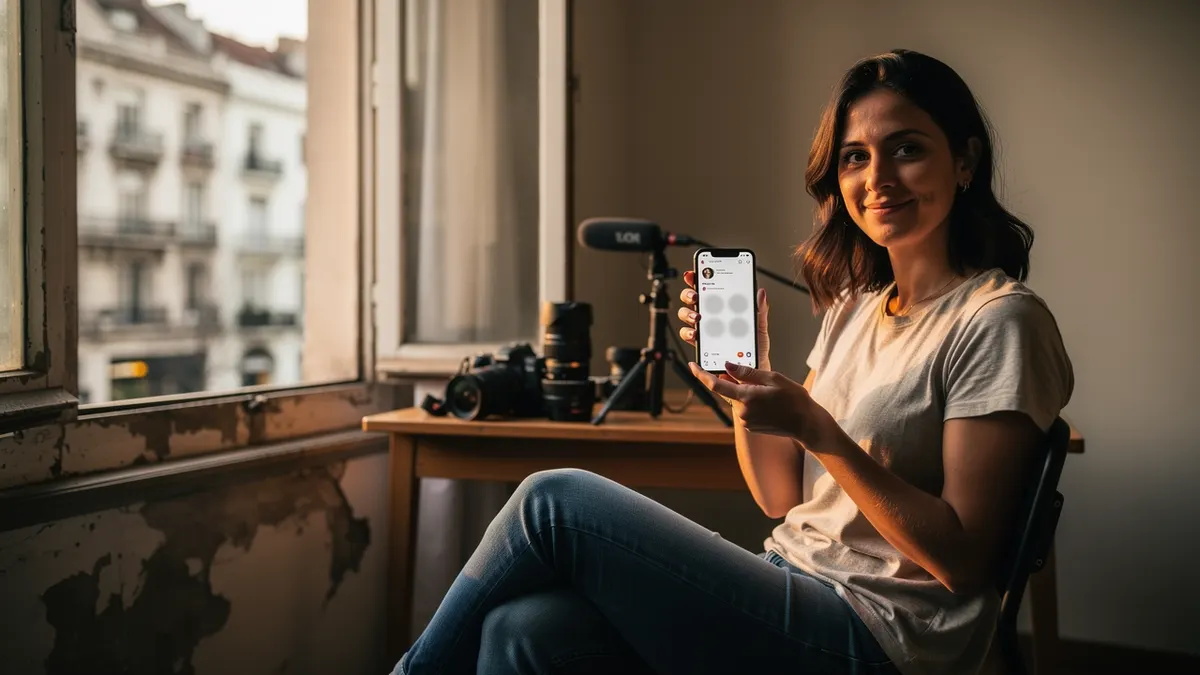
Almost nobody is comfortable on camera at the start, and the stiffness that shows on screen is not a lack of talent. It is a lack of repetitions. It is fixed with exercises, not by waiting for confidence to turn up on its own.
In Argentina there is a second obstacle on top of that one, and it explains a good share of the failed takes of the first few months.
Voseo, and the request for neutral Spanish
You speak with voseo. Vos hablás, vos tenés, vos podés. It is your everyday language, the one you naturally tell a story in.
But some of the brands hiring out of Buenos Aires do not only sell in Argentina. They run the same video in Mexico, Colombia and Chile. So they ask for what the industry calls neutral Spanish: tú instead of vos, vocabulary without regional markers, a flatter intonation.
The difficulty is not linguistic, it is physical. Monitoring your own grammar while speaking takes up exactly the share of attention that was making you sound natural. You can hear the result: the pace slows, the eyes freeze, the sentence turns recited. Plenty of Argentine creators conclude they are bad on camera when they are simply doing two things at once.
The fix is one sentence long: separate the two efforts. Write the script in neutral, read it aloud until the forms stop demanding attention, then film. You do not neutralise live, you neutralise while writing.
Why your recorded voice surprises you
When you speak you hear yourself through bone conduction: the sound travels through the skull and arrives deeper and rounder. A microphone only picks up what travels through air, which is thinner and brighter.
So there is nothing wrong with your voice. You are simply meeting the one everyone else has always heard. That discomfort fades on its own after about twenty recordings, and that is the only remedy that works.
Five exercises that take the stiffness out
Talk to a person, not to a lens
Put a photo of someone you know next to the camera and address them. Your eyes change immediately, and so does your vocabulary.
Film thirty seconds a day for two weeks
Publishing nothing. The goal is the number of repetitions, not the quality of the shot.
Enter the frame already moving
Walk in, or start with the product already in your hands. Stiffness sets in mostly when you begin motionless, facing the lens, waiting for the right moment.
Read the script aloud before shooting
If you stumble on a line while reading it, the line is badly written. The problem is the text, not you, and it takes thirty seconds to fix.
Slow down one notch
Nerves speed up delivery without you noticing. A slightly slower pace reads as more assured and leaves room to breathe between ideas.
Neutral or rioplatense: how to decide
The question comes up on every brief, and the answer depends on where the brand is running the video.
If the campaign targets Argentina, keep the way you speak. Voseo is an authenticity signal: a video where someone says vos tenés que probarlo sounds like a real recommendation between locals, not like a dubbed ad.
If the campaign travels across several countries, neutral becomes a technical deliverable in the same way a vertical format is. It is prepared in the writing, checked before filming, and worth raising when you quote, because it is extra work.
Asking the question in the brief avoids unpleasant surprises: many brands simply had not thought about it and answer happily.
How many takes are normal
Between five and ten for a thirty second piece when you are starting out. With practice it drops to two or three.
The point is not to nail it first time. It is to stop restarting the whole thing at every hesitation. Stop, breathe, pick up from the previous sentence: the cut happens in the edit and nobody sees it. Going back to the top every time is the surest way to tire your voice out before the good take arrives.
How many takes before it is usable
| What you record | Typical takes | What unlocks it |
|---|---|---|
| An opening line | 5 to 8 | Learning that one line by heart |
| A continuous demonstration | 2 to 3 | Rehearsing the movement without the camera |
| A piece to camera | 4 to 6 | Speaking to a real person off frame |
What the edit can fix
A pause, a hesitation, a repeated word: cut it, nobody will notice.
What the edit cannot fix
A crooked frame, distorted sound, light that shifts mid-take: those get reshot.
What brands are actually after
They are not looking for a professional voice over. They are looking for someone who sounds like a customer telling you what happened to them.
A hesitation, a laugh, a repeated word make the video more believable, and in advertising those takes often beat the perfectly read version. That is good news: you do not have to act well, you have to sound like yourself.
One last exercise to find that register: film the same sentence three times, neutral, enthusiastic, then as if confiding it. One of the three will ring true. That is the one you sell.
Sources
Checked on 4 September 2026. Thresholds and rates change: where this guide and the official source disagree, the official source is right.