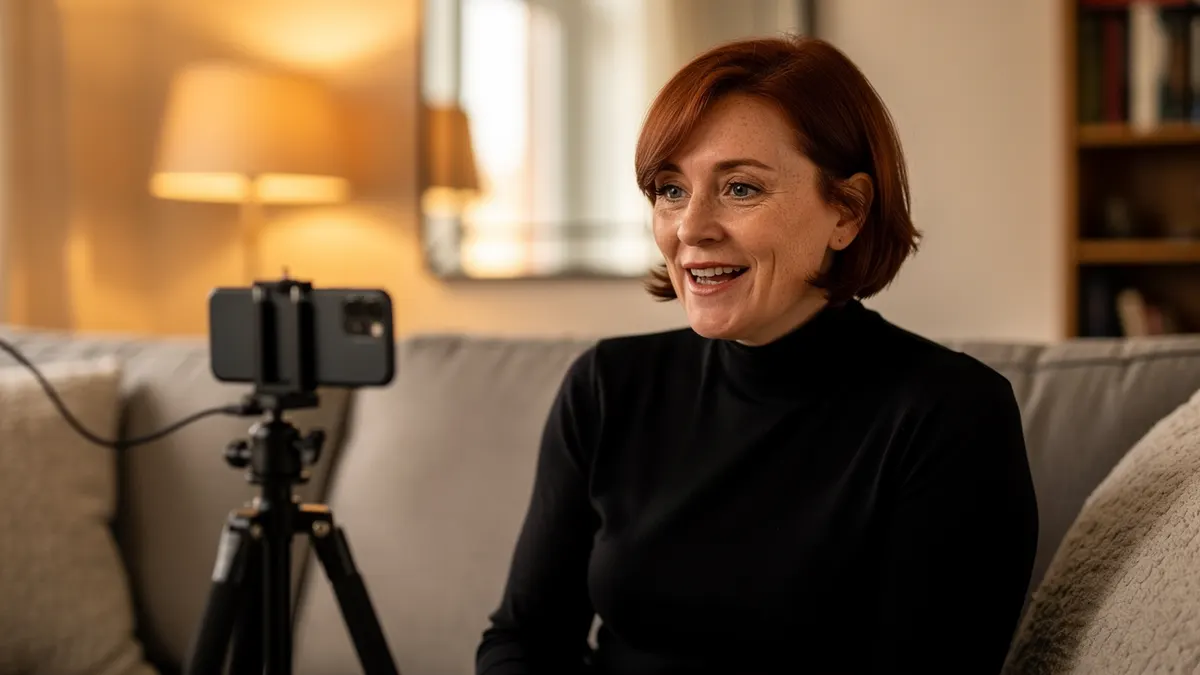
Nobody is comfortable in front of a lens at first. What can be worked on is not confidence, it is the conditions.
Why your voice sounds wrong to you
Because you had never heard it.
When you speak, your voice reaches you partly through the bones of the skull, which makes it deeper and rounder. A recording keeps only what everybody else has always heard.
In other words: your voice is not wrong on screen, it is simply unknown to you. That gap disappears with habit, generally within two to three weeks of regular recording.
The only remedy is exposure. Listen to yourself, without judging, until that timbre becomes ordinary.
The exercises that remove stiffness
Four, to be done in this order.
Speak to somebody, not to the lens
Choose a real person and address them. The gaze changes, the pace changes, and the sentences shorten by themselves.
Film thirty seconds a day for two weeks
Without publishing them. It is the only method that works, and it works through accumulation, not effort.
Start in movement
Film yourself entering the frame, putting down an object, starting an action. A busy body stops acting.
Read the script aloud, then put it away
A learnt sentence is recited; an understood sentence is said. The point of reading is not to memorise, it is to spot the words you do not pronounce naturally and replace them.
The French trap: articulating too well
It is the most widespread tension here.
Impeccable diction, perfect liaisons and complete sentences immediately give the tone of a school presentation or a news bulletin. The audience files it as advertising before the end of the first sentence.
What works is the opposite: short sentences, hesitations kept, ordinary vocabulary, and the right to start with "so" or "right".
Lower the energy a notch too. What feels flat at the shoot comes out right on screen; what feels right at the shoot comes out overplayed.
How many takes are normal
Many more than you think.
Five to ten takes for an opening, two or three for a demonstration shot: that is the usual rhythm of an experienced creator. The difference from a beginner is not the number of takes, it is that they no longer count them.
One rule only: never redo the same sentence more than three times in a row. Beyond that, the tiredness is audible. Change shot, come back later.
What brands really want
It is not a performance.
They are buying somebody credible who holds a product, follows a brief and delivers on the date. Perfect elocution has never appeared in a brief.
What does appear: clean sound, a legible face, a hook understandable without sound, and compliance with the requested disclosures.
What can be worked on, and how long it takes
| Flaw | Exercise | Visible progress |
|---|---|---|
| The voice rising | Read a text quietly before the take | From the first session |
| The wandering gaze | Stick a dot next to the lens | In two sessions |
| Filler words | Listen back to a full take | In two weeks |
What replaces a memorised script
Three cues written on a sheet off camera: the problem, the proof, the closing line. The rest is said in your own words.
What is kept in the edit
The breath before the important sentence and the small hesitation before an honest admission: they are what make the take credible.
The energy-change trick
It serves the day a take does not take off.
Do the same sentence three times: once as if you were in a hurry, once as if explaining to a child, once as if telling a secret.
None of the three is the final tone. But one of the three unblocks the fourth, which is the good one, and it is almost always that one that goes into the edit.
Sources
- Urssaf, official auto-entrepreneur portal
- Service Public, how to become a micro-entrepreneur
- Service Public, crossing the micro-entrepreneur turnover thresholds
Checked on 4 September 2026. Thresholds and rates change: where this guide and the official source disagree, the official source is right.