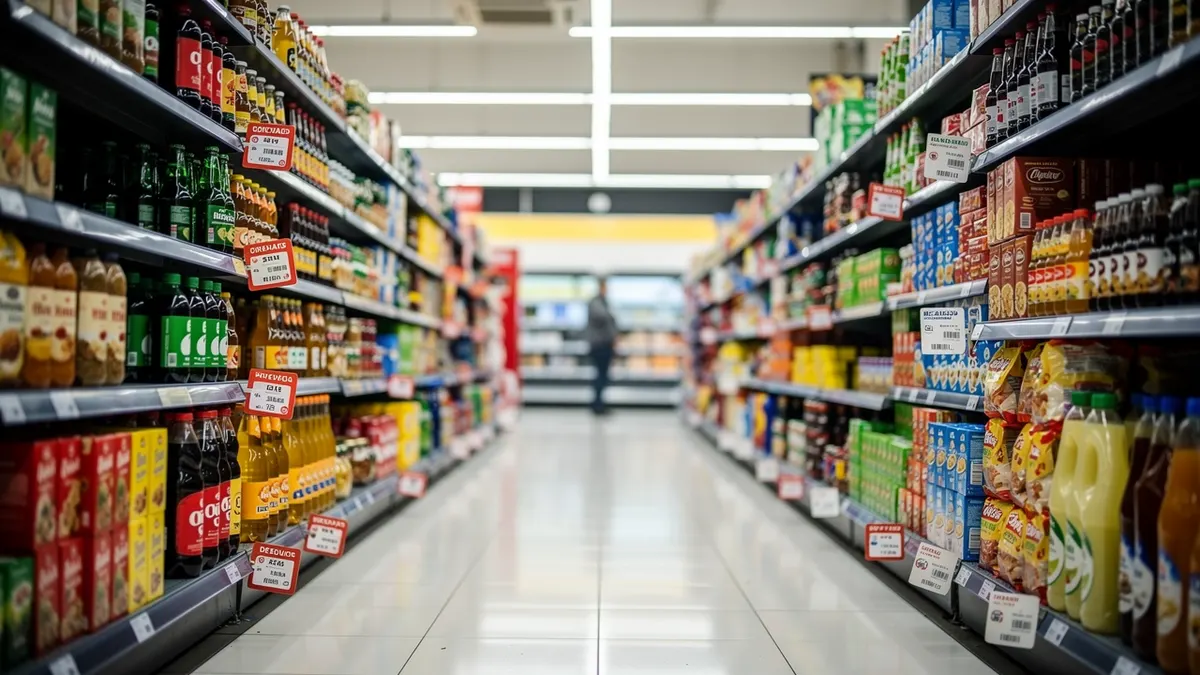
A customer standing in the aisle, phone in hand, is not deciding whether she wants your product. She is deciding whether this is the week to buy it.
What the video is really up against
The decision is about timing, not preference
In a market used to promotional cycles, the question is not which brand to take but when to buy. A video explaining why its product is better speaks to somebody who settled that question long ago and is simply waiting for the right moment.
Loyalty schemes changed what price means
The displayed price is no longer the price paid: deferred discounts, accumulations and card benefits have to be added. A video announcing a price without accounting for that mechanism looks false to the people who use it every day.
What that changes in a brief
The two things the creator should show
Seven useful elements, from the most effective to the least.
The reason to buy now, dealt with above.
The exact aisle where the product sits.
The quantity contained, the number one question in this category.
The use that justifies the price, shown rather than asserted.
How long the product keeps.
The comparison with the homemade version, when it is honest.
And where the loyalty benefit applies, without quantifying it.
Seven moments that give a reason to buy now
Seven angles, all usable without touching the price.
The start of a season, when the use becomes obvious.
A local festival or date, with its dish or its ritual.
A genuinely limited, verifiable stock.
A recipe only made at this time of year.
A local event that fills kitchens.
A return to school or to work.
And a change in the weather, which shifts habits within three days.
How to film and distribute a promotional video
Seven shots, in this order.
The product on its shelf, before any speech.
The reason for now, said in one sentence.
The use shown, not described.
The quantity, visible in the hand.
The result, with no staging.
The exact place to find it.
And the ending, with no artificial countdown.
Where to run these videos
Six placements, from the most productive to the slowest.
Advertising targeted at the postcodes covered.
The product page, at the top.
Replies to questions about availability.
The retailer's own channels, where they accept them.
Local groups, if their rules allow it.
And in-store screens, often forgotten.
What to send the creator
Six items, in the same parcel.
The exact reference stocked, in its retail packaging.
The list of mentions not to hide.
The permitted claims, on a sheet.
The end date of the offer.
The name of the contact who answers within a day.
And a photo of the shelf as it appears.
The trap, teaching people to wait
How to promote without teaching waiting
Six practices that limit the damage.
Never announcing the next offer in the video.
Avoiding regular discounts on fixed dates.
Varying the nature of the benefit, not only its amount.
Tying the offer to a use rather than to a period.
Genuinely limiting the quantities announced.
And alternating promotional periods with usage content periods.
What makes a promotion credible
Six details that change perception.
A short duration and a real end date.
An announced quantity the shop can actually hold.
A product visible on the shelf throughout the period.
A reason explained, never a discount on its own.
A person genuinely buying the product on screen.
And no countdown added at the edit.
When you cannot lower the price at all
Six angles that work without touching the price.
The cost per use, rather than the price of the packet.
The product's lifespan, which changes the calculation.
The quantity actually used each time.
The time saved, when it is visible.
What the product replaces in the basket.
And availability, when the product is hard to find.
What must not be said
Six phrasings to rule out, all to be checked against the applicable rules.
An unverifiable reference price.
A discount announced without full conditions.
A numerical comparison with a named retailer.
A promise of availability in every store.
A false or renewable deadline.
And a loyalty benefit presented as an immediate discount.
How to measure without fooling yourself
Six indicators, in this order.
The week's sales, compared with a week with no offer.
The sales of the following two weeks, more revealing.
The share of new buyers, not only the volume.
The repeat purchase rate after the promotion.
The gap between exposed stores and control stores.
And the change in average price paid over three months.
What is said about price, and how
| What you show | Possible wording | Wording to avoid |
|---|---|---|
| Value for money | What the product replaces | A price shown on screen |
| The lifespan | How long it lasts | A calculated cost per use |
| The comparison | A verifiable criterion | A comparison with a named competitor |
What makes a video reusable
Never filming the price. An amount on screen or spoken out loud locks the video into one operation, whereas the same shoot without a price serves all year.
What must stay accurate
A promotion duration, a condition, a product scope. Announcing a wider discount than reality exposes the brand, to be confirmed with them and a lawyer before release.
What to prepare before the campaign
Six points, settled in advance.
Real availability in store, verified.
The restocking planned during the offer.
The mandatory mentions tied to the offer.
The end date, firm.
The distribution areas, decided with measurement in mind.
And the person who answers questions during the campaign.
One last marker: in this market, a discount buys a week and costs a month. Look for a reason to act now, and keep price for the moments when it genuinely decides.