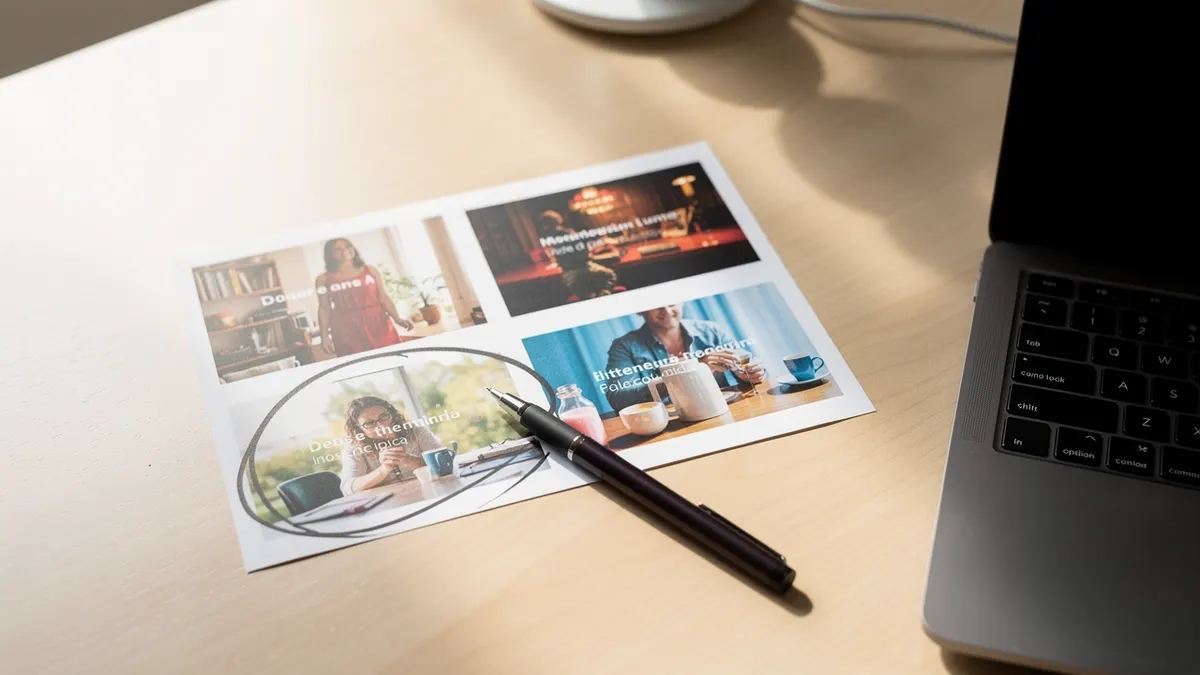
The matrix of hooks and angles, how long to let a variant run, and when to cut it instead of defending it.
The minimal matrix
Two axes, six cells, and that is all.
Three different hooks, which are three ways into the subject: a question, a surprising statement, a recognisable situation.
Two different angles, which are two reasons to buy: for example saving time and durability.
You get six short videos, all from the same shoot, with the same person and the same product.
One rule that keeps the matrix readable: never change two things at once. If hook and angle change together, no result can be interpreted.
How long to let it run
Three benchmarks, and they avoid the two opposite mistakes.
Seven days minimum, because a variant can lead for three days then collapse.
Fourteen days maximum with no decision, because beyond that you are paying for information you already have.
And an identical budget per variant, on the same audience, in the same week. Without that condition you are comparing budgets, not creatives.
When to cut and when to persist
Four situations, and the answer differs in each.
A variant clearly below the others, with the conversion threshold reached: cut it, with no discussion.
A variant below but under the threshold: let it run, you do not yet have information.
A variant average everywhere: cut it too, the worst case, because it consumes budget without teaching anything.
And an irregular variant, very good on some days: look at the hour and the day of distribution before concluding anything about the creative.
What to do with a winner
Three moves, in this order, and they multiply its return.
Increase its budget gradually, never in one go: a sudden rise changes the audience reached and breaks the result.
Decline it: the same video with three new opening seconds, which costs an hour of editing and extends its life by several weeks.
And note precisely why it wins, in one sentence. That sentence, reused in the next brief, is what improves your whole production.
What is tested, and in what order
| Rank | Variable | Why first |
|---|---|---|
| 1 | The hook | It decides the three-second view |
| 2 | The argument | It decides the full view |
| 3 | The call to action | It decides the click |
What makes a test readable
One variable at a time, an identical budget on each side, and an equal run time. Without those three conditions, the result cannot be attributed to anything.
What is kept from each test
The winning file, the losing variant and the reason written in one line. Without that note, the same mistake recurs three months later.
The most frequent mistake
It is cultural as much as methodological.
Defending a video because it was expensive, because it is beautiful, or because it is liked internally. The audience has not seen the quote and does not know the team.
Two simple safeguards. Decide with the figure agreed in advance, not with the impression of the moment. And write the decision rule before launching the test: which indicator, which threshold, which duration. A rule written beforehand costs five minutes; the same discussion afterwards costs a meeting, and almost always ends with keeping a variant everybody knew was losing.