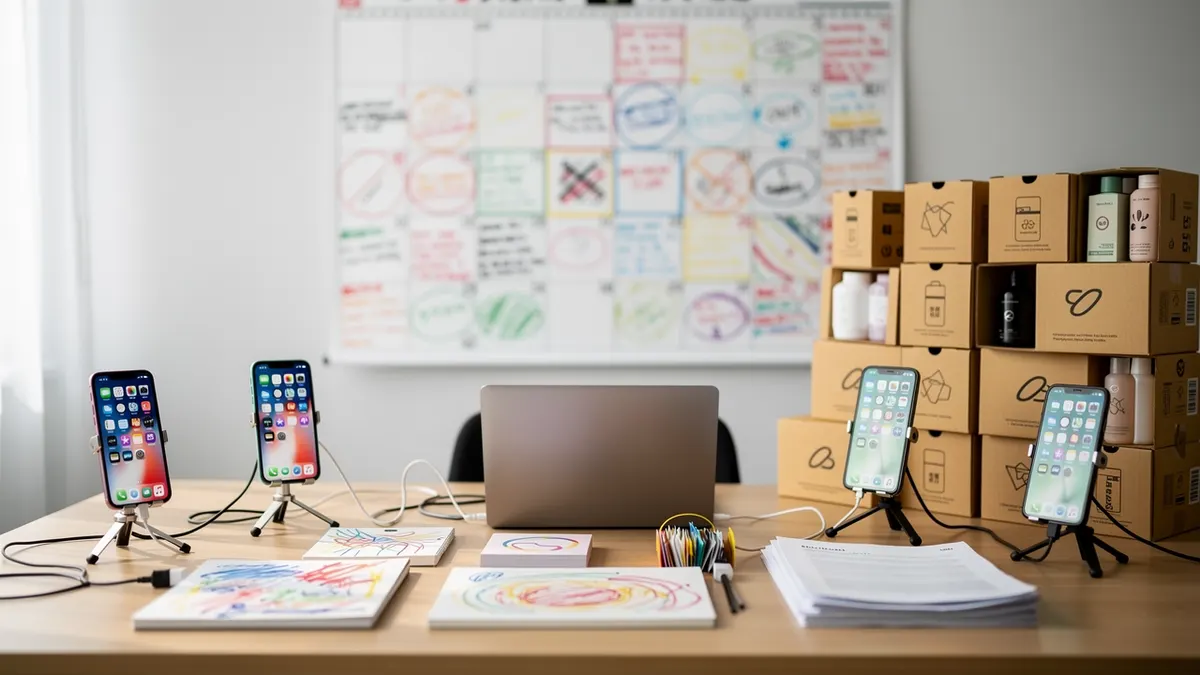
A test is useless if it does not produce a sentence you can reuse. And it is almost always the same mistake that prevents it.
The hooks and angles matrix
Two columns, four rows, one page.
In the columns, the angles: what the product solves, what it avoids, what it replaces, what it saves. In the rows, the hooks: the reported question, the objection said before the buyer, the warning, the result shown before being explained.
You never test the whole matrix: you fix one column and run through the rows.
What budget per variant
The same for all, without exception.
A variant receiving half the budget has not lost, it has not competed. And a variant launched three days later has not lived the same week. Launch everything together, on the same audience, with the same amount.
Set that amount in advance, based on what an acquisition usually costs you: below that, you will be reading noise.
How long to let it run
Until the spend threshold, not until a number of days.
Time is not the right unit: an audience reacts quickly at the weekend, slowly during the week, and the same variant can look poor on the first evening and good on the third day. Decide on spend, write that threshold into your procedure, and apply it to the one you like as to the others.
When to cut rather than defend
As soon as the threshold is reached, without trying to rescue a video through settings.
Changing the audience, the placement or the bid to save a creative that is not catching amounts to changing the question halfway through the exam. You will no longer have a comparison, and you will have spent twice.
A cut variant is not a failure: it is half the information you were after.
What remains from the test
Not the winning video, the reason for its win.
Write it in one sentence, in a document you reread before every order: people react when you talk about how long it takes, or when somebody admits a limitation, or when you show the result before the explanation.
A video wears out in a few weeks; an understood reason serves for years.
The Spanish detail
The tone, more than the format.
An overly commercial hook is punished faster here than elsewhere, and a Castilian with no placed accent sounds like nobody. So test the person too, but separately: it is a variable in its own right, and the heaviest to change.
What a test really compares
| The variable tested | What it isolates | The condition |
|---|---|---|
| The hook | The first three seconds | The rest of the video identical |
| The format | Vertical against square | The same message |
| The call to action | The end of the video | The same opening |
What invalidates most tests
Two variables changed at once. A video with a new hook and a new edit does not say which of the two worked, and the budget spent teaches nothing reusable.
What to decide before launching
The duration and the threshold. A test stopped after two days because the numbers look good is not a test, it is a confirmation of what you hoped for, and it costs the price of a real one.
What the test will never tell you
Whether the product is good.
A test compares ways of presenting the same thing. When every variant fails, it is not the creative that has to be redone: it is the offer, the landing page or the price that has to be looked at, and no video will correct that.