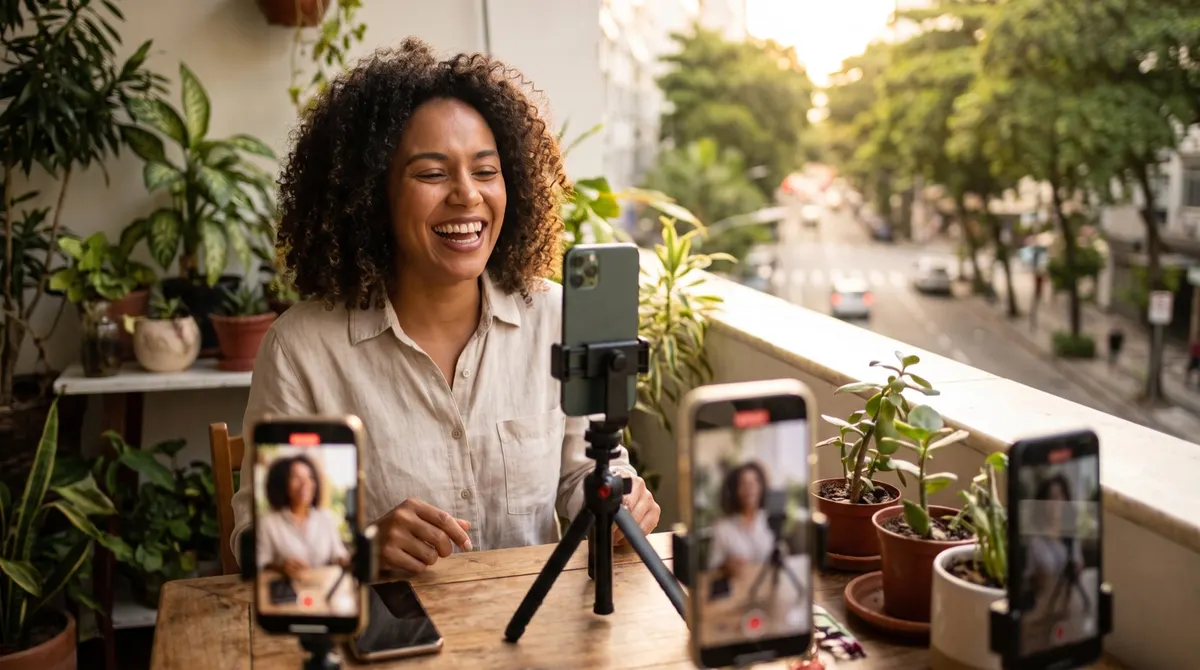
Which platform for UGC in Brazil, what distinguishes TikTok, Reels and Kwai, and how creators and brands choose.
Why the platform question matters more in Brazil
Five reasons specific to the country.
All three apps are installed massively, which is not the case everywhere, and the audiences only partly overlap.
Usage varies strongly by region and income level, more than by age.
The advertising cost differs markedly from one platform to another, which changes the profitability of the same video.
Consumption often happens on limited mobile data, which favours short, light formats.
And sharing in conversation extends a video's life well beyond the platform where it was born.
TikTok: speed of trends and young audiences
Six useful characteristics.
Discovery dominates: a video can find its audience without the account being followed.
Formats and codes change fast, which means producing often rather than perfectly.
Sound carries a large part of the effect, including for viewers who listen.
The audience is younger on average, but the gap narrows every year.
Videos age fast there: a creative wears out in a few weeks.
And the format is natively full-frame vertical, with no possible compromise.
Instagram Reels: where Brazilian purchase intent lives
Six characteristics, complementary to the previous ones.
The brand's account already exists, which makes organic publication immediately useful.
The audience is broader in age and income, so closer to the average buyer.
The path from video to shop is shorter, with integrated purchase journeys.
Private conversation extends the video there, and many sales are concluded in it.
Content lasts longer, because it stays visible on the profile.
And the same video serves several times: post, story, advertisement.
Kwai: the platform foreigners underestimate
Six reasons not to dismiss it.
Its reach is strong in regions and income brackets the other two touch less well.
Advertising cost is generally lower there, which mechanically improves the return of an average creative.
Advertising competition is less dense, so attention costs less.
Simple, direct formats work better there than heavily worked creatives.
The audience is more receptive to videos about price, promotion and practical demonstration.
And many national brands are already present there, while foreign brands still ignore it.
Quick comparison for deciding
Five criteria, with the short answer.
Discovery of a new product: TikTok first, Kwai second.
Immediate purchase intent: Reels, without hesitation.
Cost per view: Kwai most often, at equal creativity.
Lifespan of the creative: Reels the longest, TikTok the shortest.
And reuse in advertising: all three, provided a clean master was delivered, dealt with above.
What changes from one platform to another
| Point | What varies | What stays the same |
|---|---|---|
| The image format | The zones hidden by the interface | Centred framing |
| The accepted length | From a few seconds to several minutes | The first three seconds |
| The available music | The libraries and their licences | The duty to check |
What is prepared once for all three
A shoot wider than needed. A margin around the subject allows recropping for each interface without ever cutting a hand or a line of text.
What is never recycled as is
A video exported with another platform's watermark. It is downranked at distribution, sometimes rejected, and it shows in the results before anyone understands why.
How to choose in practice
Six steps, valid for a brand as for a creator.
Look at where your audience already is, rather than where the market is looking.
Choose one main platform and one secondary, never three at once at the start.
Produce one video and three different openings, rather than three separate videos.
Publish organically first, measure retention, then run as advertising what held.
Compare cost per result, not the number of views, because views do not compare across platforms.
And check that the rights bought really cover the three platforms if you intend to run there, since a licence names platforms one by one.
One last marker: the platform changes neither the script nor the face, it changes the placement of text, the rhythm and the cost of attention. Produce once cleanly, keep the margins free, and let measurement decide where the budget goes.